The AI Value Gap: Scaling Transformation and Agentic Innovation
Bridging AI Capability and Real-World Impact Through Execution Systems
Only 6% of companies create real AI value. What do they do differently?
In the 2026 global corporate landscape, the industry has entered a stage characterized by “mass adoption without mass scaling”. While approximately 88% of organizations have integrated artificial intelligence into at least one business function, a significant leap from 78% in 2024, the realization of enterprise-level financial impact remains a privilege of a select elite. This period represents a structural decoupling where technology access is no longer the primary differentiator; instead, the capacity for organizational transformation and the fundamental redesign of workflows have emerged as the new battlegrounds for competitive advantage.
As an Industrial Engineer, I view this “AI Value Gap” not as a failure of technology, but as a failure of Systemic Optimization. Most organizations find themselves trapped in a “Pilot Loop,” characterized by an endless series of proof-of-concepts that fail to converge into shared platforms or re-engineered operating models.
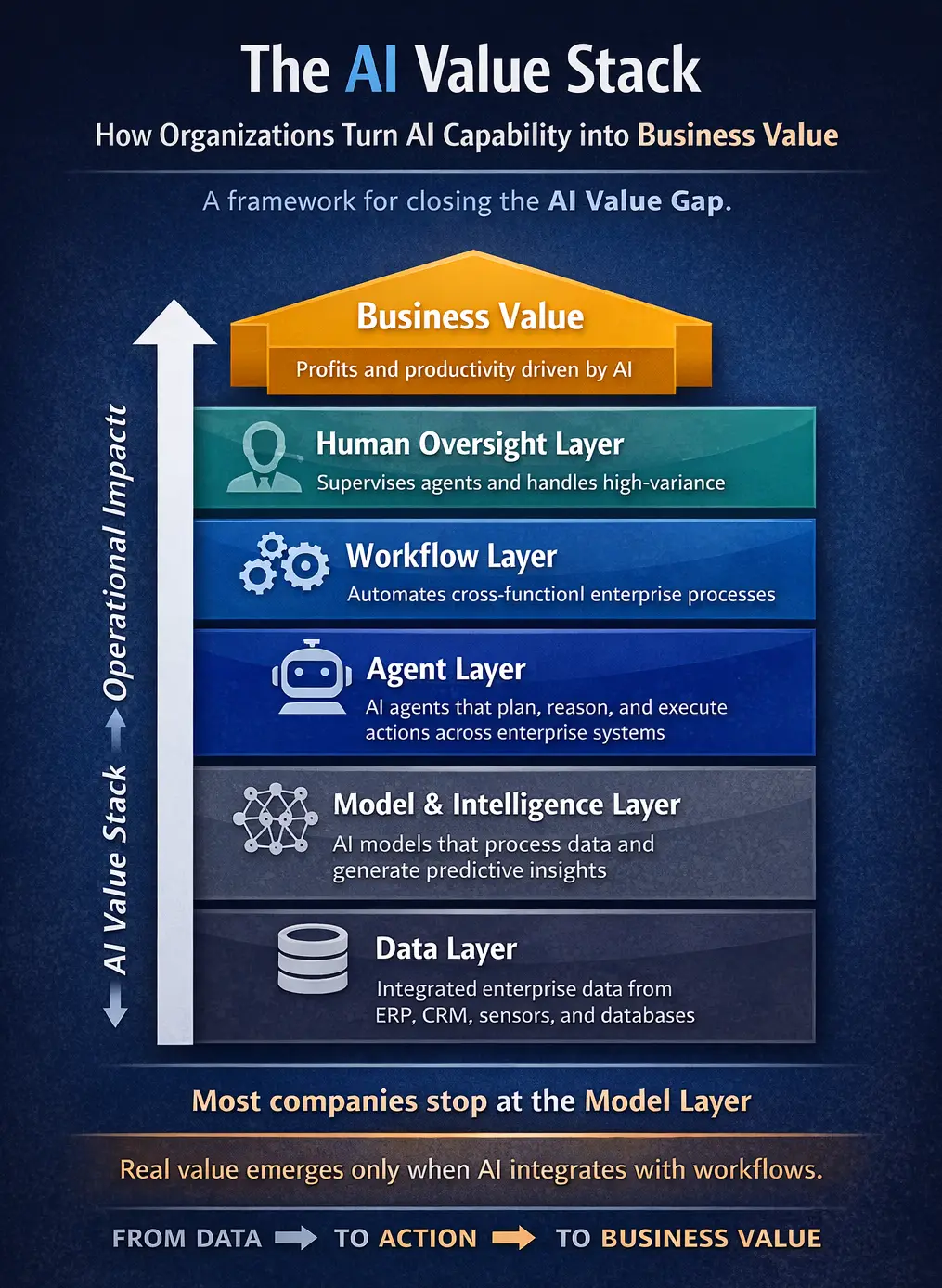
The following AI Value Stack explains how raw data becomes operational impact. Most organizations deploy models but fail to integrate agents and workflows, which is why the AI Value Gap persists.
1. Closing the AI Value Gap: System Design Over Tool Deployment
The novelty of AI has worn off, and 2026 marks the year it stops being a “science fair project” and becomes essential infrastructure. We are currently witnessing a “Great ROI Reckoning” where boards and CFOs are no longer funding experimentation without commercial proof. To move beyond the AI value gap, leaders must apply rigorous engineering principles to digital transformation.
Why the AI Value Gap Persists in Legacy Workflows
Most firms are stuck because their AI remains a “tool” rather than “infrastructure.” Statistical evidence suggests that while 88% of firms report regular use of AI, only about one-third have reached the scaling phase across the enterprise, and a mere 6% describe their AI as “fully scaled.” Up to 95% of enterprise AI pilots fail to deliver measurable financial returns because they are not integrated with underlying Enterprise Resource Planning (ERP) systems. Closing the gap requires elevating the ERP from a “back-office” repository to a strategic enabler.
Addressing the AI Value Gap in Data Infrastructure
For the majority, AI remains a “tool” rather than “infrastructure”—a distinction that separates the mainstream users from the 7% of high performers who successfully capture meaningful enterprise value. Up to 95% of enterprise AI pilots reportedly fail to deliver measurable financial returns, often because they are not integrated with the underlying Enterprise Resource Planning (ERP) systems. Closing the AI value gap requires elevating the ERP from a “back-office” repository to a strategic enabler.
2. Rearchitecting for Value: Systemic Optimization
A critical mistake in current AI deployment is “bolting AI onto broken processes.” Industrial Engineering (IE) teaches us that value is found only in the design, improvement, and implementation of the integrated system. To bridge the AI Value Gap, we must move from local automation to systemic rarchitecutre.
The IE Framework for AI Integration
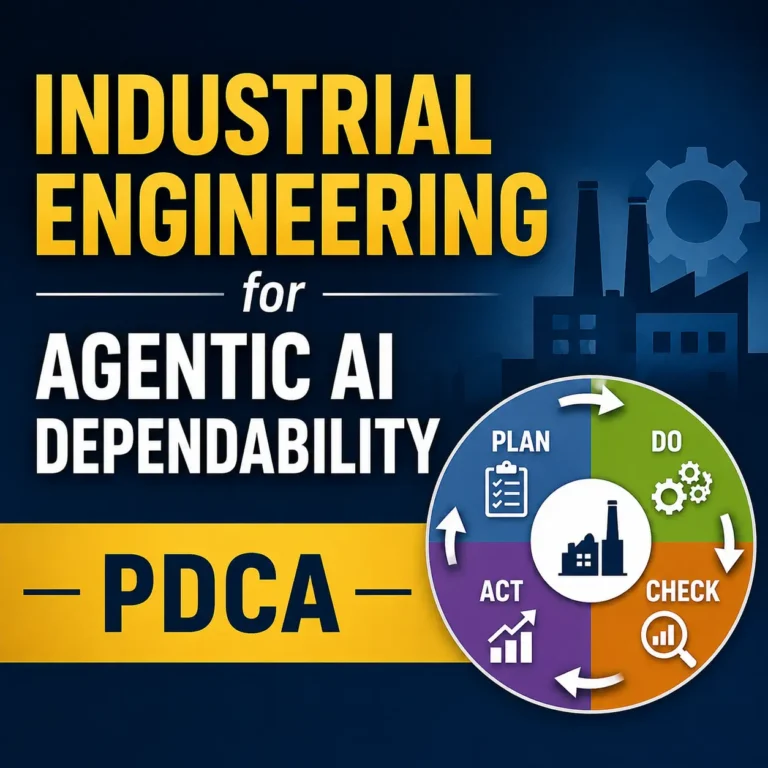
Industrial Engineering is unique because it emphasizes the integration of human and organizational issues within a total system. We treat AI agents not as tools, but as resources to be optimized within a larger operational plan.
| IE Characteristic | Application to the AI Value Gap |
| Human-System Integration | Redesigning the interface between human experts and AI agents to eliminate “Cognitive Muda”. |
| Economic Forecasting | Predicting the actual EBIT impact and cost-reductions before deployment. |
| System Lifecycle Management | Managing both the design of new agentic workflows and the maintenance of legacy ERP systems. |
Eliminating Digital Muda: Results of Redesign
Traditional IE focuses on solving problems related to the operation of the entire system. High performers are three times more likely to fundamentally re-architect their work because they understand that automating a bad process simply produces waste faster.
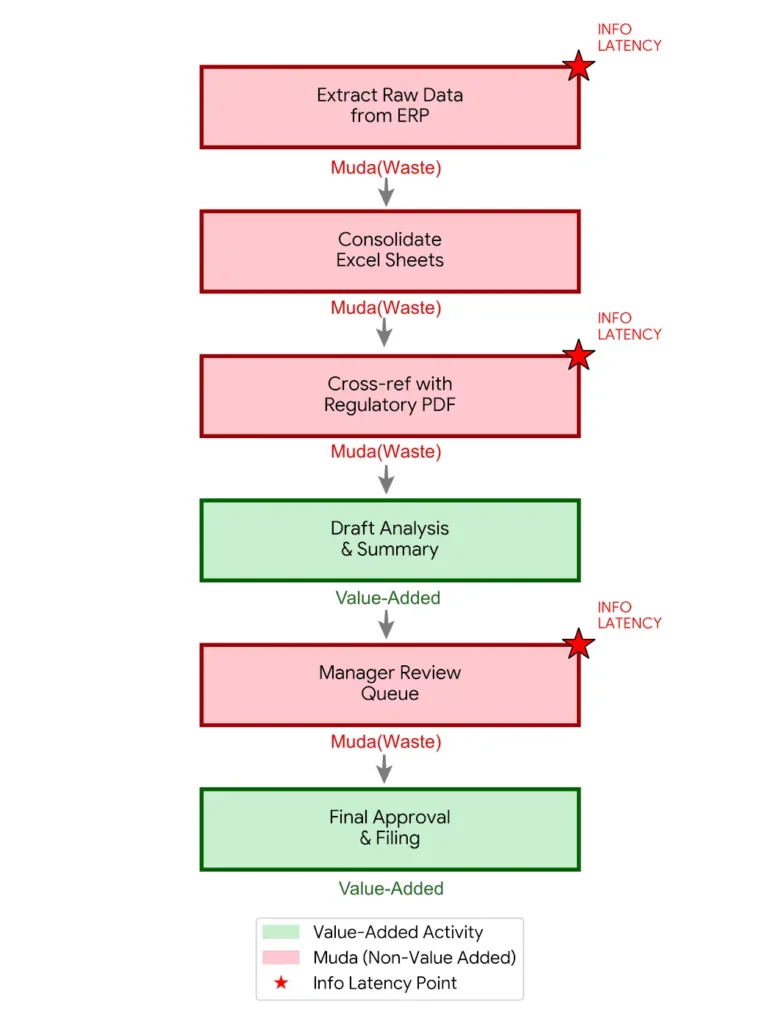
By applying Productivity Improvement techniques, we shift from incremental gains to transformative outcomes. For instance, a retail merchandiser using agentic tools can reduce a three-week analysis to just two hours, achieving a 93% reduction in processing time. In an engineered system, failing to reach these benchmarks is a clear indicator of systemic instability.
3. The Four-Blog Roadmap from AI Pilots to Agentic Execution
Closing the AI Value Gap requires more than experimentation. It requires a practical sequence that moves from value definition to workflow redesign, from enterprise integration to scalable operating discipline. This four-blog series follows that path and provides a focused roadmap for leaders who want to turn isolated AI initiatives into measurable business capability.
Blog 1: The AI ROI Reckoning: How to Spot the AI Pilot Trap Before Budgets Are Wasted
This article begins with the core question of enterprise AI: should this initiative scale at all? It explains why many pilots fail to produce real impact and shows that ROI depends on workflow fit, KPI clarity, ownership, governance, and execution discipline, not just model performance.
Blog 2: AI Enterprise Architecture: Mapping Human-Agent Workflows
With value logic established, the next challenge is design. This article shows why AI fails in fragmented workflows and how mapping human-agent interactions, information flow, and bottlenecks turns isolated tools into integrated capability.
Blog 3: The ERP-Agent Bridge: Building the Trusted Execution Layer for Agentic AI
The third blog focuses on enterprise integration and execution trust. It examines how AI agents connect to ERP and related platforms through validated context, policy controls, approval logic, and observability. The goal is to show how autonomous execution becomes reliable only when intelligence is anchored in enterprise reality.
Blog 4: Scaling Agentic Systems Through Governance, Reliability, and Operating Discipline
The final article brings the earlier stages together at scale. It addresses governance, human oversight, reliability, accountability, and performance management to show how organizations move from pilot activity to durable operating capability.
Together, these four blogs define an integrated path to enterprise AI maturity. They begin with value, move through architecture and integration, and culminate in scalable execution. The message is clear: the challenge of AI is not adoption alone, but engineered transformation.
4. The Agentic Inflection: Building a Digital Workforce
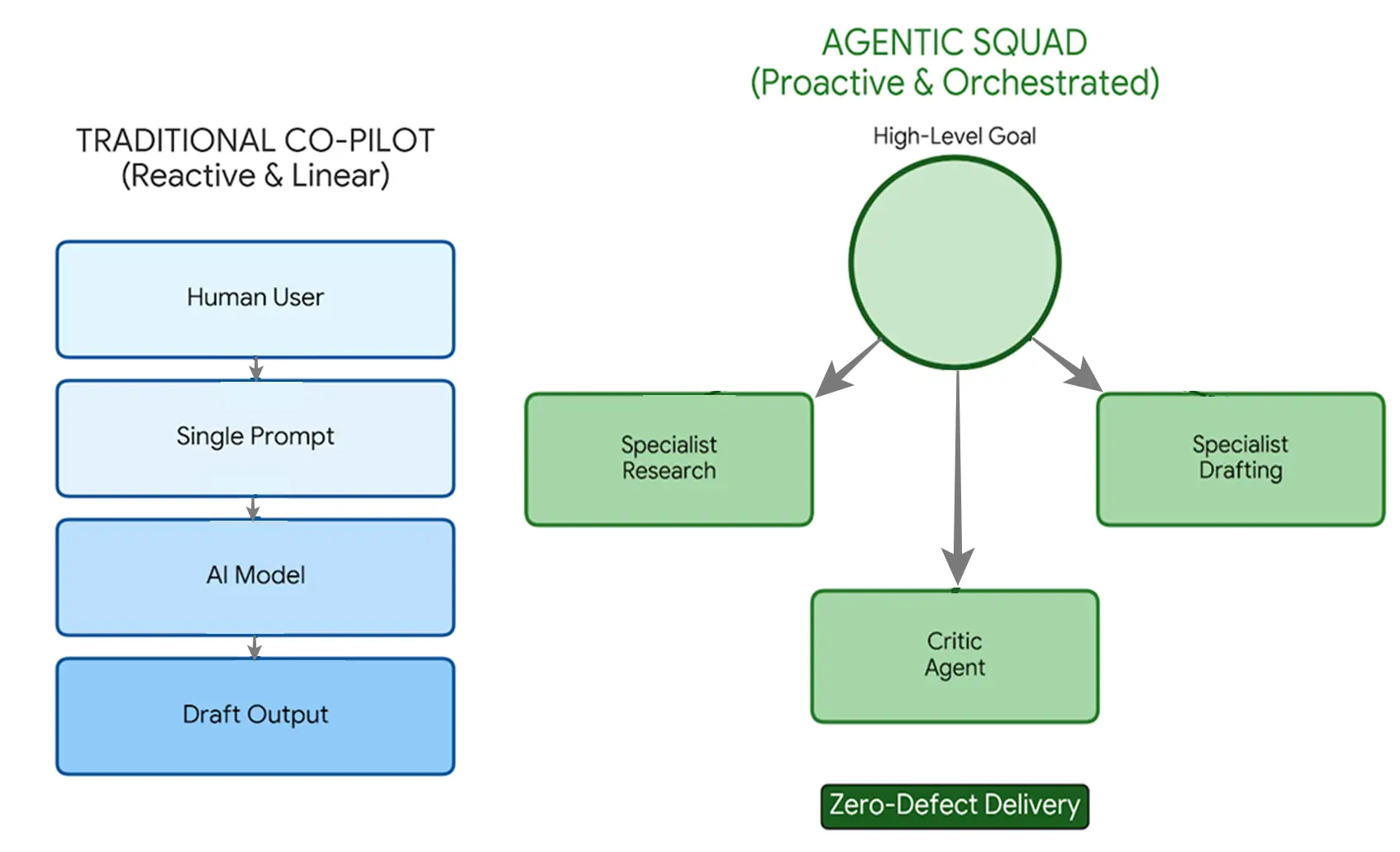
The most transformative development of 2026 is the transition from reactive “co-pilots” to proactive AI Agents. These autonomous systems are capable of perceiving context, reasoning through multi-step challenges, and acting independently across systems.
Scaling Innovation to Close the AI Value Gap
Unlike earlier iterations of generative AI, AI agents move the needle from “answering questions” to “orchestrating flows”. Currently, 62% of organizations are experimenting with AI agents, yet only 23% are scaling them in at least one function. This “readiness gap” is a primary driver of the overarching AI value gap.
The Role of Specialized Agents in the AI Value Gap
In sectors like automotive and assembly, agentic systems could generate between $450 billion and $650 billion in additional annual revenue by 2030, representing a 5% to 10% revenue uplift. High performers address the AI value gap by treating agents as a dynamic “middleware workforce” that bridges human judgment and legacy systems.
5. The Elite 6% Benchmark
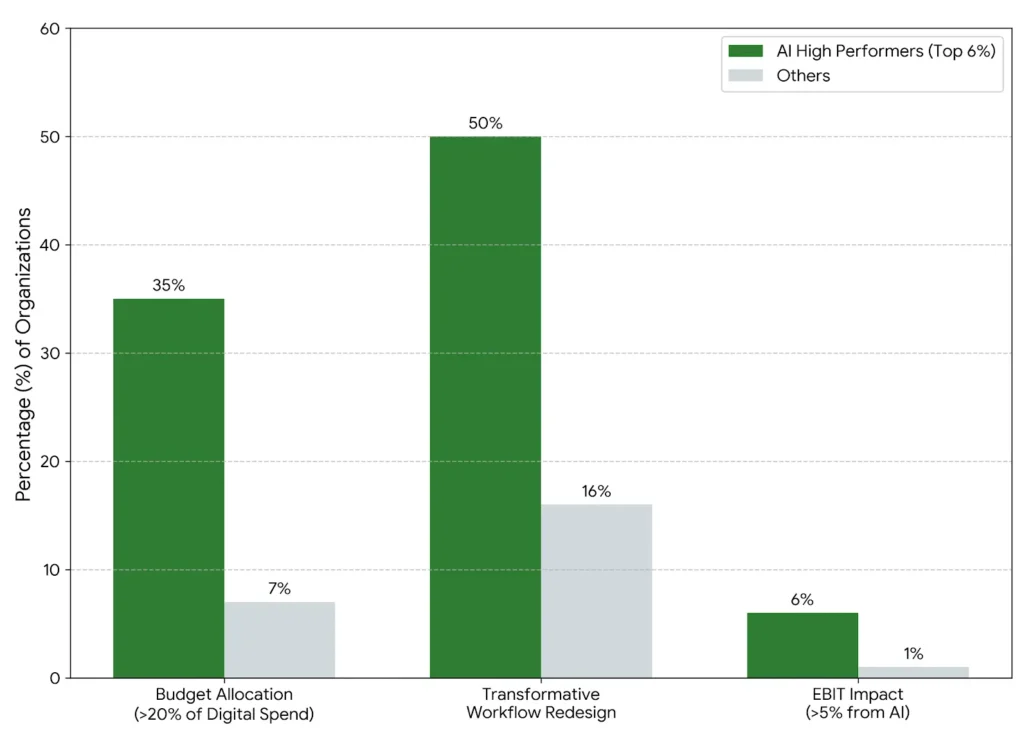
In the 2026 landscape, a mere 7% of organizations describe their AI as “fully scaled.” However, scaling alone does not guarantee a return. The true industrial benchmark is the 6% cohort of “AI High Performers,” the elite firms that successfully attribute 5% or more of their total EBIT specifically to AI.
The divide exists because high performers treat AI as a scientific method for decision-making. They don’t just “use” AI; they ensure the entire system consisting of human, organizational, and technological factors is engineered for high-margin outcomes.
Benchmark: High Performers vs. The Mainstream
| Industrial Benchmark | AI High Performers (Elite 6%) | Others (Mainstream) |
| Systemic Ambition | Transformative Intent (3.6x more likely): Focus on designing new, high-value systems. | Incremental Efficiency: Minor updates to existing local tasks. |
| Resource Allocation | Optimal Utilization (35%): Commit >20% of digital budget to AI integration. | Sub-optimal (7%): Low-risk investment focused on tool cost-cutting. |
| System Architecture | Fundamental Redesign (3.0x more likely): Re-architecting how work is done at a systemic level. | Legacy Maintenance: “Bolting on” AI to existing, unoptimized structures. |
| Leadership Logic | Scientific Decision-Making (3.0x more likely): Data-driven leadership focused on system throughput. | Intuition-Based: Treating AI as a standalone IT experiment. |
The Engineering Difference: From Scale to Value
Industrial Engineering manages both the design of new systems and the maintenance/improvement of existing ones. While many companies reach the 7% “scaling” threshold by simply increasing their volume of AI tools, the elite 6% reach their status by systemically optimizing their resources. They focus on the integration of human and organizational issues, ensuring that technology is a strategic enabler of economic results rather than a source of digital waste.
6. Workforce Evolution: From Job Loss to Superagency
The integration of AI is redefining human labor through the concept of “Superagency”. This paradigm envisions a partnership where AI automates cognitive functions—summarizing, reasoning, and decision-making to increase personal productivity and creativity.
The Human Element of the AI Value Gap
The current revolution is focused on the “automation of the brain,” placing an economic imperative on brain skills. While 59% of employees identify as “AI optimists,” 41% remain apprehensive about the transition. This internal resistance can widen the AI value gap if not managed with transparent communication.
Reskilling to Bridge the AI Value Gap
The demand for “AI fluency,” defined as the ability to manage and use AI tools, has grown sevenfold in the last two years. Organizations that neglect upskilling find that their initiatives are bottlenecked by a workforce that lacks the confidence to validate AI outputs—a significant risk given that 66% of employees admit to relying on AI results without verification. Closing the AI value gap requires a robust talent strategy.
7. Infrastructure: The Hidden ERP Divide
For an Industrial Engineer, a system is only as fast as its slowest component. In 2026, many AI initiatives are stalled by legacy Enterprise Resource Planning (ERP) systems that lack real-time data interoperability.
Modernizing Systems to Close the AI Value Gap
Success in 2026 is tied to the maturity of the underlying technology stack. Leaders must elevate ERP to a “strategic enabler” rather than treating it as legacy baggage. This is a critical move to bridge the AI value gap between AI ambition and P&L impact.
Data Quality as a Factor in the AI Value Gap
Data quality remains a paramount barrier, with 64% of leaders citing it as a major obstacle to scaling. Organizations are moving toward “agentic-native” operations, prioritizing modular tech stacks and real-time data streaming to ensure their digital workforce has the “ground truth” it needs to operate.

8. Governance and Risk in the Autonomous Era
As AI adoption broadens, the risk landscape has grown from an average of two AI-related risks in 2022 to four in 2026. Organizations that ignore these risks find themselves falling into a wider AI value gap due to negative consequences and regulatory non-compliance.
The Risk Management Factor in the AI Value Gap
Over half of organizations using AI have already experienced at least one negative consequence.
- Inaccuracy (Hallucinations): Reported by 31% of respondents.
- Cybersecurity: 18% of organizations report consequences from vulnerabilities.
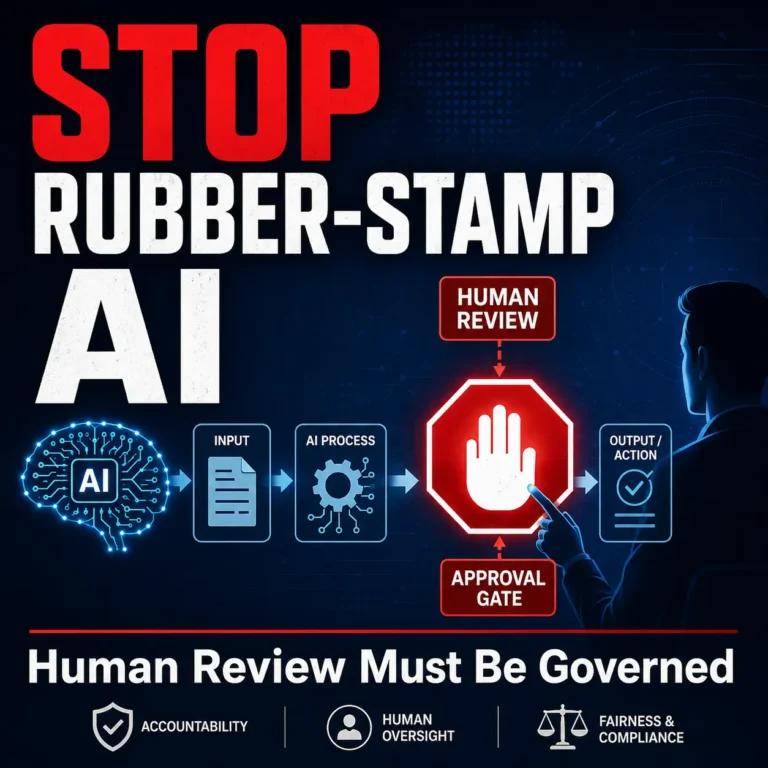
- Human-in-the-Loop (HITL): High performers implement defined processes for human validation of model outputs to ensure accuracy and trust.
Securing Proprietary Intellectual Property
For high-stakes decisions, 2026 has seen the rise of “Privacy by Physics.” This approach utilizes Edge AI and local NPUs to process sensitive data on-device so it never hits the public cloud. This is a key technical protocol to maintain competitive advantage and narrow the AI value gap.
9. The Agentic Infrastructure Checklist: 2026 Audit
To close the AI Value Gap, your foundation must move beyond simple API integrations. Use this checklist to assess your readiness for the four-blog roadmap outlined in this article.
a. Velocity & Connectivity Layer
- [ ] Sub-200ms Retrieval: Are agents grounding decisions in real-time without workflow stalls?
- [ ] Zero-Copy Architecture: Are agents querying data at the source (ERP/MES) for absolute freshness?
- [ ] Model Context Protocol (MCP): Does your stack support open standards for agent-to-tool communication?
b. Semantic & Ground Truth Engine
- [ ] Semantic Telemetry: Are your system logs readable by agents for self-correction?
- [ ] Knowledge Graph Integration: Is your business logic mapped in a semantic layer agents can navigate?
- [ ] Data Productization: Have you moved to “Data Molecules” that package data with intent and quality?
c. Orchestration & Governance
- [ ] Policy-as-Code: Are security guardrails embedded directly into the agent’s DNA?
- [ ] Dynamic Resource Allocation: Does your infrastructure pivot between “Elite” and “Efficient” models to manage costs?
- [ ] Human-Agent Handover (HAH): Is there a formal protocol for an agent to pass a “Context Brief” to a human expert?
10. Conclusion: Engineering Your Way Out of the AI Value Gap
The firms that thrive in 2026 won’t be those with the most pilots, but those who achieve Systemic Optimization, defined as the harmonious management of people, data, and autonomous agents. The AI Value Gap is more than a financial metric; it is a filter separating organizations that merely “use” tools from those that design, improve, and implement integrated systems for maximum efficiency.
As established leaders, your premium product is no longer the work itself, but your judgment in orchestrating the intelligence that performs it. To join the elite 6%, you must move from “pilot” to “integrated system,” treating AI not as an additive tool, but as the structural core of your competitive identity. Industrial Engineering teaches us that we must manage two major areas: the design of new agentic systems and the maintenance of the existing infrastructure that feeds them.
The “Agentic Divide” has been drawn. Your task for 2026 is to ensure your organization is on the right side of the gap by applying the principles of optimal resource utilization and economic forecasting to every digital workflow.
Read the full series at playtechtrend.com
Reference List
[1] Accenture (2024), The Art of AI Maturity: Advancing from Practice to Performance.
[2] American Institute of Industrial Engineers (AIIE), Industrial Engineering: Design, Improvement, and Implementation of Integrated Systems
[3] Gartner (2024), AI Success Benchmarks: Moving from Pilot to Production
[4] General Engineering Body of Knowledge / Wikipedia, 산업공학 (Industrial Engineering): Overview and Scope
[5] McKinsey & Company (2025). The State of AI 2025: Scaling and Value Capture.
[6] Microsoft & LinkedIn (2024), 2024 Work Trend Index Annual Report: AI at work is here. Now comes the hard part.
[7] BCG / Eye on AI (2026), Inside BCG’s AI Study on ‘The Widening AI Value Gap’. Interview with Amanda Luther, Global AI Transformation Lead. [Online Video].
Expert Insight: The Virtuous Circle of the Elite 6%
In a recent deep-dive with BCG’s Amanda Luther, the data confirms that leaders aren’t just “buying more AI”; they are entering a virtuous circle where AI-driven value is reinvested directly back into the P&L to fund even more sophisticated agentic systems.
Watch the full 2-minute highlight here:
[18:27] The necessity of “Zero-Based Process Design” for agentic success.
[02:51] Why 70% of value comes from core functions (Sales, Supply Chain).
[12:12] How leaders out-invest laggards by 2x to widen the gap.
#IndustrialAI #SystemsArchitecture #DigitalTransformation #OperationalExcellence #GenerativeAI