AI Enterprise Architecture: Mapping Human-Agent Workflows
AI Value Gap Series | Part 2 of 4
Using Digital Value Stream Mapping(VSM) to identify workflow bottlenecks and redesign human-agent flow
Why do so many enterprise AI initiatives improve individual tasks but fail to improve the workflow as a whole?
From an Industrial Engineering perspective, enterprise performance depends on optimization, reliability, and systems thinking across the whole workflow. That is why the next challenge in enterprise AI is not simply adoption, but architecture. Many organizations are accelerating individual tasks with AI, yet the larger process still suffers from fragmented handoffs, duplicated reviews, and disconnected systems. In that environment, AI may improve local tasks without improving enterprise performance.
This is where AI enterprise architecture becomes essential. The real issue is not whether an AI tool can generate an answer or automate a narrow task. It is whether intelligence can move through the organization in a way that improves decisions, reduces waste, and supports execution. Without a coherent AI enterprise architecture, agents, copilots, data, and human judgment remain disconnected pieces rather than a reliable operating system.
This is why Digital Value Stream Mapping matters. It provides a practical way to trace human-agent workflows, reveal workflow bottlenecks, and redesign information flow around measurable value creation. In this article, we examine how AI enterprise architecture can turn scattered AI activity into a connected enterprise system for the agentic era.
1. What Does It Mean to Architect the AI Enterprise?
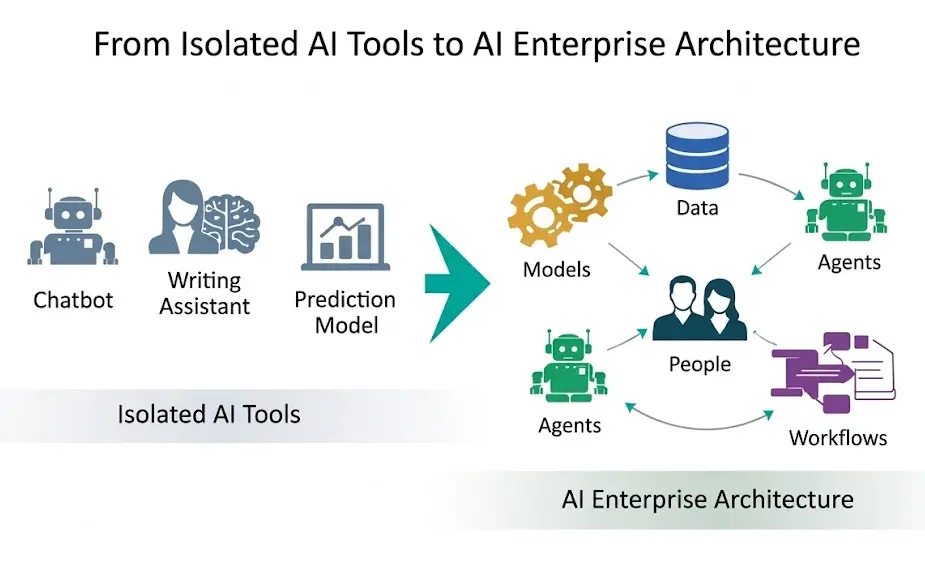
To architect the AI enterprise means building more than a set of AI tools. It means creating a system in which data, models, agents, people, and workflows work together to produce real business value. Architecture is not only about technology. It is about how intelligence moves through the organization and turns into decisions and action.
Beyond isolated AI tools
Many companies still adopt AI one tool at a time. A team uses a writing assistant, another tests a chatbot, and another builds a prediction model. Each tool may be useful, but the overall workflow often remains fragmented. Information gets passed from system to system, human review is repeated, and outputs do not always lead to execution. This is why AI adoption alone does not guarantee enterprise value.
What architecture must deliver
A strong AI enterprise architecture connects trusted data, intelligent models, agentic capabilities, workflow integration, human oversight, and measurable business outcomes. It also clarifies a few essential questions: Where does information enter the workflow? Which tasks should be handled by people, and which by agents? Where are decisions approved, escalated, or executed?
When those connections are weak, organizations see familiar problems: duplicated work, slow decisions, weak accountability, and poor ROI. When they are strong, AI becomes part of the operating system of the business. That is the real goal of AI enterprise architecture, and it is why Digital Value Stream Mapping becomes the next practical step.
2. The Industrial Engineering Perspective: Value Streams, Flow, and Waste
Industrial Engineering begins with a simple question: where is value created, and where is it being lost? That question matters even more in enterprise AI. Many organizations focus on the performance of the model, but the real business result depends on the performance of the workflow around it. If information arrives late, if approvals are repeated, or if human review is added after every AI output, the system may remain slow and expensive even when the tool itself is impressive.
Value streams, not isolated tasks
A value stream is the full path through which work moves from input to outcome. In a traditional operation, that might include materials, machines, labor, and quality checks. In an AI-enabled enterprise, the value stream includes data inputs, model outputs, agent actions, human decisions, system handoffs, and final execution. Looking at only one task inside that chain can be misleading. A chatbot may save time in one step while adding confusion or rework in three others.
This is why Industrial Engineering emphasizes system performance over local performance. A local gain is useful only if it improves the larger flow of work.
Flow, bottlenecks, and digital waste
From this perspective, enterprise AI often suffers from familiar operational problems. Work slows down at handoff points. Information is reviewed more than once. Outputs are copied from one system into another. Human approvals are inserted because trust is weak or responsibilities are unclear. These problems create what can be called digital waste, or digital Muda: activities that consume time and effort without increasing value.
In AI workflows, digital waste often appears as:
- duplicated review after an AI recommendation
- manual transfer of outputs between systems
- delays caused by unclear ownership
- rework due to low-quality or poorly timed information
- automation applied to a step that was never the real bottleneck
These are not model problems alone. They are workflow design problems.
The IE lens: optimization, reliability, and systems thinking
This is where the Industrial Engineering lens becomes especially useful. Optimization asks whether the workflow is producing the best result with the least unnecessary effort. Reliability asks whether the system performs consistently under real operating conditions. Systems thinking asks whether each improvement supports the performance of the whole enterprise rather than one isolated step.
Applied to enterprise AI, these three principles shift the conversation. The goal is no longer just to deploy smarter tools. The goal is to design a workflow in which intelligence moves smoothly, decisions are dependable, and the entire system performs better.
That is why Digital Value Stream Mapping matters. It gives leaders a way to see where value is flowing, where it is blocked, and where AI is helping or hurting the system.
3. Why Human-Agent Workflow Mapping Matters Now
Enterprise work is no longer performed by people alone. It is increasingly distributed across humans, AI copilots, agents, and enterprise systems. Tasks that once followed a clear sequence are now handled through a mix of automated outputs, human reviews, and system interactions. As a result, the true workflow has become more complex and often less visible.
The shift to hybrid workflows
In many organizations, a single task now involves multiple layers:
- data is gathered from enterprise systems
- an AI model generates an output
- a human reviews or edits the result
- an agent triggers the next step
- another system records or executes the decision
Individually, each step may appear efficient. But when combined, the overall workflow can become fragmented. Without a clear map, it is difficult to see how work actually moves from input to outcome.
When speed does not translate into performance
One of the most common patterns in enterprise AI is this: individual steps become faster, but the total process does not improve. Reports are generated quickly, summaries arrive instantly, and recommendations are produced in seconds. Yet decisions are still delayed, approvals are repeated, and execution remains slow.
This happens because the bottleneck is rarely the task itself. It is usually located in:
- handoffs between humans and agents
- unclear ownership of decisions
- duplicated verification steps
- delays in moving information across systems
Without understanding these points of friction, organizations may continue to invest in faster tools while the overall system performance remains unchanged.
The visibility problem
Another challenge is that human-agent workflows are often invisible. Unlike traditional processes, where steps are documented and physically observable, AI-enabled workflows are distributed across:
- multiple software platforms
- asynchronous communications
- automated triggers and background processes
This makes it difficult to answer basic questions: Where does work actually slow down? Where is value created? Where is effort wasted? Without visibility, improvement becomes guesswork.
From tools to coordinated systems
This is why mapping human-agent workflows has become essential. Organizations must move from thinking in terms of tools to thinking in terms of systems. The goal is to understand how intelligence, decision-making, and execution are connected across the enterprise.
When these workflows are clearly mapped, several improvements become possible:
- bottlenecks can be identified and removed
- unnecessary human intervention can be reduced
- agent roles can be better defined
- decision points can be clarified
- workflows can be redesigned for speed and reliability
This is the foundation for building effective AI enterprise architecture. And it is precisely what Digital Value Stream Mapping is designed to reveal.
4. What Is Digital Value Stream Mapping?
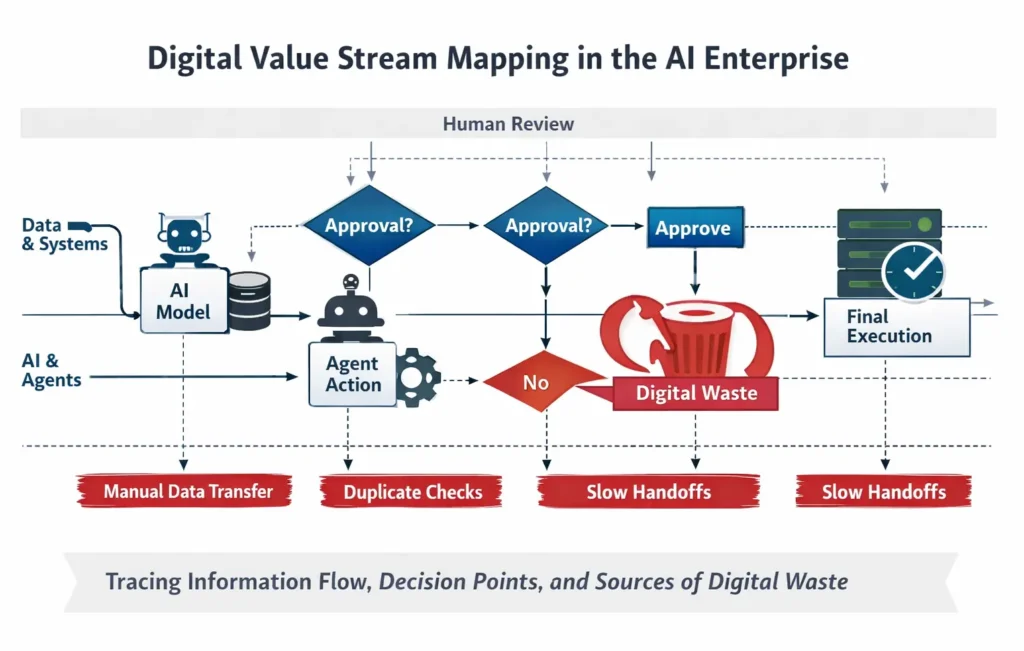
Digital Value Stream Mapping is a practical method for making human-agent workflows visible. It traces how information enters a process, how it is interpreted by people or AI systems, where decisions are made, and how action is executed. In simple terms, it shows whether intelligence is actually moving through the enterprise in a way that creates value.
Extending value stream mapping into the digital enterprise
Traditional Value Stream Mapping was developed to analyze the flow of work across an operation. In the AI enterprise, the same logic must be applied to information, decisions, and digital handoffs. Instead of tracking materials and machine time, leaders must track data inputs, model outputs, agent actions, human approvals, system transfers, delays, and rework loops.
Revealing hidden workflow bottlenecks
This is why Digital Value Stream Mapping matters. A process may appear automated on the surface while still depending on repeated human checks, slow approvals, or manual transfers between systems. Without mapping those steps, organizations may believe AI is improving performance when it is only accelerating one part of a broken workflow.
The key questions the map should answer
A strong digital map should answer a few practical questions. Where does the workflow begin? What information is required at each step? Which tasks are handled by people, and which by agents? Where do outputs pause for review, correction, or escalation? Where does the process slow down, and where is value actually created?
From visibility to architecture
Used properly, Digital Value Stream Mapping becomes the bridge between AI experimentation and AI enterprise architecture. It helps organizations see not just where AI is present, but where it fits, where it fails, and where redesign is needed. Once that visibility exists, workflow improvement becomes a structured effort rather than guesswork.
Figure 2 illustrates how Digital Value Stream Mapping makes human-agent workflows visible across the enterprise. By tracing information flow, decision points, and handoffs, the map reveals where digital waste accumulates and where workflow redesign is needed.
5. From Mapping to Redesign: How to Improve the Workflow
Once the current workflow is visible, the next step is redesign. The goal is not to automate every step, but to remove friction from the value stream and align each role in the system more clearly. In practice, this means reducing unnecessary handoffs, clarifying where human judgment is required, and improving how agents connect to data and execution.
Start with the real bottleneck
A common mistake is to redesign the most visible step rather than the true constraint. A workflow may appear slow because human review takes time, but the real problem may be poor data quality, unclear ownership, or repeated transfers between systems. Effective redesign begins by asking a simple question: where is value actually being delayed or lost?
Reduce digital waste
Once the bottleneck is identified, the next task is to remove activities that do not add value. In human-agent workflows, this often includes duplicate approvals, repeated checks, manual copying between systems, and AI outputs that still require full human rework. These steps consume time without improving quality. A stronger AI enterprise architecture reduces this digital waste so that information can move with less friction.
Redefine the human-agent boundary
Redesign also requires a clearer division of labor between people and agents. Agents should handle repetitive, rule-based, and information-intensive tasks. Humans should focus on exceptions, judgment, escalation, and final accountability where needed. When this boundary is poorly defined, either the agent is underused or the human becomes a bottleneck. When it is well designed, the workflow becomes faster and more reliable.
Connect intelligence to execution
A well-mapped workflow must also ensure that AI outputs lead to action. If insights remain trapped in dashboards, reports, or review queues, the system is still incomplete. Strong redesign links model outputs and agent actions directly to enterprise systems, approvals, and execution steps. That is how AI enterprise architecture moves from analysis to operational impact.
Design the future state
The purpose of redesign is to create a future-state workflow with fewer delays, fewer unnecessary reviews, and clearer information flow. Figure 3 illustrates this optimized state. Instead of fragmented handoffs and repeated checks, the redesigned value stream shows how trusted data, defined agent roles, and targeted human oversight can improve flow across the enterprise.
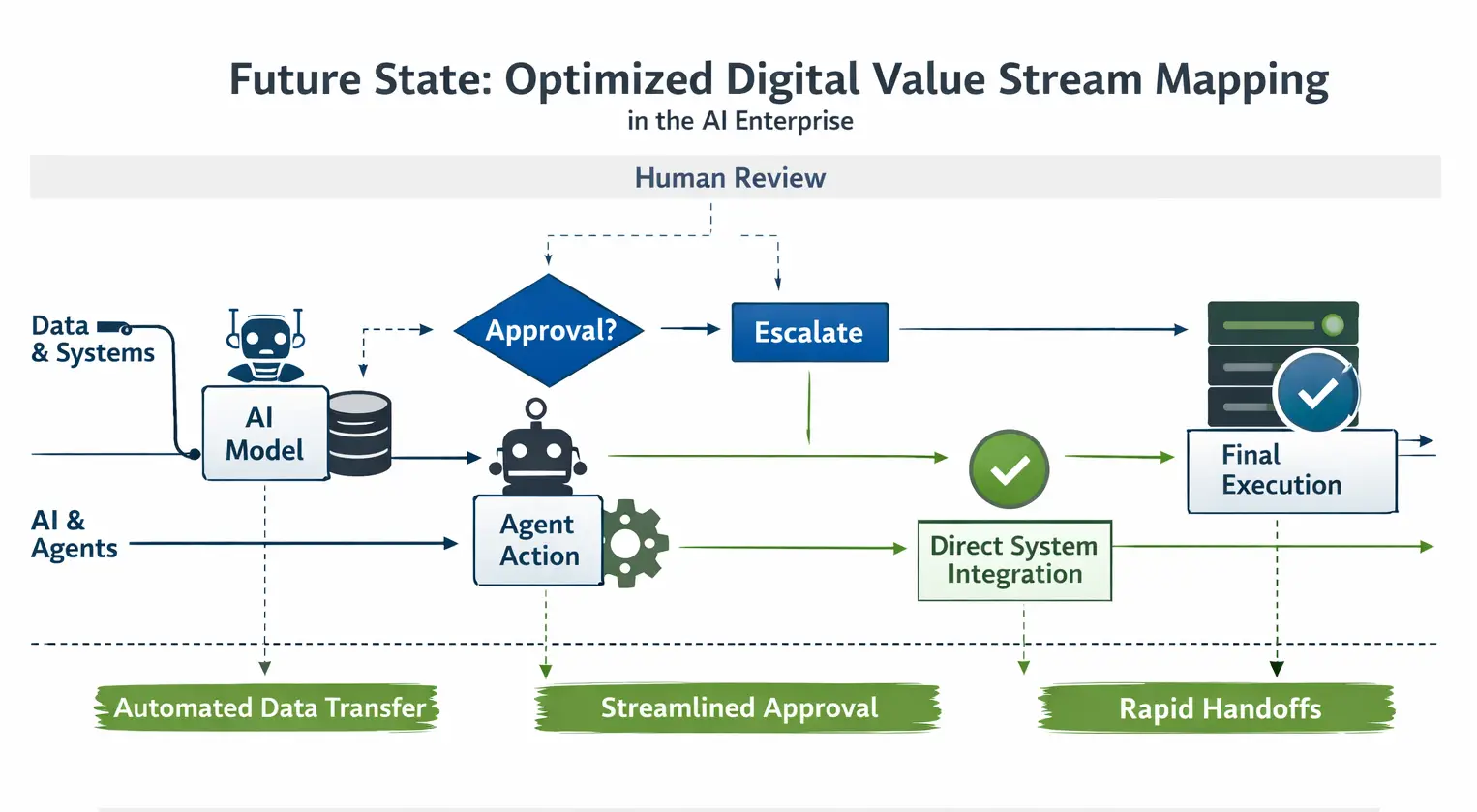
At this point, Digital Value Stream Mapping becomes more than a diagnostic tool. It becomes a practical method for building a workflow that is faster, more reliable, and better aligned with business value.
6. Conclusion
The next phase of enterprise AI will not be defined by how many tools an organization adopts. It will be defined by how well those tools are designed into a working system. That is the real meaning of AI enterprise architecture. It is the discipline of connecting data, intelligence, agents, people, and workflows into a coordinated operating model.
From an Industrial Engineering perspective, this is ultimately a question of optimization, reliability, and systems thinking. When human-agent workflows remain invisible, AI produces local gains but weak system performance. When those workflows are mapped and redesigned, AI becomes part of a value stream that supports faster decisions, smoother execution, and stronger business outcomes.
Digital Value Stream Mapping provides the visibility needed to make that shift. It exposes where information slows down, where digital waste accumulates, and where redesign can unlock value. In that sense, mapping is not the end of AI transformation. It is the beginning of building an enterprise system ready for the agentic era.