Critical Agentic Infrastructure Trends: Feb 2026 Synthesis
The Big Picture: Scaling Your Agentic Infrastructure
The transition from isolated AI pilots to a scaled Agentic Infrastructure is accelerating. In the second half of February 2026, the industry has shifted its focus from “model size” to “operational economics,” signaling a new phase where speed, cost-efficiency, and autonomous planning are the primary benchmarks for enterprise success. To build a robust Agentic Infrastructure, leaders must now move beyond experimental chatbots toward systemic, high-velocity automation.
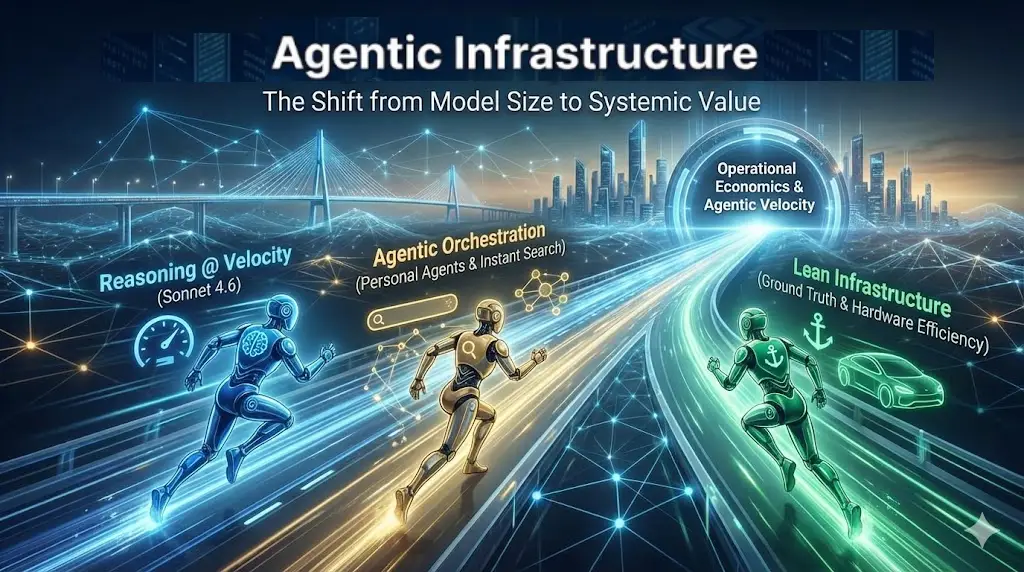
As of February 18, 2026, we are witnessing the emergence of a standardized stack for Agentic Infrastructure. This stack is no longer just about the LLM; it is about the low-latency search tools that ground them, the lean hardware that moves them, and the competitive pricing that makes large-scale Agentic Infrastructure deployment mathematically viable for the first time.
1. The Anthropic Repricing Event: Powering Agentic Infrastructure
On February 17, 2026, Anthropic released Claude Sonnet 4.6, a model that marks a clear inflection point in the economics of Agentic Infrastructure.
- Opus Intelligence at Sonnet Pricing: Sonnet 4.6 matches or exceeds the previous flagship, Opus 4.5, across coding, financial analysis, and office tasks.
- The 5x Cost Reduction: By maintaining the Sonnet price point ($3/$15 per million tokens) while delivering frontier-level reasoning, Anthropic has effectively reduced the cost of “elite” agentic reasoning by 80% compared to traditional flagship tiers.
- 1M Context Window: In beta, the model features a 1-million-token context window, enabling agents to reason across entire codebases or lengthy legal contracts in a single request.
- Vending-Bench Strategy: In simulated business arena tests, Sonnet 4.6 demonstrated advanced long-horizon planning, choosing to invest heavily in capacity early before pivoting to maximize profitability in the final stretch.
2. OpenAI’s Strategic Pivot: The OpenClaw Acquisition
OpenAI’s hire of Peter Steinberger, creator of the viral OpenClaw framework, is being read as the most significant “agentic talent grab” of the year.
- From Chatbots to Personal Agents: Steinberger will lead the “next generation of personal agents” at OpenAI.
- Ready-Made Ecosystem: OpenClaw already supports over 100 agent skills and has recorded over 2 million weekly visitors, providing OpenAI with a “plug-and-play” ecosystem for autonomous tools.
- Multi-Agent Future: Sam Altman has emphasized that the future is “extremely multi-agent,” where agents collaborate autonomously to perform complex real-world tasks like booking flights and managing sensitive document workflows.
3. Eliminating Latency: The Speed of Agentic Infrastructure
For an AI agent, Information Latency is a tax on ROI. On February 12, 2026, Exa launched Exa Instant, a new search tier specifically designed for the high-speed requirements of agentic workflows.
- Sub-200ms Search: Delivering neural search results in under 200 milliseconds, this tool allows agents to ground their reasoning in real-time data without the “stalling” common in traditional search integrations.
- Autonomous Grounding: High-speed retrieval is mission-critical for agents performing multi-step tasks that require constant “Ground Truth” verification from the web.
4. Lean Autonomy: Waymo’s 6th-Gen “Ojai” Hardware
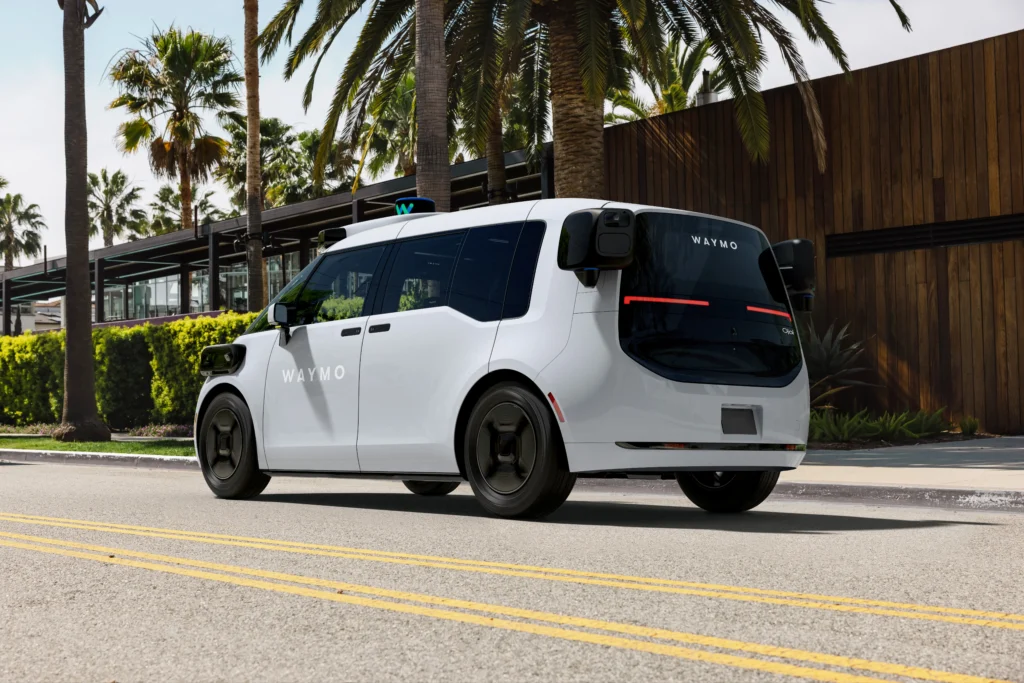
In the physical world, Waymo has demonstrated that “more” is not always better. Their 6th-generation Driver, launching on the Zeekr-built “Ojai” vans, proves that hardware efficiency is the path to scaling.
- 42% Sensor Reduction: The system has cut total sensors from 29 cameras to 13 and reduced lidar units while actually increasing resolution and range.
- 50% Cost Reduction: This hardware streamlining brings the cost of the autonomous hardware suite to under $20,000 per unit, putting Waymo within striking distance of sustainable margins for its 1-million-trip-per-week target.
- Environmental Resilience: The “Ojai” suite features modular components and cleaning systems designed to maintain operational fidelity in diverse weather conditions.
5. Behavior Forecasting: Simile AI’s $100M Stealth Exit
Simile AI emerged from stealth on February 12, 2026, with $100 million in funding to replace traditional focus groups with agent-based simulations.
- Simulated Populations: Simile populates virtual environments with AI agents that mirror the preferences and values of actual people, trained on transaction data and behavioral science experiments.
- Enterprise Adoption: Retail giant CVS is already testing the service to guide inventory decisions and predict consumer choices before physical products hit the shelves.
6. Strategic Insight (핵심 통찰)
왜 2026년 2월이 ‘에이전트 실용주의’의 원년인가?
이번 달의 뉴스들은 공통적으로 **’경제적 실현 가능성(Economic Viability)’**을 향하고 있습니다. Anthropic의 Sonnet 4.6은 지능의 가격을 1/5로 폭락시켰고, Waymo는 센서 숫자를 42% 줄여 하드웨어 효율성을 증명했습니다. 이는 AI가 단순히 ‘신기한 도구’를 넘어, 실제 기업 운영의 핵심 인프라로 자리 잡기 위한 시스템적 최적화(Systemic Optimization) 단계에 진입했음을 의미합니다.
이제 리더는 “우리 AI가 무엇을 할 수 있는가?”가 아니라, **”우리 에이전트가 200ms 이내에 실시간 데이터(Ground Truth)를 확보하여, 최소한의 비용으로 올바른 결정을 내릴 수 있는 구조인가?”**를 자문해야 합니다. 6% 엘리트는 이미 이 ‘속도와 비용’의 방정식을 풀고 있습니다.