From Models to Real Systems: Key AI Developments in Early April 2026
A practical look at AI’s shift toward interoperability, validation, and deployment in real systems
What do CarPlay, MCP, edge AI, and structured ERP outputs reveal about the next stage of operational AI?
key AI developments in early April 2026 reveal a clear shift in how artificial intelligence is advancing. While late March highlighted subagents, memory, and orchestration, early April pointed to something more practical: AI moving into real operating environments where interoperability, structured execution, and system reliability matter as much as model capability.
This shift matters because the next phase of AI progress will be shaped not only by better outputs, but by how effectively AI works inside consumer interfaces, enterprise workflows, edge environments, and validated data pipelines. In that sense, the key AI developments in early April 2026 offer a stronger picture of AI as an operational system rather than a standalone model.
1. Five Key AI Developments in Early April 2026
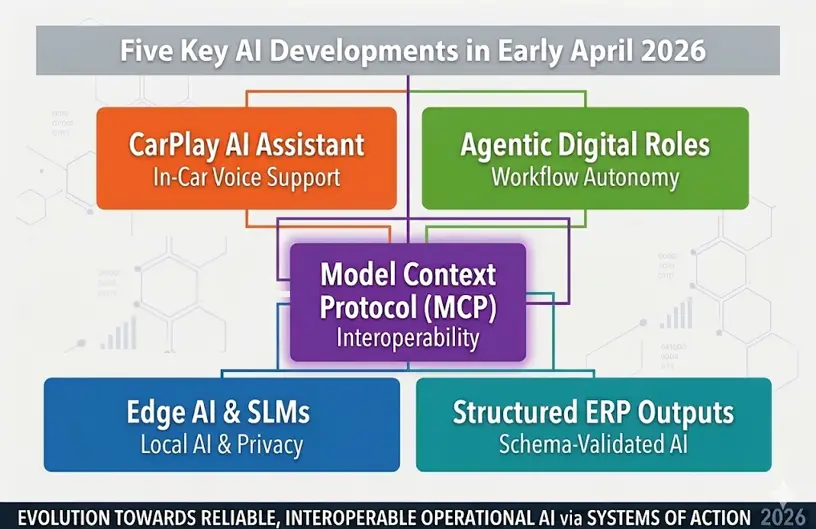
The key AI developments in early April 2026 show that AI is moving beyond model-centered progress and into more operational forms of deployment. If late March highlighted subagents, memory, and orchestration, early April showed these capabilities being connected more directly to enterprise systems, edge environments, physical hardware, and scientific research.
1️⃣ OpenAI brings ChatGPT to Apple CarPlay
On March 31, with broad consumer coverage on April 1, OpenAI extended ChatGPT to Apple CarPlay, making it one of the first voice-based conversational AI apps available in the in-car environment under Apple’s updated CarPlay rules. This was not full vehicle control, but it did mark a meaningful step toward embedding conversational AI in real-time, situational interfaces. Technically, it showed how AI assistants are moving closer to action-oriented environments where voice, timing, and context matter more than long-form text output.
2️⃣ Vector Agents publicly introduces its “Digital Worker Platform”
On April 2, Vector Agents publicly introduced its Digital Worker Platform, explicitly framing agentic AI as “digital employees” and “AI teammates” embedded in department-level business operations. This is a smaller company than the hyperscalers, but it is one of the clearest early-April examples of the language shift from AI as an assistant to AI as a role-based operational actor. Technically, this matters because it pushes enterprise architecture toward persistent role context, workflow continuity, and governed autonomy rather than single-turn productivity gains.
3️⃣ Lucidworks launches an MCP server for enterprise data integration
On April 8, Lucidworks announced its Model Context Protocol server, presenting MCP as a standardized way to connect AI agents to enterprise knowledge and reduce custom integration work. This is one of the strongest concrete examples in your list because it directly supports your “ERP-Agent Bridge” framing. Technically, MCP reduces the integration bottleneck between models and business systems by giving agents a more uniform and secure interface to proprietary data sources.
4️⃣ Google DeepMind launches Gemma 4 for edge and on-device agentic workflows
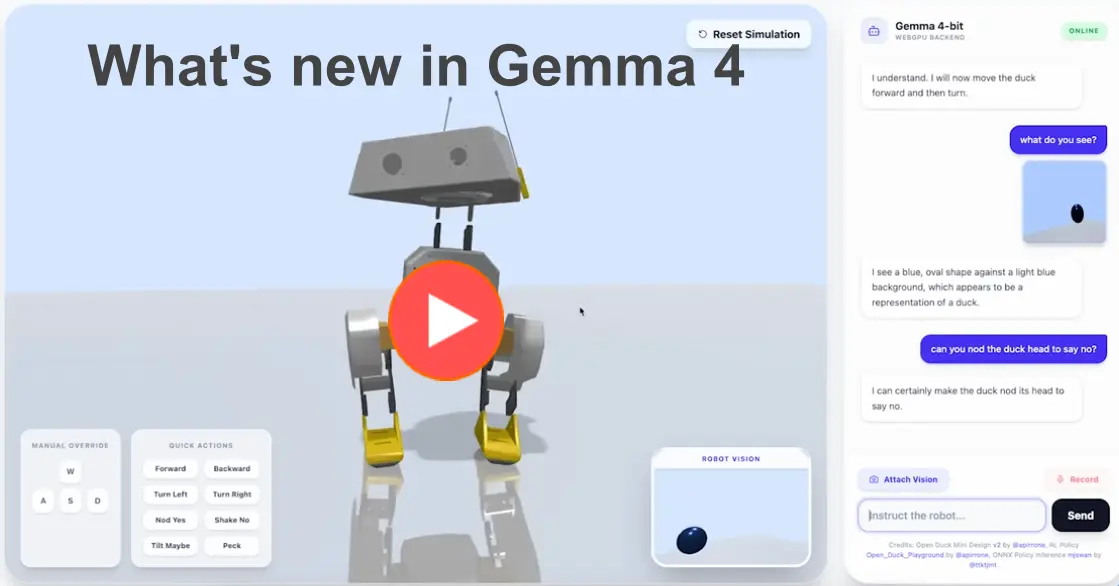
On April 2, Google DeepMind launched Gemma 4, with the company and Google’s developer team explicitly highlighting edge deployment, offline execution, and agentic skills on local hardware. This gives your SLM point a much firmer anchor than a general statement about “smaller models.” Technically, Gemma 4 matters because it pushes capable multimodal and agentic behavior into devices such as phones, desktops, and edge systems where cost, privacy, and latency are constrained.
5️⃣ Structured outputs and validation tooling gain production emphasis
Between April 10 and April 13, production-focused discussion around structured outputs and schema validation intensified, including updated guidance around provider support and a fresh Pydantic v2.13 release. This is better framed as a production engineering pattern than as a single company breakthrough, but it is still a real early-April signal because the discussion moved from prompt quality to typed reliability. Technically, this is central for ERP and transactional pipelines because agent outputs must conform to strict schemas before they can safely enter deterministic systems.
The Key Insight Across Five Developments
Taken together, the key AI developments in early April 2026 show agentic AI moving further from model capability into operational deployment. The strongest pattern is not simply smarter models, but tighter coupling with interfaces, enterprise data, local hardware, embodied systems, and structured execution layers. In that sense, early April did not prove the AI Value Gap is closed, but it did show the industry investing more directly in the engineering conditions required to close it.
2. The System Shift: Three Technical Characteristics Behind These Developments
The key AI developments in early April 2026 point to three technical characteristics that increasingly define AI progress at the system level. Rather than highlighting model capability in isolation, these developments show how AI is being engineered to operate more effectively inside real interfaces, enterprise systems, and constrained environments.
Context-Aware Interface Integration
The first characteristic is the tighter integration of AI into live user environments where usefulness depends on timing, interaction, and situational context.
Key technical implications include:
- Interface-constrained interaction: AI must work within voice, screen, and attention limits rather than open-ended chat conditions.
- Session continuity: the system must preserve conversational context across short exchanges.
- Real-time responsiveness: performance depends on timely interaction, not only on response quality.
This is visible in examples such as CarPlay-based conversational AI, where the model is no longer operating as a standalone text generator. Instead, it becomes part of an interface layer shaped by environmental conditions and user workflow.
Standardized Interoperability and Workflow Connectivity
The second characteristic is the growing importance of interoperability between models, enterprise data, and external tools. MCP is the clearest example because it reduces the need for custom integrations between AI agents and the software systems they depend on.
This characteristic involves several architectural shifts:
- Common access layers: standardized protocols reduce repeated connector work.
- Tool and data integration: agents can retrieve context and invoke external functions more consistently.
- Workflow connectivity: AI becomes easier to embed into multi-system enterprise processes.
In enterprise environments, this matters because business data is fragmented across SaaS platforms, databases, repositories, and operational systems. Standardized interoperability makes AI more scalable by turning integration into part of the architecture rather than an afterthought.
Constrained Execution Under Operational Requirements
The third characteristic is the movement toward constrained execution. This appears in edge AI, smaller deployable models, and structured ERP outputs. In each case, the common pattern is that AI must operate under tighter requirements than a general-purpose chatbot.
The main technical conditions are:
- Resource limits: models must perform within tighter memory, compute, and latency constraints.
- Structured output requirements: enterprise systems need schema-conforming outputs rather than flexible natural language.
- Control boundaries: downstream workflows require validation and reliability before execution can be trusted.
This changes the design objective from maximum model scale to efficient and dependable system performance. In practical terms, AI becomes more valuable when it can run within hardware, privacy, and workflow constraints without creating instability in downstream systems.
In Practical Perspective
Taken together, these three characteristics show that AI is no longer advancing mainly through model capability alone. It is evolving through tighter interface integration, stronger interoperability, and more constrained execution. In early April 2026, the system shift became clearer: progress depended less on isolated output quality and more on whether systems could connect, operate, and perform reliably in real environments.
3. From Technology to Application: Where These Trends Will Be Used
The key AI developments in early April 2026 matter because they show where AI is becoming more practical in real systems of work. The same three technical characteristics discussed above, interface integration, interoperability, and constrained execution, also define the environments where deployment is becoming more feasible.
Context-Aware Consumer Interfaces
The first application area is consumer and mobile assistance. CarPlay-based conversational AI shows how language models are moving into live user environments where timing, interaction, and usability matter as much as raw model capability.
Key technical implications include:
- Short-turn interaction: the system must respond quickly within limited attention windows.
- Session continuity: usefulness depends on preserving conversational context across brief exchanges.
- Interface constraints: voice, screen limits, and environmental conditions shape how AI can be used.
In these settings, value comes from responsiveness, continuity, and simplicity rather than from long-form generation alone.
Connected Enterprise and Knowledge Work
The second application area is enterprise workflow and knowledge work. MCP, structured outputs, and agentic digital roles make AI more applicable to document handling, reporting, approvals, research, analysis, and administrative coordination.
This application area depends on several system requirements:
- System access: AI must connect to enterprise data, tools, and repositories.
- Workflow continuity: multi-step work requires persistent role context and task tracking.
- Output conformity: downstream systems need structured outputs that can be consumed without manual correction.
In enterprise settings, usefulness depends less on conversational fluency alone and more on whether AI can operate inside a governed workflow with predictable inputs and outputs.
Edge and Operational Environments
The third application area is edge and secure operational environments. Smaller deployable models and structured execution requirements expand AI’s role in industrial devices, local enterprise systems, and privacy-sensitive workflows.
The main technical conditions are:
- Resource limits: models must work within tighter memory, compute, and latency boundaries.
- Local control: deployment often requires stronger privacy and reduced cloud dependence.
- Operational stability: AI must function without disrupting downstream systems or device performance.
This shifts the design focus from maximum scale to efficient and dependable operation under real constraints.
An Industrial Engineering Perspective
From an Industrial Engineering standpoint, these applications matter because they place AI inside systems where performance depends on more than model quality alone.
The key system concerns are:
- Flow: whether information moves smoothly across steps and handoffs
- Coordination: whether AI fits into the larger operating process
- Validation: whether outputs meet structural and control requirements
- Execution quality: whether the system performs reliably under real conditions
The value of AI increasingly depends on whether it can function reliably within the larger workflow rather than only producing strong isolated outputs.
The Strategic Implication
Early-April AI developments matter because they make AI easier to embed into real interfaces, connected enterprise workflows, and constrained operational environments. The broader shift is from model-centered capability to application-centered system design.
4. Conclusion: Early April Shows AI Moving Closer to Operational Reality
The key AI developments in early April 2026 suggest that AI progress is shifting from standalone model capability to system-level deployment. The most important change is not only better outputs, but tighter integration with consumer interfaces, enterprise data, edge environments, and structured workflows.
This matters because AI creates real value only when it can operate reliably inside larger systems of work. In early April, the strongest signals pointed in that direction through situational interfaces, agentic digital roles, MCP, edge AI, and structured ERP outputs.
From an Industrial Engineering perspective, this phase is important because it strengthens the conditions required for operational performance: flow, reliability, integration, and resource efficiency. Early April 2026 therefore marks another step away from experimental AI and toward engineered, usable systems.