July 2026 AI Developments: From Frontier Governance to Physical AI Execution
Seven advances in AI oversight, frontier models, enterprise agents, conversational interfaces, engineering platforms, and real-world robotics
As AI moves from model output to operational authority, who determines where it may act, how its decisions are governed, and when human control must intervene?
July 2026 AI Developments marked a shift from stronger models toward governed systems embedded in enterprise workflows, engineering environments, and physical operations.
The month’s most important announcements included frontier-model oversight, long-horizon agentic capability, role-specific enterprise agents, conversational interfaces, engineering orchestration, surgical robotics, and industrial robot learning.
At the same time, Physical AI advanced in healthcare and industry. Johnson & Johnson’s Ottava connected robotic capability with surgical workflow, while FLUX-mimic linked visual intelligence with industrial robot learning.
Together, these developments reveal a broader transition. AI is becoming part of the systems through which organizations evaluate risk, assign responsibility, interact with users, coordinate engineering, and execute physical tasks.
This article examines seven notable developments from July 2026 and considers what they mean for practical value, system integration, governance, and dependable execution.
1. Seven Key AI and Physical AI Developments in July 2026
July 2026 showed AI progress expanding beyond model performance. The month’s most important developments included new approaches to frontier-model oversight, stronger agentic models, enterprise deployment platforms, conversational interfaces, AI-supported engineering, surgical robotics, and industrial robot learning.
The seven developments are intentionally balanced between five AI or agentic AI developments and two Physical AI developments. This reflects the broader AI market while still recognizing that intelligence is increasingly moving from digital environments into machines and operational systems.
Together, the developments show a progression from evaluation and model capability to workflow integration and physical execution.
Figure 1 summarizes the seven most important July developments, including five AI and agentic AI advances and two Physical AI applications.
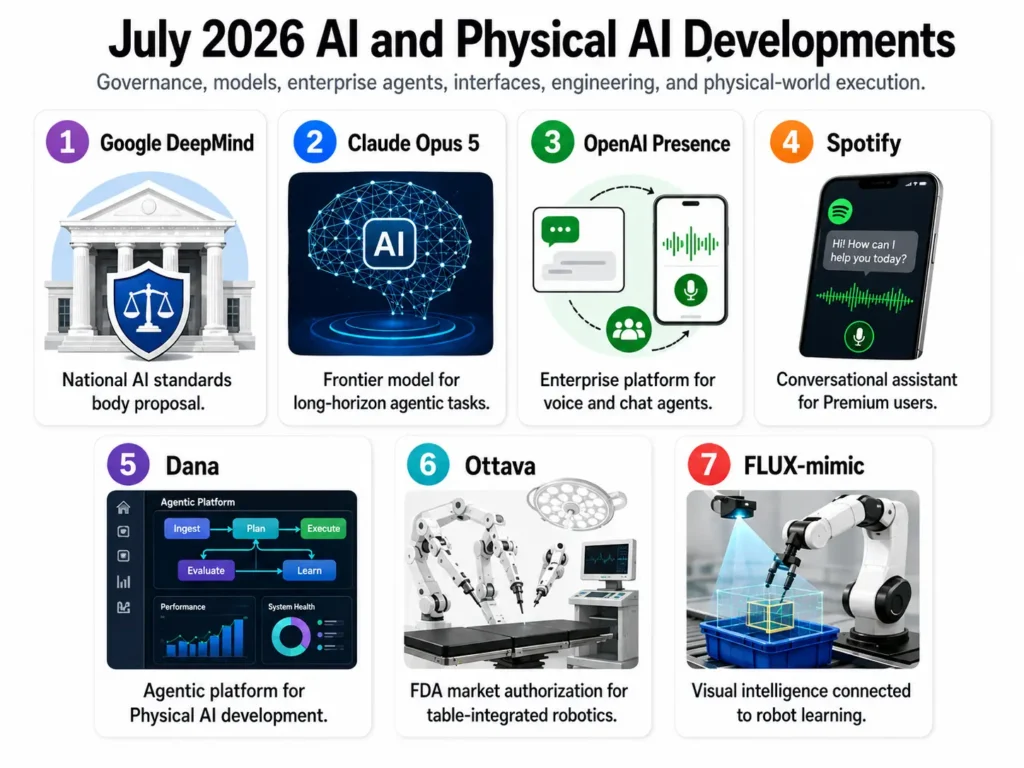
Together, these developments show AI moving from governance and model capability toward enterprise integration, engineering workflows, and real-world execution.
1️⃣ Google DeepMind proposes a national AI standards body
On July 14, Google DeepMind CEO Demis Hassabis called for a U.S.-led organization that could evaluate advanced AI models before release. The proposed body would examine risks such as cyber misuse, biological threats, deception, and the loss of effective human control.
The proposal represents a movement from safety testing conducted primarily inside frontier laboratories toward a more formal and potentially independent evaluation structure. The July newsletter described it as a watchdog capable of testing advanced models before they are released.
The broader significance is not simply the creation of another regulatory organization. An external standards body could establish common evidence requirements for demonstrating that frontier systems have been adequately tested.
However, pre-release evaluation cannot guarantee safe behavior after deployment. Models may encounter changing data, new tools, unforeseen user behavior, and operational conditions that were not present during laboratory testing. Formal evaluation must therefore be connected with runtime monitoring, intervention, and post-deployment accountability.
2️⃣ Anthropic launches Claude Opus 5
On July 24, Anthropic introduced Claude Opus 5 as a frontier model for computer use, coding, knowledge work, and long-horizon agentic tasks.
The model reportedly improved computer-use performance while offering fewer unnecessary refusals, an automatic fallback mechanism, and a faster operating mode. The newsletter described it as outperforming Anthropic’s previous model in computer use while completing extended agentic work at a lower cost.
The important shift is from models that primarily generate answers toward systems that can continue working through multiple steps. Such models can examine information, use software tools, revise outputs, and pursue a goal over a longer period.
This creates value, but it also increases operational risk. A model that only recommends an action has limited direct impact. A model that can open applications, modify files, communicate with customers, or update business systems requires stronger controls over permission, scope, verification, and recovery.
Claude Opus 5 therefore represents both greater capability and a stronger need for dependable agent governance.
3️⃣ OpenAI launches Presence for enterprise agents
On July 22, OpenAI introduced Presence as an enterprise platform for deploying voice and chat agents across internal and customer-facing workflows.
Unlike a general-purpose assistant, each Presence deployment is assigned a specific job. Examples include resolving billing problems, supporting insurance claims, and responding to employee IT requests. The platform also includes a Codex-powered improvement loop that can propose updates based on operational experience.
This job-specific structure is strategically important. Enterprise agents are easier to control when their responsibilities, data access, tools, escalation paths, and expected outcomes are explicitly defined.
A billing agent, for example, should not automatically inherit authority to modify unrelated customer records or approve a refund beyond its assigned threshold. Its authority should be tied to a defined role and revalidated before consequential actions are committed.
Presence illustrates the movement from experimental agents toward managed operational systems. The enterprise value will depend not only on how well agents communicate, but on whether they operate within clear decision rights and produce evidence that can be reviewed after execution.
4️⃣ Spotify begins rolling out a conversational AI assistant
On July 14, Spotify began rolling out a conversational AI assistant for Premium users, allowing them to interact with the service using text or voice.
Instead of navigating menus or entering a narrow search term, users can express an intention more naturally. They may ask for music that fits a particular activity, explore past listening, request information about an artist, or refine the current selection through follow-up instructions.
This represents a broader change in software design. AI is becoming an interaction layer between users and application functions.
The value is convenience, but dependable conversational interfaces require more than accurate language generation. The system must maintain context, distinguish a request from casual discussion, identify the correct application function, and prevent an ambiguous statement from causing an unintended action.
Spotify shows how conversational AI is becoming embedded in ordinary digital services rather than remaining a separate chatbot destination.
5️⃣ Applied Intuition introduces Dana for AI-driven engineering
On July 21, Applied Intuition launched Dana, an agentic platform for developing autonomous vehicles, robots, and other Physical AI systems.
Dana is intended to coordinate engineering work across areas such as data analysis, simulation, testing, model evaluation, validation, and deployment. Applied Intuition claimed that the platform could reduce some development processes from months to days.
Although Dana supports Physical AI development, it is more accurately classified as an AI engineering platform than as a physical machine. Its primary function is to help engineering teams manage complex technical work involving software, data, models, and physical-system behavior.
This reflects an important expansion of agentic AI. Agents are no longer limited to office productivity or customer communication. They are beginning to coordinate engineering activities where decisions can eventually affect vehicles, robots, and industrial equipment.
The potential value is faster development and better continuity across tools and teams. The risk is that acceleration may outpace verification. AI-generated engineering changes must remain connected to test evidence, configuration history, validation requirements, and accountable human approval.
Figure 2 illustrates how July’s major developments can be understood as a progression from model evaluation to operational integration.
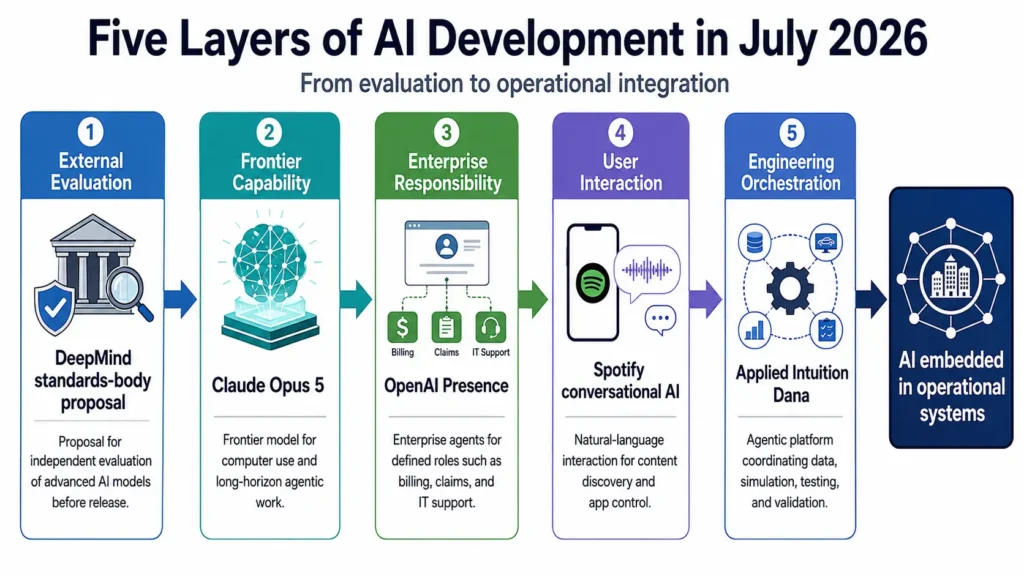
Taken together, these five layers show that AI is moving beyond standalone capability toward systems embedded in real workflows and operating environments.
6️⃣ Johnson & Johnson’s Ottava receives FDA market authorization
Johnson & Johnson received FDA market authorization for Ottava, a robotic surgical system with four robotic arms integrated into the operating table.
Ottava was authorized for several common upper-abdominal procedures. Its integrated configuration reportedly requires 30% to 50% less operating-room space than conventional systems in which separate robotic carts surround the patient.
The operating table and robotic arms can also move together. This allows the surgical team to reposition the patient without stopping to rearrange multiple pieces of equipment.
Ottava demonstrates that Physical AI value does not always come from maximum autonomy. The system’s value also comes from structural integration, synchronized movement, spatial efficiency, and compatibility with established clinical workflows.
The authorization is especially important because healthcare robotics must demonstrate not only technical capability, but also safety, usability, reliability, and clinical suitability. In such environments, dependable performance is more important than unrestricted autonomy.
7️⃣ Black Forest Labs extends visual intelligence into robot action
On July 24, Black Forest Labs opened early access to FLUX 3, a visual-intelligence system capable of working across video, images, and synchronized audio. The company also extended the technology into robotics through FLUX-mimic, developed with mimic robotics.
FLUX-mimic applies visual world representation to industrial robot control. The system reportedly learned a new factory task from approximately 30 minutes of demonstration data, compared with more than 30 hours under earlier training approaches.
This development illustrates the convergence of generative AI, world modeling, and physical action. A model that understands how objects, people, and environments change over time can do more than generate realistic video. It can help predict what physical action should occur next.
The opportunity is faster robot learning and adaptation. The governance challenge is ensuring that learned behavior remains within safe operating limits when conditions differ from the original demonstrations.
A robot may perform well during a controlled demonstration but encounter changed materials, unexpected obstacles, sensor degradation, or human workers inside its operating area. Physical execution therefore requires continuous state verification, safety constraints, interruption mechanisms, and evidence of what the robot perceived and why it acted.
Figure 3 compares two paths to Physical AI value: integrated surgical robotics and demonstration-based industrial learning.
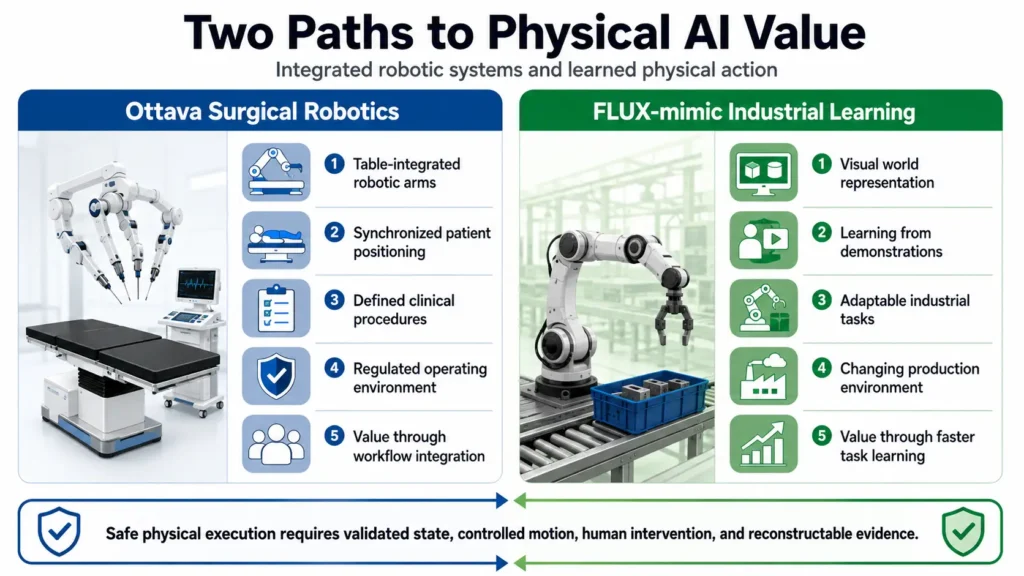
Although the applications differ, both require validated operating conditions, controlled motion, human intervention, and reconstructable evidence.
Key Insight
The seven developments provide a balanced picture of July 2026:
- Five developments focus on AI governance, frontier models, enterprise agents, conversational interaction, and engineering orchestration.
- Two developments focus directly on Physical AI through surgical robotics and industrial robot learning.
Together, they show that AI competition is moving beyond model capability toward control of the systems where intelligence is evaluated, assigned responsibility, connected to workflows, and translated into action.
2. The System Shift Behind These Developments
Behind the key AI and Physical AI developments in July 2026, one pattern is clear: AI competition is moving from model capability toward control of the systems where intelligence is evaluated, assigned work, and permitted to act.
This shift can be understood through three layers: governance ownership, workflow ownership, and physical execution ownership.
2.1 Governance Ownership: AI Evaluation Moves Beyond the Lab
Google DeepMind’s proposed national AI standards body shows frontier-model evaluation moving toward formal external oversight. The goal is to assess advanced systems for cyber, biological, deception, and other serious risks before release.
Claude Opus 5 reinforces why this matters. As models become more capable of computer use and long-horizon agentic work, organizations need stronger evidence that they can operate safely and reliably.
2.2 Workflow Ownership: AI Becomes an Operating Environment
OpenAI Presence, Spotify’s conversational assistant, and Applied Intuition’s Dana show AI moving into defined operational environments.
Presence assigns agents to specific enterprise jobs, Spotify connects natural-language conversation with application functions, and Dana coordinates data, simulation, testing, and validation across complex engineering work.
The strategic meaning is that AI companies are no longer supplying only models. They are building the environments where users and professionals interact with AI, assign tasks, review results, and complete work.
2.3 Physical Execution Ownership: AI Moves Into the Real World
Ottava and FLUX-mimic show two paths from digital intelligence to physical execution.
Ottava creates value through table-integrated robotic arms, synchronized movement, and clinical workflow fit. FLUX-mimic connects visual world modeling with industrial robot learning from demonstrations.
Physical AI is different from digital AI because intelligence must be connected to controlled motion, changing environments, safety constraints, and reliable real-world performance.
Section 2 Key Insight
The deeper pattern behind July 2026 is governed execution-layer ownership. AI organizations are building the systems where intelligence is evaluated, connected to workflows, and translated into physical action.
3. Where July’s Developments May Deliver Practical Value
July’s announcements point to value in four areas: safer use of advanced models, role-specific agents, faster engineering cycles, and specialized robotic systems.
3.1 Safer Deployment of Advanced Models
The proposed frontier-AI evaluation body could provide a more consistent method for testing serious risks before powerful models reach the market. Claude Opus 5 shows why this matters: models are becoming better at computer use and extended, multi-step work.
Organizations may gain more value from these models when pre-release testing is combined with permissions, monitoring, fallback procedures, and records of agent activity.
3.2 Role-Specific Agents for Services and Operations
OpenAI Presence applies agents to clearly defined activities such as billing, insurance claims, and IT support. Spotify uses conversational AI to make content discovery and application control more natural for users.
The strongest use cases will likely be those with a limited task scope, known data sources, explicit action boundaries, and a clear route to human assistance.
3.3 Faster and Better-Connected Engineering Work
Applied Intuition’s Dana brings agentic AI into the development of autonomous vehicles, robots, and other intelligent machines. It connects activities such as data preparation, simulation, testing, and validation within a coordinated engineering process.
The potential benefit is not only reduced development time. A shared AI-supported environment may also improve continuity between engineering tools, test evidence, design decisions, and safety reviews.
3.4 Physical AI in Controlled, High-Value Environments
Ottava and FLUX-mimic illustrate two different ways Physical AI can produce value.
Ottava improves surgical work through integrated robotic arms, synchronized patient positioning, and a smaller operating-room footprint. FLUX-mimic helps industrial robots acquire tasks from shorter demonstrations.
These systems are most promising where the operating environment, task boundaries, safety requirements, and human intervention procedures are clearly defined.
Section 3 Key Insight
July’s developments suggest that AI value will increasingly depend on how well intelligence is fitted to a specific role, workflow, and operating environment. Better models matter, but practical results will come from connecting them to reliable processes, appropriate controls, and measurable outcomes.
4. Conclusion: AI Value Depends on Controlled Integration
The July 2026 developments show AI advancing across governance, model capability, enterprise agents, consumer interfaces, engineering platforms, and physical systems.
The common thread is integration. Models are being connected to defined roles, operational data, software tools, engineering processes, surgical equipment, and industrial robots. As that connection becomes stronger, AI can produce greater value, but it can also create greater consequences when something goes wrong.
Organizations should therefore evaluate AI systems by more than intelligence or speed. They should also examine whether responsibilities are clear, actions are properly authorized, evidence is available, intervention is possible, and important decisions can be reconstructed afterward.
The most successful AI deployments will be those that combine capable models with disciplined system design, human oversight, and reliable execution in both digital and physical environments.