The ERP-Agent Bridge: Trusted Execution, State Mutation, and Admissibility
An execution-boundary architecture for controlling agentic actions before they mutate systems of record
When an AI agent generates a valid ERP action, what proves it is authorized, admissible, and safe enough to execute?
The ERP-Agent Bridge addresses the gap between AI-generated intent and enterprise execution. A technically valid API request may still lack current authority, sufficient evidence, or an admissible business purpose.
The bridge establishes a trusted execution boundary between agent reasoning and systems of record. It evaluates proposed actions against runtime governance conditions, enforces binding decisions, and preserves evidence before enterprise state changes.
As agentic workflows expand across multiple systems and agents, shared-state consistency and governed recovery become as critical as single-action admissibility.
The agent proposes. The bridge decides, enforces, and proves. The enterprise commits only when the action is admissible.
1. From Agent Reasoning to Enterprise Consequence
The ERP-Agent Bridge is needed because agent reasoning and enterprise execution operate under different control conditions. Before commitment, an AI system proposes an action. After commitment, that proposal becomes an operational consequence.
API Validity vs. Execution Validity
An AI agent can produce a technically valid API request that should never execute.
Authentication, endpoint access, schema validation, and payload structure confirm that a request can reach the target system. Runtime governance must still establish whether the action is authorized, evidence-supported, workflow-valid, and admissible.
For the ERP-Agent Bridge, API validity means the interface can process the request. Execution validity means the proposed consequence remains admissible at the moment of commitment.
Enterprise State-Mutation Surfaces
ERP actions can alter more than database fields. Agent-generated actions may change vendor or customer master data, inventory positions, invoices, payments, approval status, workflow transitions, or downstream automation.
These effects propagate across systems. A vendor bank-account change, for example, may influence procurement records, payment processing, and later financial transactions.
The bridge therefore treats consequential actions as controlled state mutations, not ordinary tool calls.
The governing question is not whether an agent can invoke an ERP function, but whether its resulting business effect is legitimate under current execution conditions.
Why Risk Changes at the Commit Boundary
Before commitment, failures remain proposed intent. After commitment, they may become enterprise consequences.
A useful execution chain is:
User request → Evidence → Agent reasoning → Proposed action → Routing → Admissibility → State mutation → Business consequence
A technically correct proposal may become inadmissible if authority expires, evidence becomes stale, workflow state changes, or another agent modifies a shared dependency.
The ERP-Agent Bridge must therefore operate directly in the execution path rather than merely auditing transactions afterward.
2. ERP-Agent Bridge Architecture
The ERP-Agent Bridge separates AI reasoning from consequential enterprise execution. It does not replace agent reasoning; it prevents proposed actions from directly mutating systems of record.
Three Runtime Zones
The architecture contains three runtime zones.
1. AI reasoning zone
The agent interprets requests, retrieves evidence, plans actions, selects tools, and prepares a proposed execution object. It may use knowledge bases, APIs, and orchestration services, but consequential state changes must follow the governed execution path.
2. Trusted execution boundary
The ERP-Agent Bridge intercepts and routes proposed actions. It evaluates current authority, evidence, policy, workflow state, risk, and execution conditions before issuing and enforcing a binding disposition.
3. Enterprise state-mutation zone
This includes ERP, CRM, SCM, payments, workflow, and other systems of record. Admitted actions may produce operational state changes and downstream consequences.
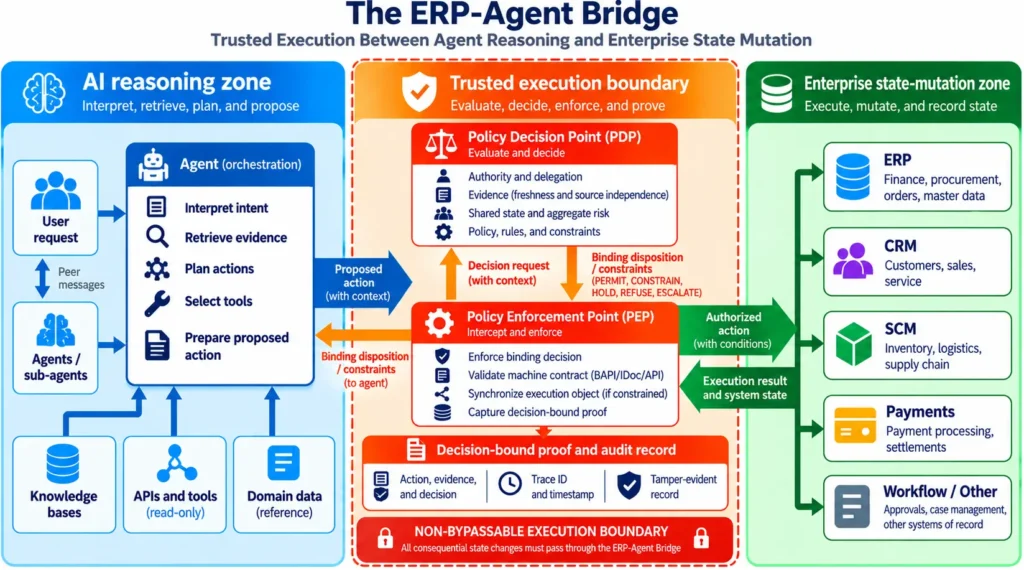
The governing principle is straightforward: agent reasoning occurs upstream, while consequential state mutation passes through a trusted, non-bypassable execution boundary.
In multi-agent environments, this boundary also governs consequential interactions propagated through delegated execution, shared state, messages, and intermediate tool effects.
Policy Decision Point and Policy Enforcement Point
Decision and enforcement must remain distinguishable.
A mandatory Policy Enforcement Point (PEP) intercepts the effectful request before enterprise state changes. It sends decision-relevant context to an independently governed Policy Decision Point (PDP), which evaluates admissibility and returns a binding disposition. The PEP enforces that result before invoking the target system.
This follows the general decision-and-enforcement separation described in NIST SP 800-207, Zero Trust Architecture.
Non-bypassability requires more than protecting one API route. Every consequential effect class needs an identified enforcement surface. The same business consequence must not be reachable through an ungoverned connector, message, batch process, database write, or equivalent path.
The model remains the proposer or orchestrator, not the authorization authority.
Capability Is Not Authority
An agent may know how to call an API without having legitimate authority to execute the underlying business action.
Likewise, an authenticated user may access a system while lacking authority for a particular payment or master-data change.
Retrieved documents, tool output, persistent memory, and peer-agent messages cannot create governance authority merely through model interpretation. A supplier invoice requesting a bank-account change is evidence to evaluate, not authorization to change vendor data.
Agreement among agents is not independent corroboration. Three agents endorsing a vendor bank-account change based on the same invoice still rely on a shared evidence source. Agent agreement must not substitute for independent evidence or independently governed authorization.
When an orchestrator delegates tasks to sub-agents, downstream authority must remain within the effective upstream grant. Further delegation requires explicit permission and limits on scope, duration, delegation depth, and fan-out.
For consequential actions, the bridge may also need to verify that the authorized logical agent is the actual runtime instance presenting the request.
For cloud-native deployments, NIST SP 800-207A provides complementary guidance on identity-based access control across distributed services.
These authority boundaries are developed further in Agentic AI Governance: 10 Runtime Controls Before Enterprise Agents Scale.
The ERP-Agent Bridge therefore evaluates current, legitimate authority-to-act, not merely technical capability.
3. Pre-Admissibility Routing and Commit-Time Admissibility
The ERP-Agent Bridge cannot apply one generic rule to every proposed action. Before commitment, it first selects the appropriate governance path according to the mutation surface, consequence, and risk.
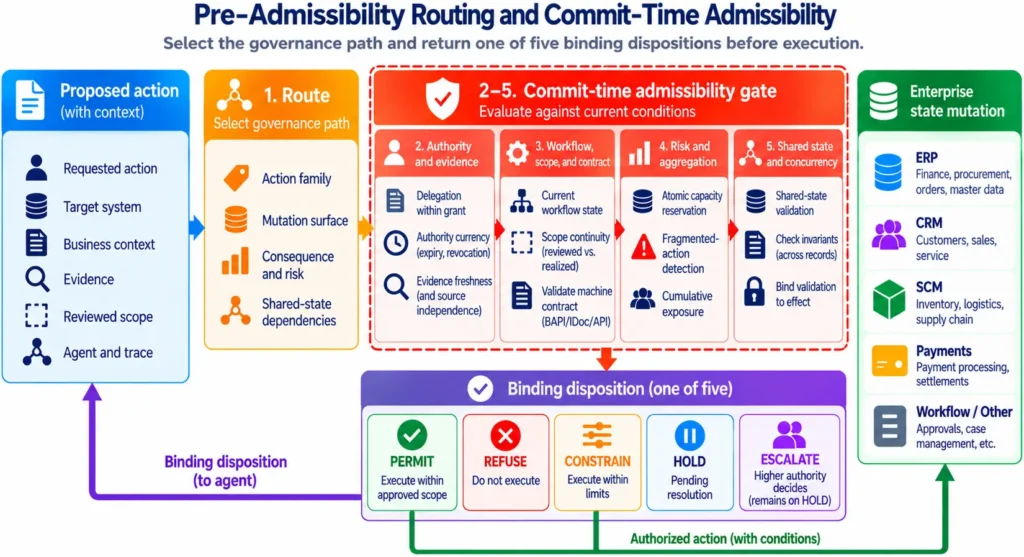
Routing by Action Family, Mutation Surface, and Risk
Pre-admissibility routing determines which controls, evidence requirements, reviewers, and recovery rules apply.
A payment release, vendor-master update, inventory adjustment, and workflow approval may all use technically valid APIs. Their consequences, however, differ substantially.
Routing should consider action family, target system, reversibility, financial or regulatory impact, downstream propagation, cumulative exposure, and recovery feasibility.
For multi-agent execution, it should also identify material shared-state dependencies and applicable concurrency constraints.
This risk-sensitive approach is consistent with the broader lifecycle governance objectives described in the NIST AI Risk Management Framework, although the specific commit-time controls here come from the Four Runtime Governance Pillars.
Routing does not authorize an action. It determines how the action must be evaluated.
Authority Currency, Evidence Freshness, Workflow State, and Machine-Contract Validation
Commit-time admissibility evaluates current conditions rather than relying on assumptions established earlier.
Authority may expire. Evidence may become stale. Workflow state may advance. Another agent may change a shared resource after the original proposal was reviewed.
Freshness requirements depend on how quickly relevant conditions change. Master data may remain usable for hours, while payment status, inventory availability, or workflow state may require near-real-time verification.
Premise age includes inference, queuing, human review, retry, and dispatch delay. A material change invalidates a premise regardless of its age.
Revalidation alone is insufficient. The bridge must bind validation to the governed effect through a transaction, compare-and-set, fencing, or equivalent mechanism that protects material shared-state invariants against intervening changes.
Where decision conditions are unresolved, stale, contradictory, unavailable, or materially under-represented, the gate must not default to PERMIT. The action follows HOLD, REFUSE, or ESCALATE according to its active domain profile.
The execution object must also satisfy the target system’s machine contract. A semantically appropriate action that violates a BAPI, IDoc, API, or adapter contract must not execute.
If translation, normalization, or a material connector or schema change alters the proposed effect or invalidates an assumption underlying the decision, the affected execution object requires renewed evaluation.
System-Level Risk and Execution-Scope Continuity
Admissibility extends beyond individual transactions.
Several actions may each satisfy local limits while collectively exceeding a budget, inventory constraint, operational capacity, or enterprise risk threshold.
For example, two agents may independently release payments within their authorized limits while together exceeding the remaining budget. The bridge should atomically reserve shared risk capacity before permitting commitments that depend on that capacity.
Fragmentation introduces a related risk. A purchase exceeding an approval threshold may be divided among several agents or requests, each below the limit. Individually admissible fragments must not authorize a collectively prohibited purpose or aggregate-bound violation.
Shared-state consistency requires more than capacity reservation or per-record version checks. Validation must also cover predicate conditions and invariants spanning multiple records, such as a three-way match across a purchase order, goods receipt, and invoice.
Execution-scope continuity is equally important. Approval of an abstract proposal does not automatically authorize a realized plan with new targets, parameters, tools, sub-actions, or effects.
Approval to reorder from one supplier, for example, should not authorize substitution of another supplier or a larger quantity without renewed evaluation.
Five Binding Dispositions: PERMIT, REFUSE, CONSTRAIN, HOLD, ESCALATE
The commit-time gate returns one of five binding dispositions:
- PERMIT: The action is admissible and may proceed within its approved scope.
- REFUSE: The action violates a hard boundary and must not execute.
- CONSTRAIN: The action may proceed only within a narrower, explicitly permitted envelope.
- HOLD: Execution is suspended pending resolution or revalidation of a material condition.
- ESCALATE: A higher or independent authority must decide; execution remains on HOLD until a fresh binding disposition is issued.
HOLD and ESCALATE confer no execution authority. Their expiry must never become automatic PERMIT.
If an original approver becomes unavailable, stale approval cannot be reused. The action remains in HOLD while an authorized substitute path is resolved. If no valid approval path is available within the applicable deadline, the predefined REFUSE or ESCALATE rule applies, except where a constrained alternative was explicitly preauthorized.
When CONSTRAIN changes the amount, target, scope, or effect, the revised execution object must be synchronized with the active workflow before proof binding and execution.
The relationship between human approval, continuing authority, and execution enforcement is examined further in Designing Dependable Human-Agent Workflows: Preventing the Rubber-Stamp Problem.
The distinction is simple: PERMIT opens the commit path; REFUSE closes it; CONSTRAIN narrows it; HOLD pauses it; ESCALATE redirects the decision without bypassing HOLD.
4. Decision-Bound Proof and Evidence Continuity
Admissibility is weak when a governance decision becomes separated from the evidence justifying it.
The ERP-Agent Bridge should bind proof to the decision at the execution boundary rather than relying exclusively on audit logs generated afterward.
Decision-Evidence Package and Decision-Bound Proof
Before execution, the bridge binds the proposed action to the evidence and governance conditions supporting its disposition.
The decision-evidence package should preserve the proposed action, relevant evidence, authority, workflow state, policy/profile version and current activation epoch, risk conditions, required human approval, trace information, and binding disposition.
The essential sequence is:
Route → Validate → Bind proof → Commit or refuse
A later log may show what happened without proving why the action was admissible when commitment occurred.
For higher-risk actions, proof should identify the principal, acting agent, target system, reviewed scope, realized execution object, and enforcement acknowledgment.
In multi-agent execution, relevant records should also preserve shared-state versions, dependency lineage, concurrency constraints, and validation-to-effect evidence.
Proof of an individually admissible action does not establish that concurrent actions preserved enterprise-level constraints.
Within the Four Runtime Governance Pillars, Pillar 2 governs admissibility and binds the decision to evidence, while Pillar 4 reconstructs that decision across execution, intervention, recovery, and outcome. Pillar 1 defines the governing controls, and Pillar 3 manages intervention and recovery.
These records also support the Agentic AI Scorecard, which translates runtime evidence into measurable indicators of control effectiveness, recovery performance, and reconstruction completeness.
Symmetric Decision Records and Proof Boundaries
Evidence should be preserved for more than successful PERMIT decisions.
REFUSE, CONSTRAIN, HOLD, ESCALATE, timeouts, nonresponses, and failed reviews must also leave durable, attributable records.
The executor should not be the sole source of its own authorization or evidence claims. Higher-consequence actions require appropriately independent observation or verification.
Cryptographic integrity may demonstrate that a record has not changed. It does not establish that its source was truthful, its evidence sufficient, its policy correct, or its realized execution faithful.
Decision-bound proof supports bounded execution assurance, not an unlimited claim of system correctness.
5. Execution Integrity, Recovery, and Revalidation
Passing the admissibility gate does not guarantee successful execution, and PERMIT is not permanent authorization.
Material changes in authority, policy, reviewer standing, workflow, shared state, or execution conditions should propagate as authenticated governance-status signals within a defined latency objective and trigger intervention or renewed admissibility. Partial commits or inconsistent outcomes may require governed recovery.
Idempotency and Transaction Integrity
Retries must not transform technical failures into duplicate business transactions.
The bridge should associate governed actions with idempotency keys or execution fingerprints so repeated requests can be recognized as continuations rather than automatically treated as new transactions.
Where legacy ERP interfaces lack native idempotency, external deduplication, transaction registries, read-before-write verification, or equivalent safeguards may be necessary.
The objective is to prevent duplicate invoices, payments, inventory movements, approvals, and downstream triggers.
Outcome-State Reconciliation
After execution, the bridge compares the authorized and expected effect against independently observable enterprise state.
A successful API response does not establish that every intended update occurred, that no unintended effect occurred, or that downstream systems reached the required state.
Reconciliation should identify partial commits, uncertain outcomes, missing acknowledgments, inconsistent workflow states, and unexpected side effects. A missing acknowledgment must be treated as an unresolved outcome, not as proof that no execution occurred.
When discrepancies occur, the system should determine residual state before considering another execution attempt.
Residual Execution State and Governed Recovery
Failure assessment should consider four dimensions:
- External effects already produced
- Enterprise state already changed
- Workflow execution state
- Agent context available for continuation
Residual execution state determines which technical recovery mechanisms remain possible. However, an available checkpoint is not necessarily an admissible recovery point.
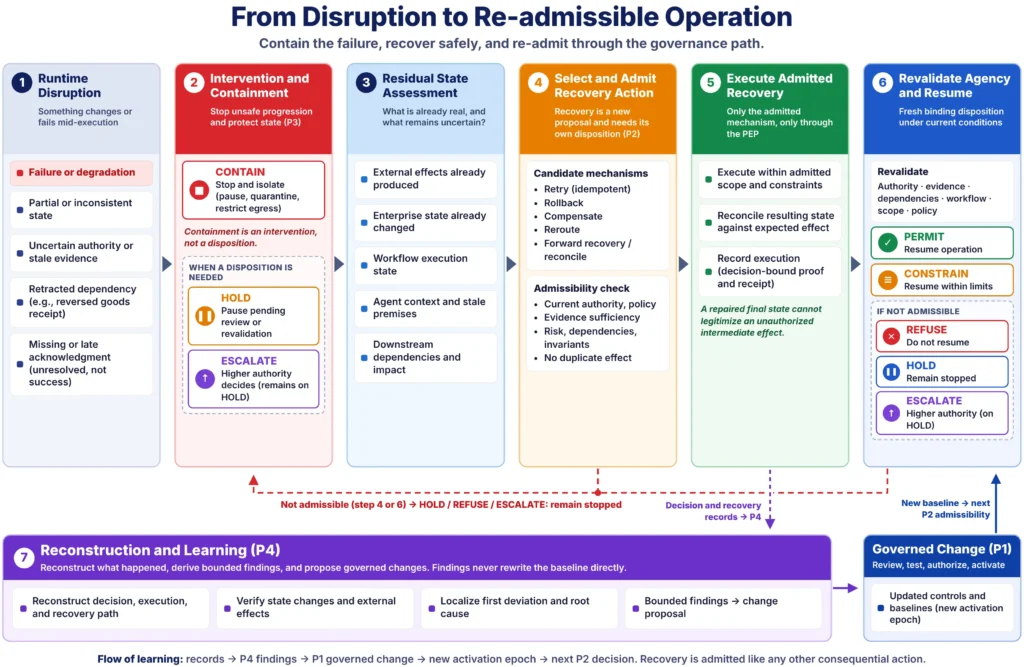
Retry, rollback, compensation, rerouting, forward recovery, and reconciliation can themselves produce consequential state changes.
Each proposed recovery action must therefore re-enter governance and receive its own admissibility decision before execution. This requires current authority, sufficient evidence, valid dependencies, applicable policy, and an admissible recovery scope.
The same applies to conflict repair and tool substitution. A repaired final state cannot legitimize an unauthorized intermediate effect.
As Figure 3 illustrates, containment, residual-state assessment, recovery admission, and execution are distinct stages. Reconstruction and learning run alongside the operational recovery process, while any proposed control changes require separate review, testing, authorization, and activation through Pillar 1.
This principle is developed further in Agentic AI Operational Resilience: Recovering Safely and Restoring Admissible Operation.
Dependency Retraction and Post-Recovery Agency Revalidation
Authority revocation and evidence retraction are different events.
Consider a goods receipt that is reversed after an invoice was matched against it. Pending payments relying on that match lose executable standing until re-admitted.
Already committed payments instead require residual-state assessment and an admitted recovery or compensation plan, not automatic mass rollback.
Technical recovery also does not restore the authority to continue.
During interruption, approval may expire, delegation may be revoked, workflow state may change, or evidence may become invalid.
Before consequential operation resumes, the bridge must revalidate current authority, evidence, dependencies, workflow state, execution scope, and policy conditions.
A fresh binding disposition determines whether the next action is permitted, constrained, held, refused, or escalated.
Recovery restores technical capability; revalidation restores legitimate agency.
6. Reconstruction and Governed Continuous Fortification
The ERP-Agent Bridge should preserve enough evidence to reconstruct the complete path from proposed intent to business outcome.
Reconstruction connects the original request, governance decision, realized execution, interventions, recovery actions, and resulting enterprise state.
For multi-agent execution, it should also identify material cross-agent dependencies, shared-state conflicts, effect ordering, and evidence supporting collective admissibility.
As Figure 3 shows, recovery records feed reconstruction, and reconstruction findings reach the operating baseline only through governed change.
Reconstruction supports audit and incident analysis, but its larger value is controlled learning.
Refused, constrained, held, escalated, recovered, and near-miss cases can reveal deficiencies in runtime controls, policy thresholds, routing rules, tool schemas, review workflows, and recovery logic.
However, runtime findings must not directly rewrite the operating baseline.
They become governed change proposals, reviewed, tested, authorized, and activated through Pillar 1 before changing subsequent routing, evaluation, or enforcement behavior.
This evidence-driven improvement process connects runtime governance to the Industrial Engineering principles described in From Theory to the Floor: Applying IE to Agentic AI Dependability.
The bridge is therefore more than an execution gate. It participates in a closed governance system where reconstruction evidence strengthens the next operating cycle through controlled change.
Conclusion: From Valid AI Action to Governed Enterprise Execution
The ERP-Agent Bridge addresses a critical enterprise problem: a technically valid AI action is not necessarily an admissible business action.
Trusted execution requires current authority, sufficient evidence, system-level risk evaluation, protected shared-state dependencies, binding governance dispositions, and decision-bound proof.
These requirements become especially important when multiple agents act concurrently. Individually acceptable transactions cannot be assumed to produce collectively acceptable enterprise outcomes.
After commitment, the bridge must support monitoring, reconciliation, governed recovery, and revalidation. Reconstruction then converts runtime evidence into controlled improvement rather than uncontrolled policy change.
The governing principle remains:
The agent proposes. The bridge decides, enforces, and proves. The enterprise commits only when the action is admissible.