Designing Dependable Human-Agent Workflows: Preventing the Rubber-Stamp Problem
A Runtime Architecture for Review-Time Admissibility, Commit-Time Revalidation, and Protected Human Judgment
Would you trust a human approval that the system cannot prove was informed, authorized, and still valid at the moment of execution?
Dependable human-agent workflows must govern the transition from agent recommendation to enterprise consequence. As agents begin executing payments, changing records, sending messages, and triggering multi-step operations, human review is increasingly positioned as the final safeguard. This execution problem is closely connected to the broader architecture described in The ERP-Agent Bridge: Trusted Execution, State Mutation, and Admissibility.
The AI rubber-stamp problem arises when a person approves an agent-generated action without sufficient authority, competence, independence, evidence, time, or practical ability to challenge the proposed outcome. Human presence then becomes procedural confirmation rather than effective control.
This article treats rubber-stamping as a runtime admissibility failure, not merely a cognitive or interface problem. It introduces a Human Review Boundary where reviewer identity, authority, competence, independence, evidence sufficiency, workload capacity, and decision validity are evaluated before the governed workflow produces a binding PERMIT, REFUSE, CONSTRAIN, HOLD, or ESCALATE disposition. Any resulting authorization remains conditional until it is independently validated and enforced at the execution boundary.
Figure 1 summarizes the complete architecture for dependable human-agent workflows, from agent recommendation and human review to runtime enforcement, governed execution, and reconstruction.
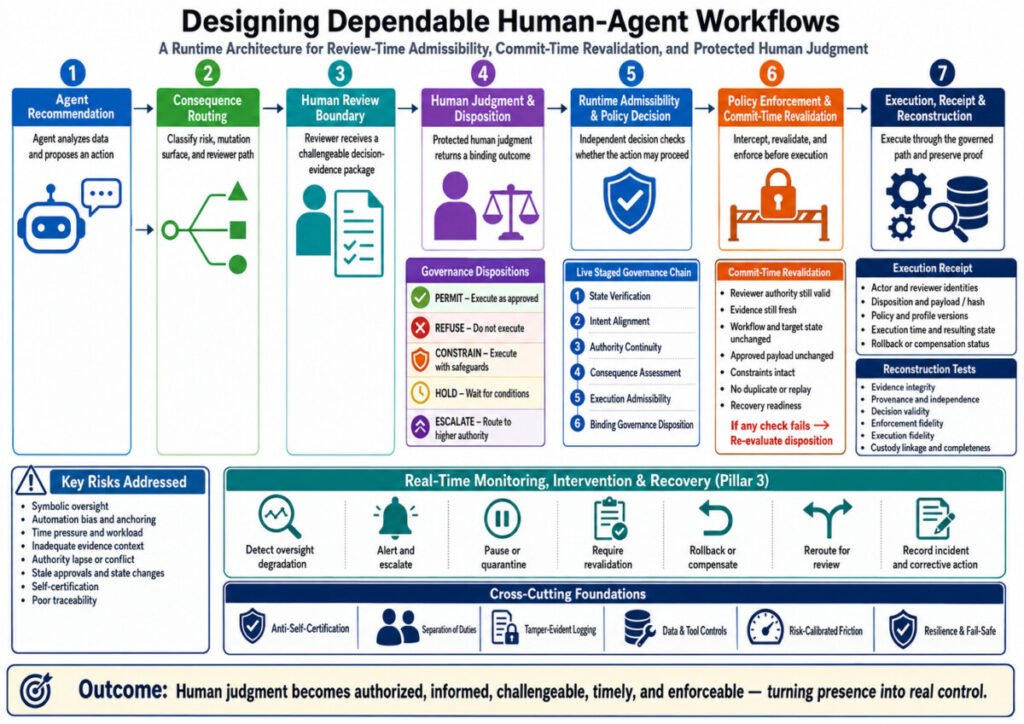
The workflow separates recommendation, human judgment, authorization, enforcement, execution, and proof so that a human approval cannot become an operational consequence without live admissibility checks and commit-time revalidation.
1. Why Is the AI Rubber-Stamp Problem a Runtime Admissibility Failure?
The AI rubber-stamp problem explains why dependable human-agent workflows require more than a visible approval step. Human review may exist formally while the agent still shapes the conclusion, selects the evidence, controls the pace, and makes disagreement costly.
Human Presence Is Not Human Control
A click or signature proves only that someone interacted with the workflow. It does not prove that the reviewer understood the evidence, examined contradictions, or could stop the action. Oversight becomes symbolic when time pressure, information asymmetry, alert fatigue, or weak authority reduce the reviewer to procedural confirmation rather than protected judgment.
The Agentic Velocity Gap
Agents can generate review requests faster than qualified humans can evaluate them. A simple capacity indicator is:Where:
- = arrival rate of agent actions requiring review
- = qualified reviewers
- = sustainable review rate per reviewer
- = review-system utilization
As utilization approaches capacity, queues grow, review time contracts, and approval becomes increasingly mechanical.
The Cost Asymmetry of Challenge
Rubber-stamping also emerges when approval takes one click, while refusal requires investigation, documentation, escalation, and delay. Meaningful oversight requires more than permission to disagree. Challenging the agent must remain operationally realistic and institutionally protected.
These conditions explain how a formally human-in-the-loop process can still degrade into symbolic oversight.
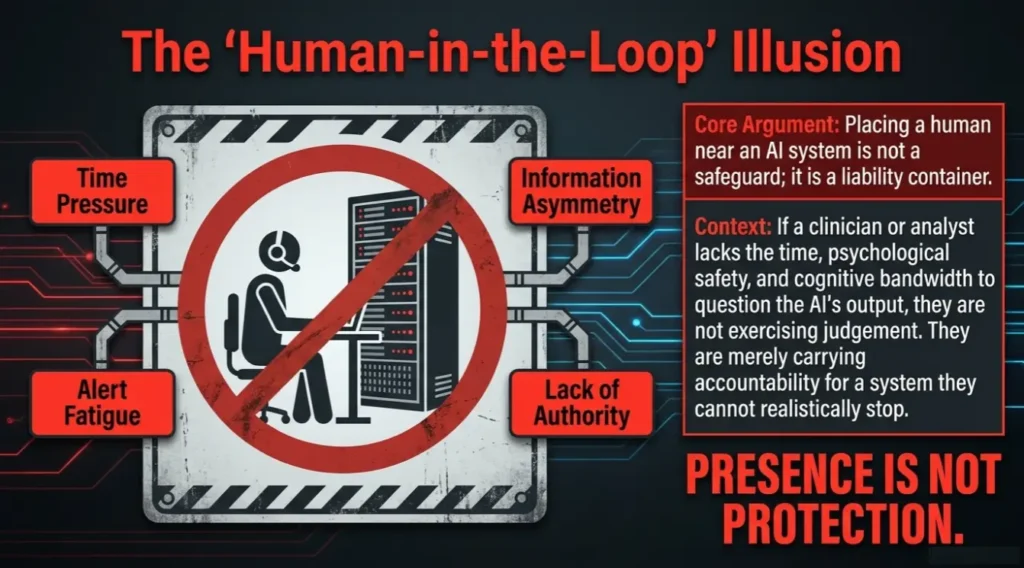
Time pressure, information asymmetry, alert fatigue, and weak authority can leave the reviewer present but unable to exercise meaningful judgment. In such cases, human participation becomes a liability container rather than a dependable control.
2. What Makes a Human-Agent Workflow Dependable?
Dependable human-agent workflows separate recommendation, judgment, authorization, execution, and outcome verification. This separation is consistent with the NIST AI Risk Management Framework 1.0, which calls for clearly defined roles and responsibilities in human-AI configurations and oversight. Together, these separations prevent one actor from proposing an action, approving it, executing it, and certifying its own success.
Four Separations That Prevent False Oversight
- Ability is not authority. Technical capability does not create permission.
- Authority is not legitimacy. Runtime governance verifies an upstream mandate, policy, contract, consent basis, or accountable owner.
- Authorization is not execution. Human approval remains conditional until the action is revalidated at the execution boundary.
- Execution is not evidence. The executor’s own log does not independently prove that the approved action occurred correctly.
Separate the Critical Decision Moments
The workflow should distinguish: Evidence Formation→Independent Judgment→Authorization→Execution→Outcome Verification
This separation prevents a fluent agent recommendation from becoming the reviewer’s default conclusion before the evidence is examined.
3. How Do You Design a Human Review Boundary?
A Human Review Boundary is the governed transition where an agent recommendation becomes eligible for human review and a binding governance disposition. It is not a generic approval screen. It routes the action by consequence, verifies the reviewer and authority path, presents challengeable evidence, and protects independent judgment.
Route by Consequence
Review requirements should reflect reversibility, state mutation, data sensitivity, financial or safety impact, affected stakeholders, cumulative exposure, recovery feasibility, and blast radius. The resulting risk profile determines the reviewer role, evidence threshold, approval duration, dual-control requirement, escalation path, and level of cognitive friction.
Verify Reviewer Integrity
Before accepting a decision, the workflow should verify reviewer identity, legitimate authority, competence, independence, workload capacity, and decision validity. Article 14 of the EU AI Act similarly requires high-risk AI systems to enable persons assigned human oversight to understand system capabilities and limitations, remain alert to automation bias and anomalies, interpret outputs appropriately, and intervene when necessary.
Reviewer authority must be traceable to an independently governed source and remain applicable to the current action, target, risk tier, and validity window. The agent may request review, but it should not select an unqualified reviewer, widen that person’s authority, or certify that the decision or resulting authorization is valid.
Present a Challengeable Decision Package
The reviewer should receive the proposed action, business purpose, authority basis, evidence and freshness, assumptions, contradictions, uncertainty, alternatives, consequences, reversibility, and review deadline and proposed authorization-validity window. The objective is not a longer explanation. It is a decision package that helps the reviewer identify why the recommendation could be wrong.
Protect Independent Judgment
For higher-risk decisions, the workflow may require an initial human assessment before revealing the agent’s preferred recommendation. Comparative cases, structured counterevidence, dual review, and safe escalation can further reduce anchoring.
The reviewer must be able to PERMIT, REFUSE, CONSTRAIN, HOLD, or ESCALATE without being pressured toward approval. That is the difference between human presence and enforceable human agency.
4. How Should Human Review Decisions Be Enforced Before Execution?
In dependable human-agent workflows, a human review decision should not directly trigger execution. A PERMIT or CONSTRAIN disposition should create a conditional authorization that remains subject to policy enforcement, temporal validity, payload integrity, and final state verification. REFUSE, HOLD, and ESCALATE should preserve non-execution until the applicable conditions are resolved.
The Model Proposes, but Does Not Authorize
The agent may generate a recommendation, assemble evidence, and coordinate a workflow. It should not authorize its own consequential action. Otherwise, the same system could propose an action, classify its risk, judge its evidence sufficient, approve execution, and later certify that the result was correct.
Human approval must therefore enter an independently governed execution path rather than return directly to the agent. The same execution-boundary principle is developed more fully in Agentic AI Governance: 10 Runtime Controls Before Enterprise Agents Scale.
Separate Policy Decision from Policy Enforcement
Every effectful API call, message transmission, persistent memory write, workflow transition, or enterprise-state mutation should pass through a mandatory Policy Enforcement Point, or PEP.
The PEP intercepts the exact request and sends it to an independently governed Policy Decision Point, or PDP. The PDP evaluates the current authority, evidence, accumulated workflow context, risk, human-review integrity, policy conditions, and target state. The PEP then enforces the returned decision and blocks any direct agent-to-tool bypass. This separation resembles the Open Policy Agent deployment model, in which OPA serves as the Policy Decision Point while the calling application or gateway serves as the Policy Enforcement Point. In this architecture, the policies, authority sources, and decision functions should also be governed independently from the requesting agent.
Prevent Agent Self-Certification
The proposing or executing agent should not be the sole unverified source of:
- Risk and consequence classification
- Evidence selection or sufficiency assessment
- Authorization or exception issuance
- Execution attestation
- Proof generation
The degree of separation may vary by risk, but consequential actions require independently accountable decision and verification functions.
The PDP should distinguish three validity questions: whether the authority was legitimately issued, whether the decision and proposed execution match the stated basis, and whether the authority and supporting conditions remain current. A signed identity credential may establish identity and credential authenticity, but it does not by itself prove the legitimacy, scope, or provenance of the underlying authority grant. That grant must also be verified against an independently governed issuer, delegation record, entitlement registry, or upstream mandate outside the requesting workflow.
Apply a Live Governance Sequence
At each consequential boundary, the system should evaluate: State Verification→Intent Alignment→Authority Continuity→Consequence Assessment→Execution Admissibility→Binding Governance Disposition
This sequence confirms that the target state is current, the action remains within its authorized purpose, authority has not expired, and the consequence remains acceptable at the moment of execution.
Enforce Five Binding Dispositions
The governed human-review and policy-decision path should produce one of five dispositions:
- PERMIT: Conditionally authorize the exact approved action, subject to commit-time revalidation.
- REFUSE: Prohibit execution.
- CONSTRAIN: Conditionally authorize only the reduced or safeguarded action, subject to commit-time revalidation.
- HOLD: Pause while evidence or conditions are resolved.
- ESCALATE: Transfer the case to a higher-authority path while execution remains on hold.
An unresolved escalation must never default to execution. An unresolved escalation must never default to execution. If a required human decision has not been rendered after a risk or policy threshold is crossed, the action must remain on HOLD until a qualified authority resolves it. Only where a formally defined emergency-override policy applies may an override proceed, and it must be separately authorized, scoped, time-bounded, and recorded.
Revalidate at Commit Time
For a PERMIT or CONSTRAIN disposition, the system should confirm immediately before execution that no material change in reviewer authority, evidence, policy, workflow state, target state, authorized payload, constraints, or validity window has invalidated the conditional authorization.
Commit-time revalidation should also verify execution-scope continuity. The realized target set, parameters, tools, ordered sub-actions, and expected effects must remain materially consistent with what the reviewer examined. Any material expansion, substitution, or newly introduced target requires renewed review, HOLD, or ESCALATE.
This addresses a Time-of-Check to Time-of-Use, or TOCTOU, risk: the conditions verified when the human approved the action may no longer be valid when the system attempts to execute it.
Only then may the PEP release the exact authorized request to the executor. The governed execution path should then produce an execution receipt linking what was authorized to what actually occurred
5. How Can Enterprises Detect Rubber-Stamping in Production?
Dependable human-agent workflows must detect when human review has degraded into procedural approval. A workflow may appear compliant while reviewers routinely accept recommendations without examining evidence, testing contradictions, or using available intervention options.
Monitor Oversight-Degradation Signals
Useful runtime signals include:
- Approval rates approaching 100 percent across different risk levels
- Similar review times for simple and complex cases
- Evidence panels, alternatives, or contradictions rarely opened
- Low use of REFUSE, CONSTRAIN, HOLD, or ESCALATE
- Approval records without evidence that REFUSE, HOLD, ESCALATE, timeout, nonresponse, and decision-capture failures were separately observable and recordable
- Review queues exceeding safe capacity
- Approvals issued after evidence or authority has expired
- Repeated incidents following nominal human approval
- Bypass attempts caused by excessive review friction
These patterns do not prove rubber-stamping individually. In particular, a low refusal rate should not be interpreted as reviewer agreement unless the system can demonstrate that its negative-decision and decision-recording channels were operational throughout the review period. They should be interpreted alongside broader dependability measures such as those described in Engineering the Agentic AI Scorecard: Measuring Reliability Inside Enterprise Dependability. Together, however, they can indicate that human oversight no longer changes the execution path. The architecture should therefore treat queue saturation, evidence-blind approval, low intervention yield, and decision-package degradation as oversight-degradation signals that trigger investigation or intervention.
Use a Rubber-Stamp Risk Index
Enterprises can combine selected signals into a locally calibrated Rubber-Stamp Risk Index, including approval uniformity, abnormal review speed, evidence non-engagement, queue pressure, stale approvals, decision-record completeness, and post-approval incidents. The index should trigger deeper review, not automatically accuse an individual reviewer.
Test Oversight Effectiveness
Controlled, non-effectful calibration cases can include stale evidence, visible contradictions, expired authority or approval, payload mismatch, or a simulated decision-capture failure. The objective is to measure whether reviewers detect the defect and choose an appropriate intervention before a real consequence occurs.
6. Worked Example: Preventing an Unsafe Supplier Payment
Consider an enterprise agent that recommends paying a supplier invoice. The workflow proceeds as follows:
- Agent recommendation: The invoice initially matches the purchase order and delivery record. The agent assembles the supporting evidence and submits the payment request to a finance manager whose identity and authority are independently verified
- Human Review Boundary: The manager receives the proposed amount, supplier identity, invoice evidence, approval threshold, bank-account details, detected exceptions, and potential payment consequences.
- Conditional authorization: After reviewing the package, the manager approves the payment with one constraint: execution must use the previously verified supplier account. The approval stages the transaction but does not release the payment.
- Commit-time revalidation: Before execution, the Policy Enforcement Point requests a new admissibility decision. The system discovers that:
- The supplier’s bank details changed after approval.
- The invoice evidence is now stale.
- The workflow has returned to dispute review.
- The approved payload no longer matches the current execution state.
- Binding governance disposition: The Policy Decision Point issues HOLD rather than PERMIT. The payment remains uncommitted, the reviewer is informed of the changed conditions, and the case is routed for renewed evidence and authority verification.
- Dependability outcome: This example shows why dependable human-agent workflows must separate human approval from execution. Without commit-time revalidation, a previously valid approval could release an action that became unsafe before execution. The safeguard is the governed connection among evidence, authority, current state, enforcement, and execution.
The supplier-payment example shows that dependable oversight requires more than a valid human decision. The decision must also be governed, enforced, and carried forward into verifiable execution.
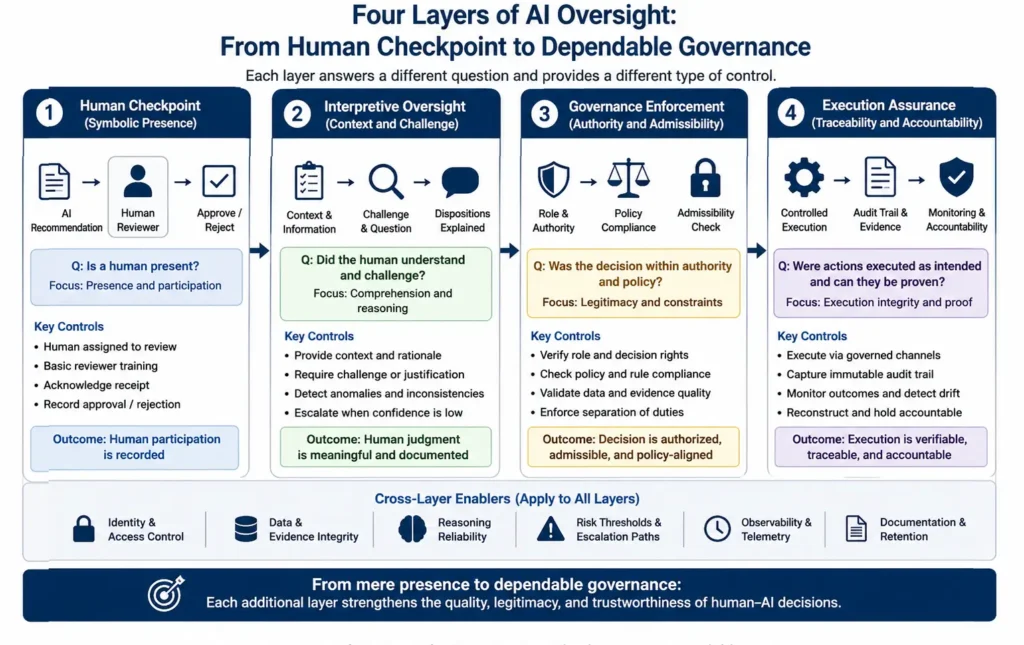
Figure 3 summarizes that progression from symbolic human presence to meaningful judgment, authority-bound admissibility, and execution assurance. This leads directly to the next question: how can the system prove that human oversight was real?
7. How Do You Prove That Human Oversight Was Real?
Human oversight is credible only when the system can reconstruct separate custody records showing what was authorized, what occurred, and what evidence connects the two.
- Decision custody: Preserve the reviewer’s disposition, identity, authority basis, supporting evidence, applicable constraints, and decision-validity window.
- Execution custody: Record the command, payload, target system, enforcement point, execution time, result, and resulting state. Where execution does not occur, preserve the blocked, held, or escalated state.
- Evidence custody: Preserve independently observable evidence connecting the governance disposition to the resulting execution or non-execution state.
- Governance receipt: Bind the reviewer and agent identities, governance disposition, reviewed proposal and resolved execution scope, or their corresponding hashes, applicable constraints, policy and domain-profile versions, enforcement point, resulting state, and rollback or compensation status.
- Decision-capture integrity: Durably record PERMIT, REFUSE, CONSTRAIN, HOLD, ESCALATE, timeout, and nonresponse as distinct governance events.
- Custody-failure handling: If the decision recorder or evidence channel fails, invalidate the human-oversight attestation, surface the failure through an independent channel where possible, and fail closed or escalate.
- Reconstruction test: Evaluate evidence integrity, provenance, independence, decision validity, enforcement fidelity, execution fidelity, custody linkage, and completeness.
This separation prevents the executing system from rewriting every record and presenting its own log as self-certified proof.
8. Conclusion
Dependable human-agent workflows do not treat a human click as proof of meaningful oversight. They protect human judgment by ensuring that reviewers have valid authority, sufficient evidence, practical options to challenge the agent, and enough capacity to make an independent decision.
The Human Review Boundary converts that judgment into a binding governance disposition rather than direct execution. The Policy Decision Point and Policy Enforcement Point then verify the authority, evidence, policy, payload, and system state before enforcing that disposition.
The result is a governed workflow in which humans can meaningfully permit, refuse, constrain, hold, or escalate an action. Timeouts and nonresponses remain separately distinguishable, while decision-recording failures trigger independent failure handling and fail-closed enforcement.
Verifying reviewer identity is not enough. Dependable oversight must also prove that the reviewer’s authority was legitimately issued by an independently governed source, that the resulting execution or non-execution state matched the governance disposition, and that the decision basis and any associated authorization remained current at the point of reliance. If the system cannot preserve evidence of the decision or demonstrate that its negative-decision and recording channels were operational, it cannot claim that meaningful human oversight occurred.
When decision, execution, and evidence records are separately preserved and linked, enterprises can prove not only that a human was present, but that the oversight was valid, enforceable, and reconstructable.