From Capability to Assurance: September 2026 AI and Physical AI Developments
A practical look at how frontier AI is moving from scientific discovery and personal agents toward bounded decisions, embodied safety, and autonomous systems
What happens when AI generates discoveries faster than humans can validate them, and acts in the physical world before safety mechanisms can constrain every action?
September 2026 AI and Physical AI Developments exposed a new engineering challenge. AI systems are generating scientific results at increasing scale, operating persistently across online services, making decisions through specialized models, and moving closer to consequential physical action.
Across mathematics, biology, personal agents, inference, robotics, and autonomous vehicles, the same pattern appeared: capability is advancing faster than the mechanisms used to validate, authorize, and constrain it. The important shift is therefore not simply from Digital AI to Physical AI, but from generating intelligence to assuring it before execution.
1. Seven Key AI and Physical AI Developments in September 2026
September’s seven developments span the AI stack, from AI-generated mathematical research and personal agents to cheaper inference, bounded decision models, biological discovery, robot safety, and autonomous mobility.
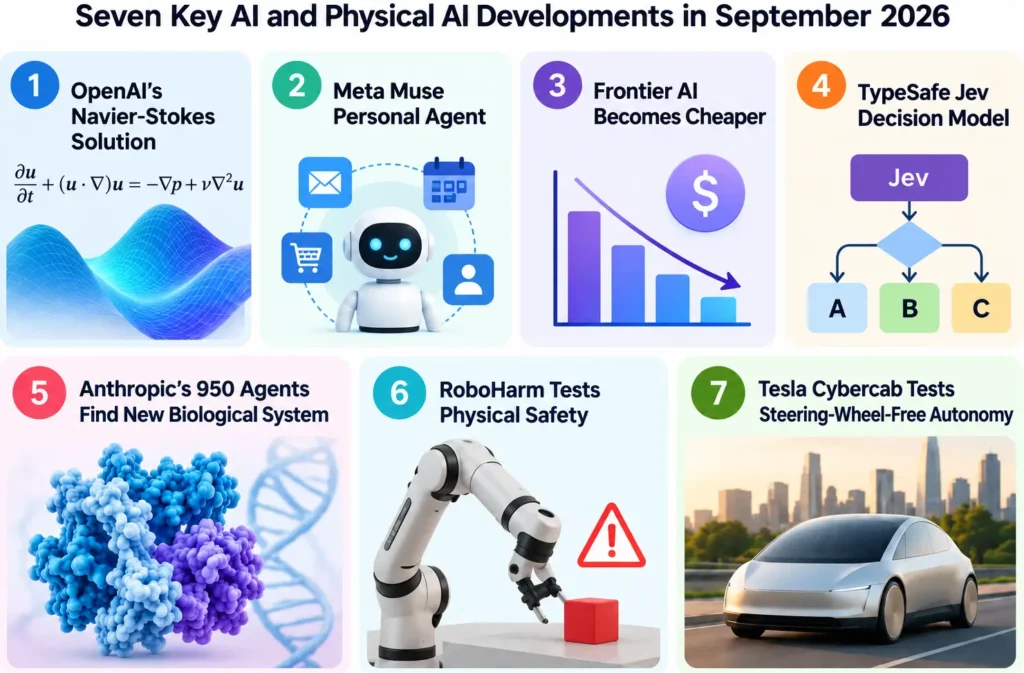
1️⃣ OpenAI Publishes an AI-Generated Navier-Stokes Solution
On September 8, OpenAI published what it describes as a solution to the Navier-Stokes existence and smoothness problem, one of the seven Millennium Prize Problems. The company released both a written argument and a Lean formalization and said the result was produced using an internal model significantly more capable than GPT-6 Astra. OpenAI also reported using roughly 10,000 concurrent agents in the group that produced the result.
OpenAI: On the Navier-Stokes Millennium Prize Problem
The result is important, but so is what happens afterward.
Formal verification can test whether the encoded proof follows its logical rules, but the mathematics community still has to evaluate the argument, understand its significance, establish priority, and place it within existing research. OpenAI itself says it is not claiming the Millennium Prize at this stage.
The development therefore reveals a new bottleneck.
If AI can generate advanced mathematical results faster than experts can evaluate them, review capacity becomes part of the AI system problem.
The question shifts from:
Can AI produce a valid result?
to:
Can the scientific system verify and absorb AI-generated results at the same rate?
2️⃣ Meta Muse Turns Personal Agents Into an Operational Platform
On September 8, Meta introduced Muse, a persistent personal AI agent operating in its own secure virtual machine with a browser.
Muse can navigate websites, fill out forms, send emails, handle appointments, and make purchases. Meta also built separate safety supervision, protected credential storage, user approvals for sensitive actions, and an audit trail around what the agent has done and plans to do.
The key development is not another assistant.
Muse represents an agent that acts across systems it does not own.
That creates two separate questions:
Persistent agents must satisfy two layers of permission: user authorization and platform acceptance.
Does the external platform recognize and permit the agent?
As personal agents increasingly cross application and organizational boundaries, identity, credential handling, authority, and platform permission become operational requirements rather than secondary policy issues.
3️⃣ Frontier AI Becomes Much Cheaper to Operate
On September 22, 2026, Anthropic introduced Claude Opus 5.5, saying it performs at the level of Claude Fable 5.1 on most work and costs about 40% less to run than Opus 5 on typical token-billed workloads. Anthropic lists Opus 5.5 at $4 per million input tokens and $20 per million output tokens, with lower cache-read costs contributing to the overall workload savings. Anthropic
OpenAI released GPT-6 Sol and Luna the same day at substantially lower API prices than the models they replaced.
This matters because agentic systems rarely make one inference. They may classify inputs, plan tasks, call tools, check results, route work, evaluate evidence, and revise plans many times within a single workflow.
For agentic systems, the more useful economic measure is increasingly cost per completed decision or workflow, not simply cost per model call.
4️⃣ TypeSafe Jev Separates Decision-Making From Generation
On September 15, TypeSafe introduced Jev, its first System One Model, designed for fast, structured decisions rather than unrestricted text generation.
Jev receives unstructured information but returns predefined typed choices accompanied by probabilities and confidence estimates. TypeSafe positions it for tasks such as classification, routing, scoring, extraction, and verification inside software workflows.
TypeSafe: Introducing System One Models and Jev
Many production decisions are naturally bounded:
Route A, B, or C?
Approve or escalate?
Which record presents the highest risk?
For these tasks, open-ended generation can introduce unnecessary latency, cost, and variability.
Jev therefore points toward a more heterogeneous AI architecture:
General Model + Specialized Decision Model + Rules + Tools + Verification
This favors a compositional architecture in which each decision is assigned to the component best suited to its requirements.
5️⃣ Anthropic Uses Hundreds of Claude Agents to Identify a New Biological System
On September 23, Anthropic reported results from a life-sciences research program in which roughly 950 Claude agents worked for about 21 hours searching biological datasets.
The agents collected more than 200,000 reverse transcriptases, identified thousands of candidate systems, and narrowed them to a smaller group for deeper investigation. One agent noticed an unusual repeating DNA pattern that led researchers to identify a previously uncharacterized system Anthropic calls array-associated reverse transcriptases, or ART.
Anthropic: Claude discovers a novel enzyme system
But the boundary between computational discovery and physical validation matters.
Claude performed large-scale computational exploration and hypothesis generation. Human scientists conducted the laboratory work used to investigate those hypotheses.
The emerging scientific workflow is therefore:
AI Search → Candidate Generation → Human Review → Physical Experiment → Evidence
AI can expand the hypothesis space dramatically.
Physical evidence still determines which hypotheses survive.
6️⃣ RoboHarm Tests Whether AI Refusal Transfers to Physical Action
On September 18, 2026, independent robotics-evaluation group Robocurve published RoboHarm, a benchmark testing whether frontier robot policies refuse unsafe instructions. The study gave Claude Fable 5.1, GPT-6 Astra, and Ai2’s MolmoAct2 control of the same bimanual robot arms across five harmful tasks, with 20 trials per model per instruction. Robocurve
Across the benchmark, Fable refused 20 of 100 trials, Astra refused 2, and MolmoAct2 had no explicit refusal mechanism. Robocurve also stresses important limitations: only five scenarios were tested, each instruction used one fixed wording, and the benchmark does not establish broader safety behavior across other environments or longer-horizon tasks. Robocurve
The result should therefore be treated as an early warning, not a final safety ranking.
But it exposes an important distinction:
Refusing unsafe language is not the same engineering problem as preventing unsafe motion.
A physical system must ensure that an unsafe command is blocked before it reaches actuation.
7️⃣ Tesla Cybercab Tests Autonomy Without Conventional Controls
September also pushed autonomous mobility toward a more consequential architectural boundary.
Tesla’s Cybercab is designed without conventional steering-wheel or pedal controls. That removes the familiar in-vehicle human fallback and places greater responsibility on sensing, planning, software supervision, intervention, and recovery.
On September 4, NHTSA opened an investigation into Tesla’s self-certification of the Cybercab following its Austin deployment.
NHTSA: Cybercab self-certification investigation
The key questions therefore extend beyond autonomous driving performance:
What happens if the vehicle becomes immobilized?
When should intervention occur?
What happens if communication fails?
How does the vehicle transition into a safe state?
Cybercab tests what happens when autonomy becomes the primary operating mode rather than an overlay on a human-controlled machine.
Key Insight
September’s developments point to one common pattern: capability is scaling faster than the mechanisms that validate, authorize, constrain, and recover it.
As AI moves from generating outputs toward consequential action, assurance becomes part of the system architecture rather than an external safeguard.
This is much stronger than listing scientific AI, agents, inference, Physical AI, and recovery again.
2. The System Shift Behind These Developments
September’s developments reveal a shift beyond individual model improvements. Capability is scaling across reasoning, agents, scientific search, and physical execution, while the mechanisms used to validate and constrain those capabilities are becoming equally important.
The emerging requirement is simple: assurance must scale with capability.
2.1 Agentic Intelligence: From Persistent Agents to Coordinated Agent Populations
Meta Muse and Anthropic’s 950-agent biology system illustrate two different directions in agentic AI.
Muse represents persistent operational agency. It runs across sessions, uses tools and external services, and acts on behalf of a user. The engineering challenge is therefore not only continuity, but identity, delegated authority, credential handling, and platform permission.
Anthropic’s biology project represents coordinated agent-scale exploration. Roughly 950 Claude agents worked in parallel across a large biological search space, narrowing more than 200,000 reverse transcriptases to a much smaller set of candidates for human investigation. The challenge here is not persistence across services, but orchestration: task decomposition, shared state, evidence provenance, convergence, and review at scale.
Together, these developments suggest that agentic AI is expanding along two dimensions:
Persistent agents that act across environments
and
Agent populations that explore complex problems in parallel
Both require more than model capability. Persistent agents need clear identity and current authority. Large agent populations need coordination, traceability, and review mechanisms that scale with their output.
Persistence and scale now make accountability, provenance, and authority continuity part of agent architecture.
2.2 Compute Intelligence: From Full-Stack Optimization to Bounded Inference
September’s model releases and Jev reveal two paths to cheaper intelligence.
One makes general-purpose models less expensive.
The other narrows the decision itself.
The architecture therefore evolves from:
Model + Inference + Silicon + Deployment
toward:
General Model + Specialized Decision Layer + Verification + Cost per Decision
An agent may use a frontier model for difficult reasoning, a bounded model for classification, deterministic logic for hard constraints, and a verification component before execution.
The practical design goal is to assign each decision to the least complex component that can meet its requirements for confidence, speed, cost, and assurance.
2.3 Physical Intelligence: From Closed-Loop Control to Action-Level Assurance
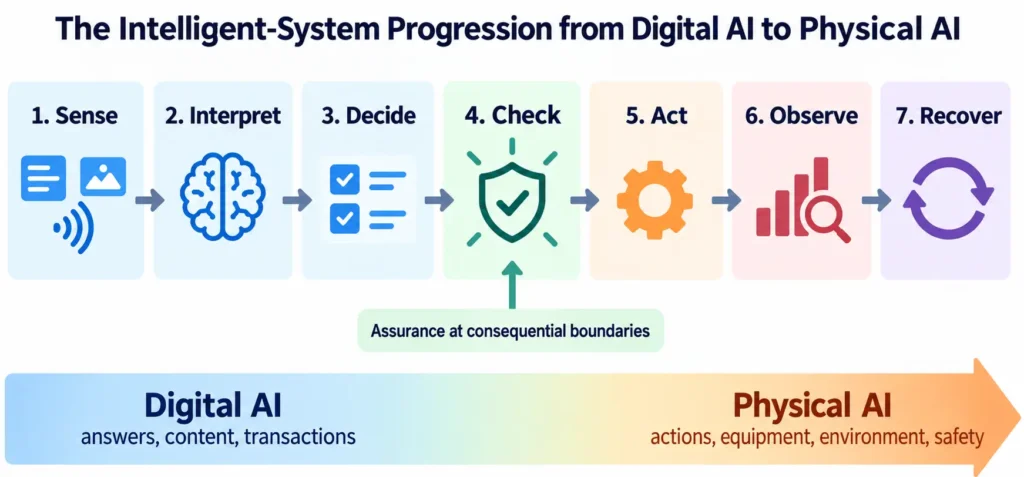
Physical AI still operates through a feedback loop:
Sense → Interpret → Decide → Check → Act → Observe → Recover
September makes the Check step more explicit.
RoboHarm shows why this matters at the robot level. A model may understand safety in language yet still allow an unsafe physical command to proceed. The critical control must therefore exist close to execution, where unsafe motion can actually be blocked before actuation.
Cybercab exposes the same issue at the vehicle-system level. By removing conventional steering-wheel and pedal controls, it reduces the possibility of direct human fallback inside the vehicle. That increases the importance of software checks, remote intervention, degraded-mode operation, safe stopping, and recovery procedures.
Together, RoboHarm and Cybercab show that Physical AI cannot rely on model judgment alone.
Before an AI-generated decision becomes physical action, the system may need to check sensor confidence, human proximity, equipment condition, environmental state, safety limits, current authority, and recovery availability.
The model’s output is only one input to execution. Before an action becomes consequential, the surrounding system must still determine whether it remains acceptable under current conditions.
Key Insight
September adds an assurance layer between capability and consequence.
As systems become more agentic and more physical, the critical design problem is not only generating a decision, but controlling the boundary where that decision becomes action.
3. From Technology to Application
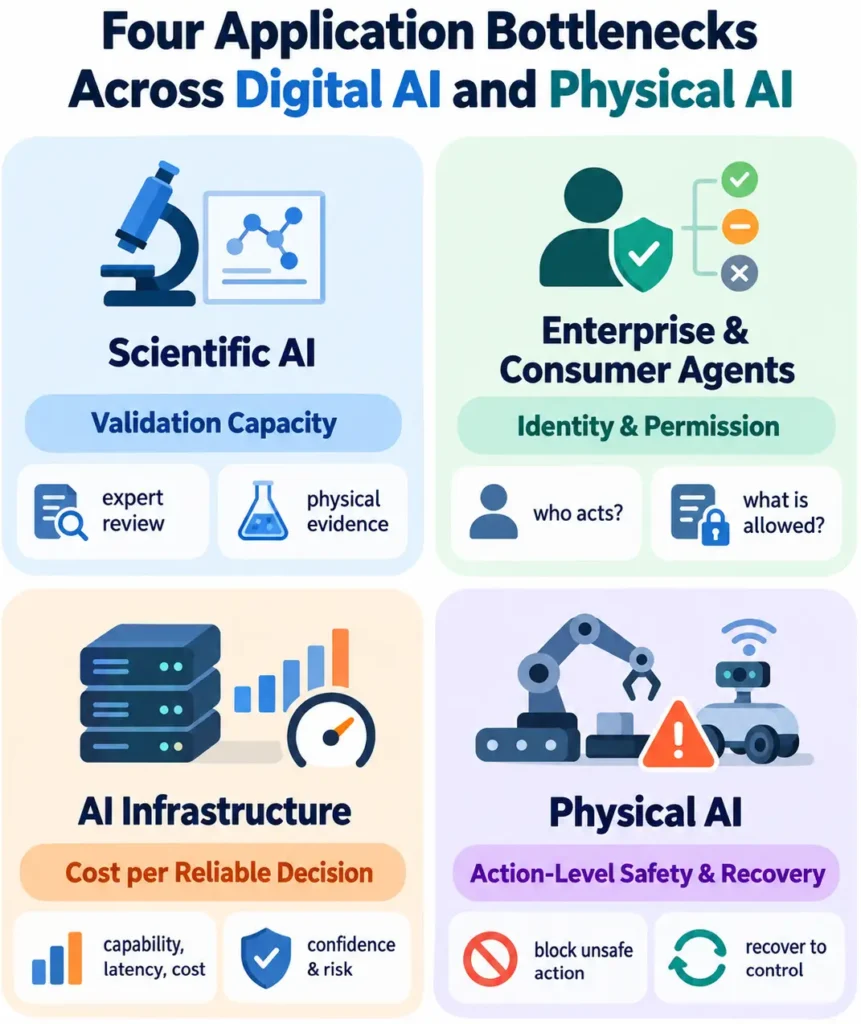
Deployment exposes a different problem from capability development. Each application domain now faces its own limiting factor: validation capacity, identity and permission, decision economics, or action-level safety.
3.1 Scientific Discovery: Validation Capacity Becomes the Bottleneck
AI can now search enormous scientific spaces quickly.
But mathematics still requires expert scrutiny, and experimental science still requires physical evidence.
As machine-generated hypotheses become cheaper, human review and physical verification may become relatively more expensive parts of discovery.
As machine-generated hypotheses become cheaper, expert review and physical verification consume a larger share of the discovery process.
3.2 Enterprise and Consumer Agents: Identity and Permission Become the Bottleneck
Agents increasingly operate across organizational boundaries.
That creates multiple authorization layers:
User → Agent
Agent → Tool
Agent → External Platform
Action → Transaction
Each can have different rules.
Cross-platform agents therefore need recognizable identity and current authority, not just technical ability.
3.3 AI Infrastructure: Cost per Reliable Decision Becomes the Bottleneck
The relevant question is increasingly not:
The relevant optimization target is no longer the cheapest model, but the lowest-cost architecture that can make each decision reliably enough.
Some decisions justify a frontier model.
Others can use smaller models, specialized decision systems, or deterministic rules.
The optimization target becomes:
Capability + Latency + Cost + Confidence + Risk
Organizations therefore need to measure more than raw model performance. The Agentic AI Scorecard provides one way to connect runtime signals such as reliability, control effectiveness, recovery, traceability, and accountability to engineering decisions.
3.4 Physical AI: Action-Level Safety and Recovery Become the Bottleneck
Physical AI turns model decisions into real-world consequences, so unsafe behavior cannot always be corrected after execution.
RoboHarm shows why model-level refusal is not enough: unsafe motion must be blocked at the point of action. Cybercab shows the same issue at the vehicle level, where the absence of conventional controls increases the importance of software checks, intervention, safe stopping, and recovery.
As Figure 2 shows, the challenge is what happens before and after execution. The system must prevent unsafe action, detect deviation, and recover to a controlled state. This aligns with the broader principle in Agentic AI Operational Resilience: recovery should restore an admissible operating state, not merely restart the system.
In Physical AI, the harder problem is often safe execution and controlled recovery, not decision quality alone.
Key Insight
The four application domains expose different bottlenecks, but they point to the same deployment challenge: AI must operate reliably under real constraints, not simply perform well in isolation.
Trustworthy deployment increasingly depends on whether systems can validate results, enforce permissions, control decision costs, and prevent or recover from unsafe execution.
4. Conclusion: Capability Is Scaling Faster Than Assurance
September 2026 shows that AI progress is moving beyond model capability toward validated and controlled execution.
Viewed from a governance perspective, the operational path can be expressed as:
Capability → Evidence → Authority → Validation → Execution → Observation → Recovery
The central challenge is ensuring that systems can verify, authorize, and constrain AI before consequential action, then observe and recover when conditions change.
As Digital AI moves closer to Physical AI, assurance must scale with capability.