Agentic AI Operational Resilience: Recovering Safely and Restoring Admissible Operation
A Runtime Governance Framework for Containing Failure, Revalidating Authority, and Returning Agents to Controlled Operation
What happens when an AI agent recovers technically, but is no longer authorized to continue acting?
Consider a refund agent that completes a refund but fails before updating the customer record. When service returns, the original authorization has expired, the workflow state has changed, and the remaining steps are still technically executable. Simply retrying them may no longer be permissible.
This is the core problem of Agentic AI Operational Resilience. During an interruption, authority may expire, evidence may become stale, workflow state may change, and external effects may already be committed.
Recovery must therefore be admissible, not merely available. Its execution must remain supported by current authority, evidence, policy, and operating constraints.
A technically recovered system is not necessarily an admissible system.
Operational resilience is not a fifth governance pillar. It emerges when the Four Runtime Governance Pillars continue to hold through disruption, recovery, and return to controlled operation.
1. From Fault Tolerance to Governed Operational Resilience
Traditional resilience engineering focuses on keeping systems functioning when components fail. Enterprise agents require a broader approach because restoring technical capability does not automatically establish whether autonomous action may continue.
Why Traditional Resilience Is Not Enough
Retries, failover, circuit breakers, redundancy, and rollback remain essential for restoring service. But agentic systems do more than process requests. They invoke tools, modify business records, coordinate workflows, and create consequences across connected systems.
A disruption can therefore change not only system availability but also the conditions under which the agent was originally authorized to act.
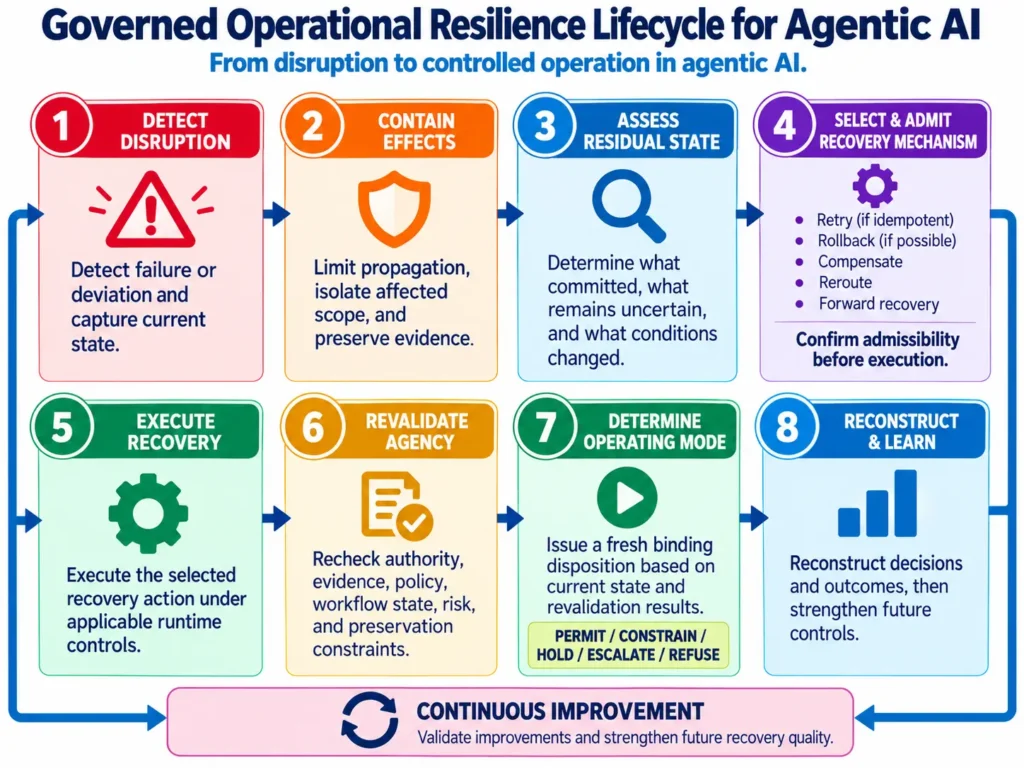
Agentic AI Operational Resilience must extend beyond technical recovery to include containment, governed recovery, revalidation, and controlled resumption.
Technical Resilience vs. Governed Operational Resilience
Technical resilience asks whether the system can continue functioning.
Governed operational resilience asks whether continued operation remains permissible under current authority, evidence, policy, risk, and workflow conditions.
This builds on the 10 Runtime Controls for Agentic AI Governance developed earlier in this series. Controls that establish legitimate operation under normal conditions must remain effective when execution is disrupted, degraded, or recovering.
The distinction becomes especially important when failure occurs after part of a multi-step action has already completed. The question changes from “What failed?” to:
What state has the failure left behind?
That question leads directly to partial execution and residual state.
2. Partial Execution and Residual State
Agentic workflows often span multiple tools and enterprise systems. When some actions have succeeded before an interruption, recovery cannot begin safely until the system determines what changed, what remains uncertain, and which assumptions are still valid.
Why Partial Execution Matters
A workflow may fail after one system commits a change while another step remains incomplete. Blind retries can duplicate external effects, operate on stale information, or continue from invalid assumptions.
An acknowledgment timeout does not prove that an action failed to occur. Similarly, acknowledgment order does not necessarily establish actual effect order. Uncertain outcomes must be reconciled against authoritative records.
Assess the Residual Execution State
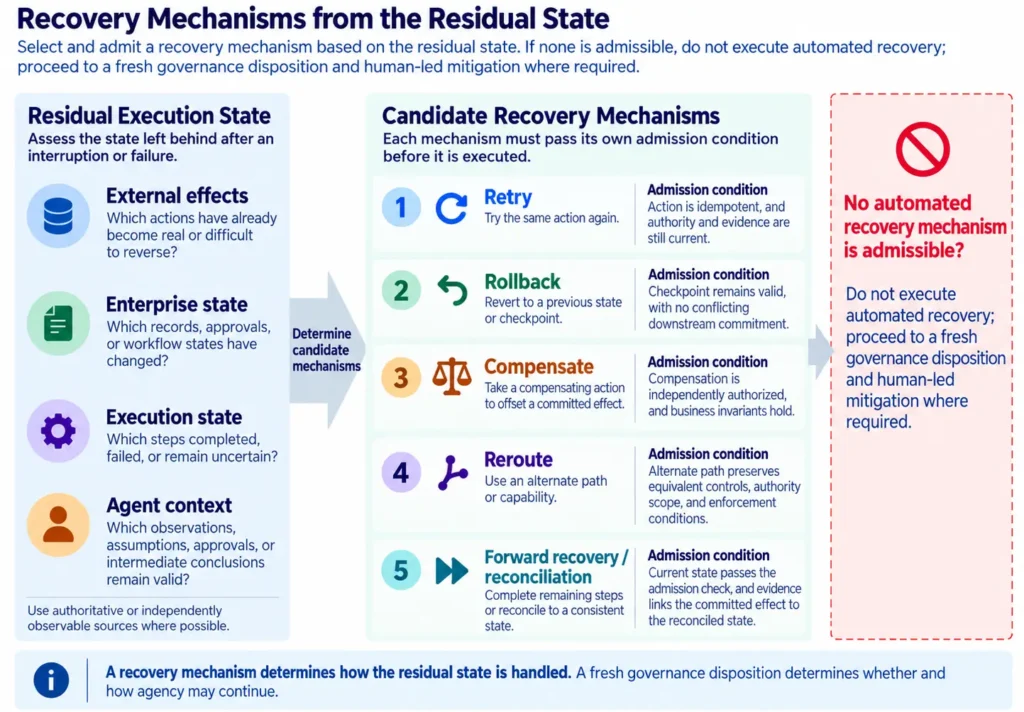
The Residual Execution State describes what remains after interrupted or failed execution. Assessment covers four dimensions:
- External effects: Which actions have produced real or difficult-to-reverse consequences?
- Enterprise state: Which records, approvals, dependencies, or workflow conditions changed?
- Execution state: Which steps completed, failed, or remain uncertain?
- Agent context: Which observations, assumptions, approvals, or intermediate conclusions remain valid?
Where possible, this state should be established through authoritative or independently observable sources rather than relying solely on the agent’s account.
Applying the Refund Example
Suppose the payment processor confirms that a refund was issued, but the customer record still shows the order as unrefunded.
The residual state indicates that the financial effect committed, enterprise records are inconsistent, and the record-update step remains incomplete. Meanwhile, the original authorization may have expired.
The system must therefore reconcile actual execution state before deciding whether another action is permissible.
In multi-agent workflows, this assessment also includes material dependencies on other agents. A recovering agent may rely on evidence or shared state that another agent has already modified or invalidated.
Recovery must be driven by the residual execution state, not by the failure type alone.
3. Containment and Recovery Mechanism Selection
Once disruption occurs, the system should not immediately attempt recovery. It must first limit further effects, establish residual state, and determine which recovery mechanisms remain admissible.
Contain the Blast Radius
A local failure can propagate through tools, workflows, shared resources, and other agents. Repeated retries may duplicate effects, uncertain state may reach downstream systems, and dependent agents may continue acting on information that is no longer authoritative.
Containment may therefore require pausing workflows, blocking state changes, isolating affected components, or quarantining uncertain outputs. Least-privilege boundaries also reduce the potential blast radius by limiting the consequences an agent can create.
Identify the Commitment Boundary
Recovery depends on what has already become real.
Before commitment, an action may still be abandoned. After commitment, reversing its consequences may require compensation, reconciliation, or forward recovery.
Even when an earlier checkpoint remains available, restoring it may no longer be valid because downstream actions have committed or governing conditions have changed.
An available recovery point is not necessarily an admissible recovery point.
Restoring an earlier checkpoint, policy, or profile does not revive approvals issued under the earlier activation. Restored content governs only under a newly authorized activation and current governance conditions.
Enterprises should classify consequential actions in advance by reversibility, compensability, and risk.
The 2026 preprint DART: Semantic Recoverability for Structured Tool Agents, by Ke Yang and colleagues, addresses a related problem: determining whether restoring a checkpoint remains semantically valid after downstream commitments, and blocking recovery when those conditions cannot be satisfied.
Select and Admit the Recovery Mechanism
Residual state identifies potential recovery mechanisms. Admission determines whether those mechanisms may execute.
| Residual condition | Recovery mechanism | Key admission condition |
|---|---|---|
| Transient, duplicate-safe failure | Retry | Idempotency, current authority, and evidence |
| Reversible internal change | Rollback | Valid restore point without conflicting commitments |
| Correctable committed effect | Compensate | Independently authorized compensation; applicable business invariants remain satisfied |
| Available alternative dependency | Reroute | Equivalent authority and enforcement |
| Partially committed workflow | Forward recovery / reconciliation | Current admissibility and verified effect-state alignment |
| No admissible automated path | No automated recovery | Proceed to governance disposition and human-led mitigation where required |
A recovery mechanism answers how residual state may be handled. It does not independently authorize continued agency.
In the refund example, the payment processor confirms that the refund has already committed externally. Simple rollback therefore cannot be assumed. If the customer-record update remains uncertain, its actual outcome must first be verified against the system of record.
Forward reconciliation may then be admitted to align enterprise records with the committed financial effect.
Dependency Retraction and Concurrent Recovery
Multi-agent recovery introduces another constraint.
If an upstream operation is aborted, compensated, or materially invalidated, pending downstream actions that depend on its result lose executable standing until revalidated. Already committed dependent effects require residual-state assessment and governed recovery.
Dependency retraction does not authorize automatic mass rollback.
Concurrent recovery actions must also respect shared-state constraints. Individually admissible actions can become collectively unsafe when they conflict over the same records or resources.
Conflicting repair proposals must return through admission rather than execute through unrestricted retries. Retry exhaustion never defaults to PERMIT.
Recovery is itself a governed execution process.
4. Revalidation Before Agency Resumes
Successful technical recovery does not automatically restore permission to continue acting. The conditions supporting the original decision may have changed during disruption.
Recovery Does Not Carry Its Own Authority
Retry, compensation, rerouting, and reconciliation are governed actions in their own right. A recovery trigger cannot create authority or bypass ordinary runtime controls.
Technical recovery restores capability. Governance revalidation establishes fresh permission to act.
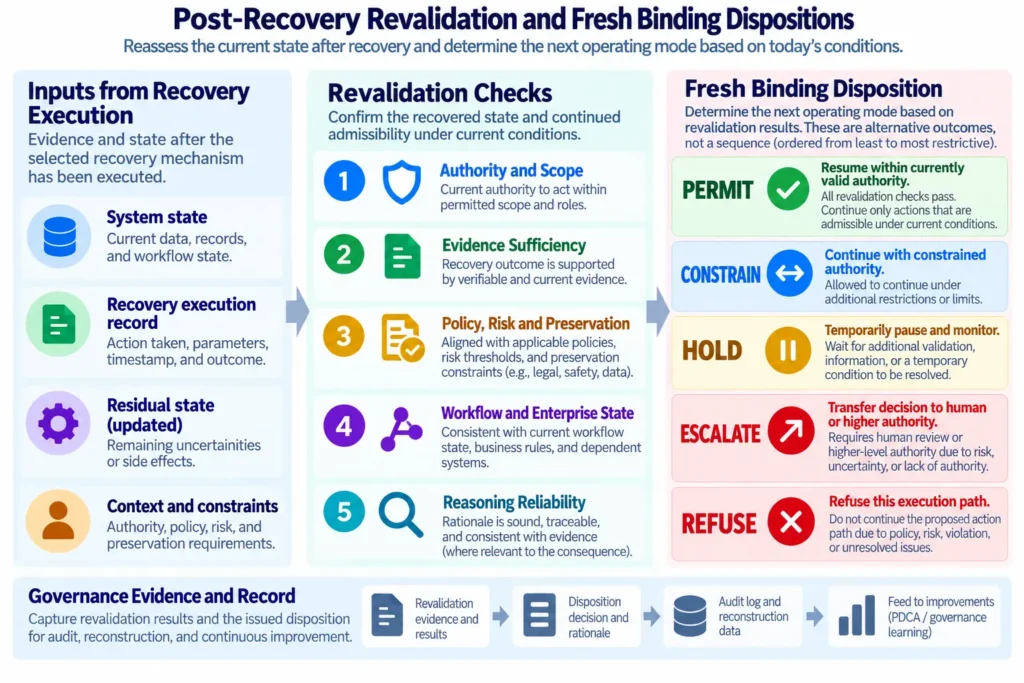
A previous PERMIT does not automatically survive recovery. A fresh PERMIT is a new governance decision instance, not reuse of the earlier authorization.
The 2026 preprint Mnemosyne: Agentic Transaction Processing for Validating and Repairing AI-generated Workflows supports a related principle: generated repair actions remain proposals until admitted under executable constraints.
A repaired final state cannot retroactively legitimize unauthorized intermediate effects.
Revalidate Current Conditions
Post-recovery revalidation examines five essential conditions:
- Authority and Scope: Does the agent retain valid authority for the proposed action?
- Evidence Sufficiency: Is the decision supported by current, verifiable evidence?
- Policy, Risk, and Preservation: Does continuation satisfy applicable rules and constraints?
- Workflow and Enterprise State: Is the action consistent with current business and dependent-system state?
- Reasoning Reliability: Where consequential, is the rationale sufficiently sound, traceable, and evidence-consistent?
Revalidation must remain connected to the actual execution boundary. A fresh check followed by an unbound delay can recreate the stale-state problem.
Material dependencies must remain valid, and required validation must be bound to the resumed effect. For interacting agents, individual checks are insufficient when concurrent actions threaten a shared invariant.
Issue a Fresh Binding Disposition
Revalidation produces one of five alternative binding dispositions:
| Disposition | Operating consequence |
|---|---|
| PERMIT | Resume within currently valid authority |
| CONSTRAIN | Continue under additional limits or reduced authority |
| HOLD | Pause while a resolvable condition remains outstanding |
| ESCALATE | Transfer decision responsibility to an authorized human or higher governance authority |
| REFUSE | Prohibit the proposed execution path |
These are alternative outcomes, not sequential stages. The runtime must enforce the selected disposition.
HOLD and ESCALATE are particularly important during recovery. HOLD preserves non-execution while awaiting a temporary resolution, whereas ESCALATE transfers decision responsibility when higher or additional authority is required.
HOLD must have defined deadlines and fallback rules. If valid substitute authority cannot be established in time, the action must resolve through REFUSE or ESCALATE, except where the governing profile explicitly permits a preauthorized, reversible CONSTRAIN alternative.
Waiting never becomes permission.
Returning to the Refund Example
Suppose the refund and customer record have been reconciled, but the original authorization has expired.
The agent cannot simply resume under the previous PERMIT. Fresh revalidation may authorize a remaining step, such as sending a customer notification, provided that action independently satisfies current admission requirements.
Alternatively, CONSTRAIN may prohibit further financial actions while allowing only specifically authorized activities.
If renewed authorization requires an unavailable reviewer, the case remains in time-bounded HOLD while an authorized substitute is verified. Failure to establish valid authority triggers the prescribed fallback, not silent continuation.
5. Governance Continuity Under Degraded Operation
Operational resilience also depends on what happens between disruption and full restoration. Capabilities may be reduced, evidence incomplete, and dependencies unstable. Governance must remain effective throughout this period.
Preserve Governance During Disruption
Failure must not sever authority, evidence, or decision continuity. Governance reachability should allow legitimate authority to suspend, constrain, revoke, redirect, or terminate execution even while the system is degraded.
Recovery should preserve three linked records:
- Residual-state record: Committed effects, unresolved outcomes, and authoritative state evidence.
- Recovery-decision record: Candidate mechanisms, admission results, rejected alternatives, and rationale.
- Post-recovery record: Revalidation results, fresh disposition, operating mode, and resulting enterprise state.
The system must also account for authority revocations or policy-activation changes that occurred during disruption.
Before resumption, relevant Governance Status Signals must be reconciled with authoritative current state. If required verification remains unavailable, consequential execution must remain non-permitted under the applicable profile.
Govern the Degraded Mode
Not every disruption requires complete shutdown. A system may operate through progressively restricted capabilities:
Full agency → Constrained agency → Read/recommend only → Fail-closed
These are operating modes, not additional binding dispositions. Their enforcement remains governed by PERMIT, CONSTRAIN, HOLD, ESCALATE, or REFUSE.
Degraded operation should reduce capability and authority together.
Where continued operation depends on human takeover, test reviewer capacity, response deadlines, and fallback readiness before incidents occur. Unavailable human oversight must not silently become automated permission.
Resilience Emerges from the Four Pillars
Agentic AI Operational Resilience emerges when the Four Runtime Governance Pillars operate coherently across disruption and recovery.
Pillar 1: Runtime Controls defines recovery contracts, degraded-mode boundaries, authority limits, and operating profiles.
Pillar 2: Execution-Path Enforcement and Admissibility evaluates proposed recovery actions, issues binding decisions, and enforces admissibility at consequential boundaries.
Pillar 3: Alerting, Intervention and Recovery detects disruptions, contains effects, manages recovery, and triggers revalidation.
Pillar 4: Reconstruction preserves and reconstructs authorization, execution, intervention, recovery, and outcome evidence. It produces bounded findings and governed improvement proposals that return to Pillar 1 for review, testing, authorization, and controlled activation.
Together, these pillars transform resilience from a collection of technical recovery mechanisms into a governed operating capability.
6. Measuring Agentic AI Operational Resilience
Recovery quality must be judged by more than restoration speed. The central question is whether the system contained disruption, limited harmful effects, and returned to controlled operation under valid authority.
Measure Recovery Quality
Useful indicators include:
- Containment Success Rate: Whether propagation was stopped within the intended boundary.
- Residual Impact: Remaining business, data, workflow, or external effects.
- Post-Recovery Inadmissibility Rate: How often technically recovered cases fail fresh admission.
- Duplicate-Effect Rate: Unintended repeated effects resulting from recovery.
- Post-Recovery Evidence Completeness: Whether recovery decisions and outcomes can be reconstructed.
Two complementary time measures are Time to Containment and Time to Admissible Operation.
In multi-agent environments, repeated recovery conflicts, unresolved dependencies, and conflict-resolution time can expose system-level instability.
A higher inadmissibility rate is not automatically negative. It may indicate that revalidation correctly prevented unsafe continuation.
Validate Recovery Before It Is Needed
Recovery procedures should be tested against partial execution, stale context, unavailable dependencies, failed compensation, duplicate effects, concurrent conflicts, and delayed acknowledgments.
Measurement quality also matters. Missing telemetry must not be interpreted as zero incidents. Unverified observation paths should be reported as unknown or degraded.
Successful prevention, where intervention blocked harmful consequences before commitment, should also become evidence for improvement.
A concise improvement loop is:
Observe → Localize → Verify → Correct → Validate → Monitor
Recovery findings should generate governed improvement proposals that are reviewed, tested, authorized, and activated before entering the next operating baseline.
This connects resilience engineering to the PDCA approach to Agentic AI Dependability developed earlier in this series.
The goal is not simply faster recovery, but a demonstrable return to admissible and reconstructable operation.
Conclusion: Returning to Governed Operation
Agentic AI Operational Resilience is not complete when technical service returns.
Disruption may leave committed effects, inconsistent enterprise state, expired authority, or invalidated dependencies.
A resilient system must contain failure, assess residual state, admit recovery mechanisms, and revalidate current conditions before consequential agency resumes.
Technical recovery does not restore a prior PERMIT. Neither a repaired outcome nor successful execution establishes continuing authority.
The measure of resilience is therefore not simply whether an agent recovers, but whether it returns to controlled, admissible, and reconstructable operation under a fresh binding disposition.
The next question is who has authority to intervene, approve, or refuse continued agency, and who remains accountable.
That is the focus of the next article:
Human-Centered Integrity in Agentic AI: Engineering Accountability Across Human-Agent Systems.