AI Enters the Execution Era: May 2026 AI Developments
A practical look at frontier AI’s shift into voice agents, scientific workbenches, coding systems, and Physical AI
What happens when AI starts executing real work?
May 2026 AI Developments show a clear shift from model intelligence to real-world execution. Frontier AI companies are moving beyond smarter models and building the environments where AI can act: voice agents, agentic devices, scientific workbenches, coding systems, secure infrastructure, and Physical AI.
The message is clear: the next AI advantage will come from connecting intelligence to useful, reliable, and governed execution. This continues the pattern discussed in my earlier analysis of key AI developments in Late April 2026, where AI had already begun moving deeper into workflow control.
1. Seven Key AI and Physical AI Developments in May 2026
May 2026 was defined by a broader shift from model capability to real-world execution. The important signal was not only that frontier AI systems became more powerful, but that they moved closer to the environments where work actually happens.
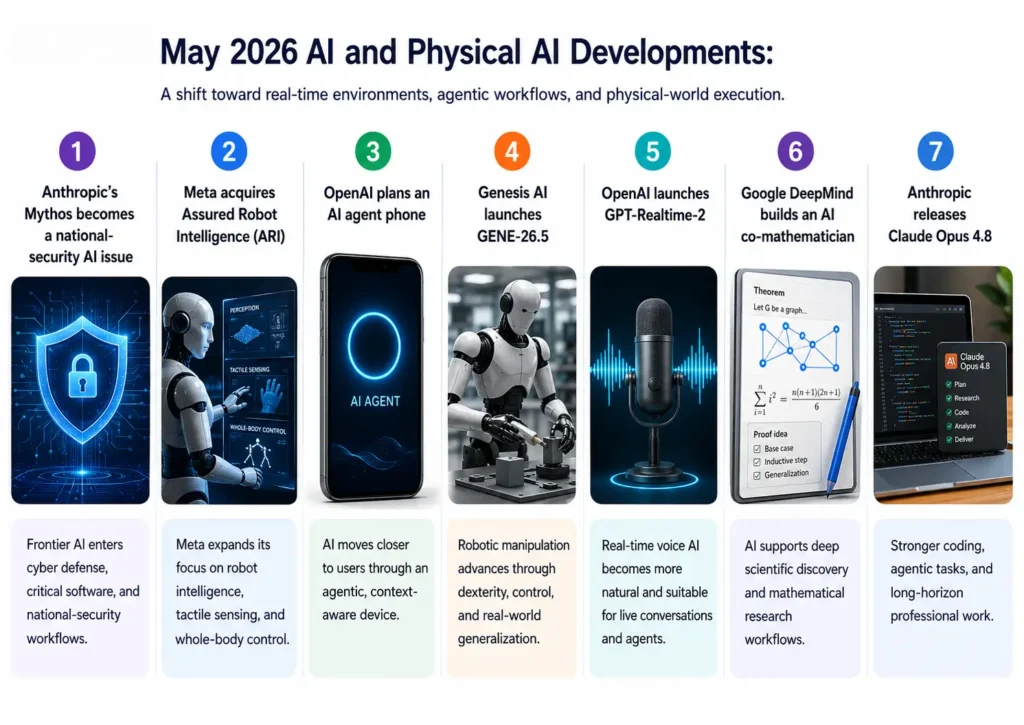
The seven developments below show this shift across both digital and physical domains. Some developments focused on secure infrastructure and national-security use. Others moved AI closer to users through voice agents and agentic devices. Several pushed AI deeper into scientific research, coding workflows, humanoid robotics, and robotic manipulation.
This matters because the next stage of AI competition will not be decided only by benchmark performance. It will be shaped by how well AI systems can operate inside real environments, connect with tools and workflows, support human review, and act safely across digital and physical execution layers.
1️⃣ Anthropic’s Mythos becomes a national-security AI issue
First announced through Project Glasswing in April 2026, Anthropic’s Mythos became a major national-security AI issue in May when the Pentagon reportedly began deploying it to find and patch software vulnerabilities across the U.S. government. The issue was not simply whether the model was powerful. The deeper question was how a highly capable cybersecurity model should be deployed across government, defense, and critical-infrastructure environments.
The strategic meaning is important. AI can strengthen cyber defense by identifying serious software vulnerabilities at scale. At the same time, it raises difficult questions about access control, misuse risk, oversight, and accountability.
For enterprises, the lesson is clear: AI governance must move closer to the execution path. This is why runtime controls for agentic AI governance become essential when AI systems begin operating inside high-stakes environments.
2️⃣ Meta acquires Assured Robot Intelligence for humanoid AI
On May 1, 2026, Meta acquired Assured Robot Intelligence, a startup focused on AI models for humanoid robots. The move fits Meta’s broader push into embodied AI, robot intelligence, and physical-world interaction.
Meta is no longer competing only through social platforms, Llama models, smart glasses, and AI assistants. It is moving toward the robot-intelligence layer.
Humanoid robots need more than mechanical design. They need perception, whole-body control, motion planning, simulation, and adaptation to unpredictable physical environments. This points to a broader Physical AI trend in which models, sensors, robot bodies, edge chips, and real-world feedback loops become one integrated stack.
3️⃣ OpenAI reportedly fast-tracks an AI agent phone for 2027
In early May 2026, reports said OpenAI was accelerating development of its first AI agent phone, with mass production possibly targeted for 2027.
This is a meaningful shift in personal computing. A traditional smartphone is organized around apps. An AI agent phone would be organized around tasks, context, memory, voice, vision, and proactive execution.
In that model, the user may not need to open many separate apps. The agent could coordinate across services and complete multi-step goals. The broader implication is that frontier AI companies may want to control the device layer, not only the model layer.
4️⃣ Genesis AI unveils GENE-26.5 for robotic manipulation
On May 7, 2026, Genesis AI introduced GENE-26.5, its first robotic foundation model system and the initial public release in the GENE family.
This was one of the most important Physical AI developments in May. Genesis described the system as a full-stack approach to robotic manipulation, combining model design, dexterous hardware, human-centric data, control systems, and high-fidelity simulation.
The system demonstrated contact-rich tasks such as cooking, lab automation, wire harnessing, making a smoothie, solving a Rubik’s cube, multi-object grasping, and piano playing.
The strategic meaning is significant. Physical AI becomes commercially useful only when robots can interact with the real world reliably. Manipulation is especially difficult because robots must handle contact, friction, shape variation, timing, force, and uncertainty.
5️⃣ OpenAI introduces GPT-Realtime-2 for voice agents
On May 7, 2026, OpenAI introduced GPT-Realtime-2, along with GPT-Realtime-Translate and GPT-Realtime-Whisper.
This matters because voice agents need more than speech recognition and text-to-speech. They need reasoning, timing, turn-taking, memory, tool use, and the ability to handle messy real-time human interaction.
GPT-Realtime-Translate points toward live multilingual communication, while GPT-Realtime-Whisper strengthens streaming transcription. The broader signal is clear: AI interfaces are moving from chat boxes to live interaction channels.
6️⃣ Google DeepMind publishes AI co-mathematician research
In May 2026, Google DeepMind and Google researchers published work on an AI co-mathematician, an agentic workbench designed to help mathematicians pursue open-ended research.
The system supports ideation, literature search, computational exploration, theorem proving, theory building, uncertainty management, and stateful research workflows.
This is not simply “AI answers a math question.” It is an example of AI becoming a research operating environment. The same logic can apply beyond mathematics to enterprise research, engineering analysis, scientific discovery, and other deep knowledge work.
7️⃣ Anthropic launches Claude Opus 4.8 for agentic coding
On May 28, 2026, Anthropic launched Claude Opus 4.8, describing it as an upgrade for coding, agentic tasks, computer use, and professional workflows.
This development matters because agentic coding is moving beyond autocomplete. The new direction is long-horizon software work, where an AI system can plan, inspect code, identify uncertainty, coordinate subtasks, and verify output before returning results.
For developers and enterprises, the deeper question is not only whether a model can write code. The better question is whether it can participate in a governed delivery process involving task assignment, context retrieval, tool use, code review, error detection, escalation, and reconstruction.
Key Insight
Taken together, these seven developments show that frontier AI competition is moving from model capability to environment ownership.
AI companies are not only releasing better models. They are trying to shape the places where AI work actually happens: secure infrastructure, phones, voice systems, research workbenches, software pipelines, robotic hands, and humanoid bodies.
2. The System Shift Behind These Developments
Behind the key AI and Physical AI developments in May 2026, one pattern is clear: AI competition is moving from model performance to system design. This also makes agentic AI reliability a system-level issue, not only a model-quality issue.
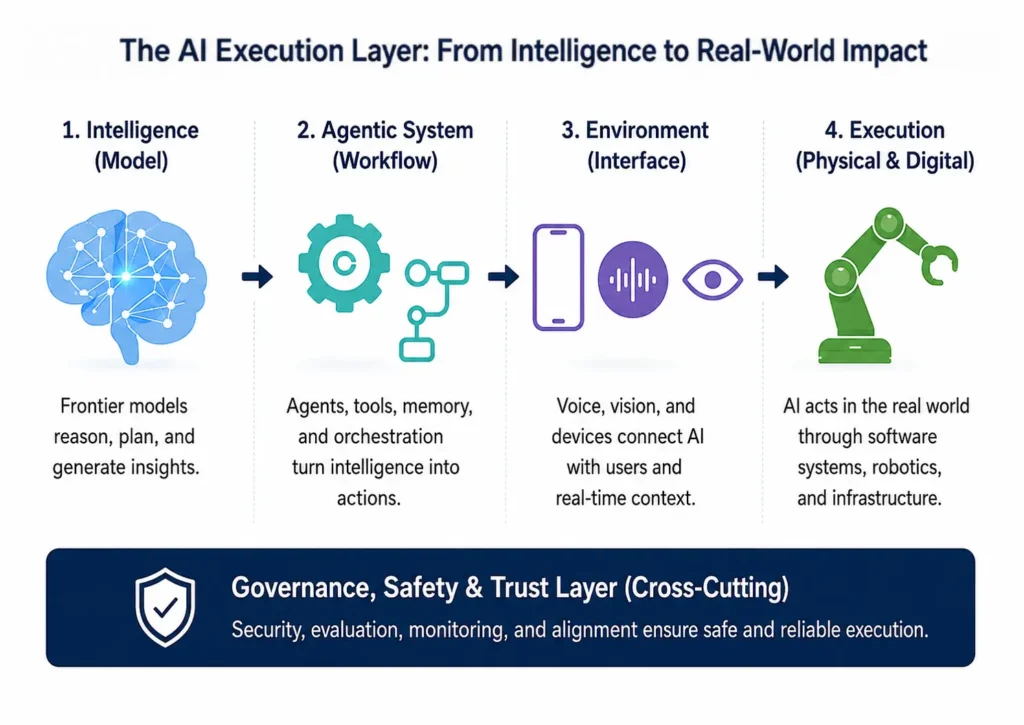
Frontier AI companies are no longer competing only to build stronger models. They are competing to control the environments where AI listens, reasons, acts, collaborates, and executes. This shift can be understood through three layers: interface ownership, workflow ownership, and physical execution ownership.
2.1 Interface Ownership: AI Moves Closer to the User
OpenAI’s GPT-Realtime-2 shows that voice is becoming a serious AI execution channel. The reported OpenAI AI agent phone points in the same direction. A traditional smartphone is organized around apps, but an AI-native device would be organized around goals, context, memory, voice, vision, and proactive task execution.
The strategic meaning is clear. If AI companies control the interface, they can shape how users access services, make decisions, retrieve information, and complete tasks.
2.2 Workflow Ownership: AI Becomes a Managed Work Environment
Claude Opus 4.8 and Google DeepMind’s AI co-mathematician show that AI is moving from one-time answers to structured work environments.
Claude Opus 4.8 reflects this shift through stronger coding, agentic task handling, computer use, and effort control. Google DeepMind’s AI co-mathematician shows the same pattern in scientific research, where AI supports ideation, literature search, computational exploration, theorem proving, and theory building.
The strategic meaning is that AI work is becoming more like managed operations. Agents need task assignment, memory, review, verification, escalation, and reconstruction.
2.3 Physical Execution Ownership: AI Moves Into the Real World
Meta’s acquisition of Assured Robot Intelligence and Genesis AI’s GENE-26.5 show that Physical AI is becoming a full-stack engineering problem.
The key point about Meta is the software-versus-hardware split. Meta’s strategic interest appears closer to the AI control stack: perception, tactile sensing, whole-body control, and robot intelligence. Genesis AI reinforces the same idea. Robotic manipulation requires dexterous hardware, physical interaction data, simulation, control systems, sensors, actuators, and real-time feedback.
This is why Physical AI is different from digital AI. In robotics, intelligence must be connected to safe, reliable, physical action.
Section 2 Key Insight
The deeper pattern behind May 2026 is environment ownership. AI companies are trying to control the interface where users interact, the workflow where AI performs professional tasks, and the physical execution layer where AI acts through machines.
3. From Technology to Application
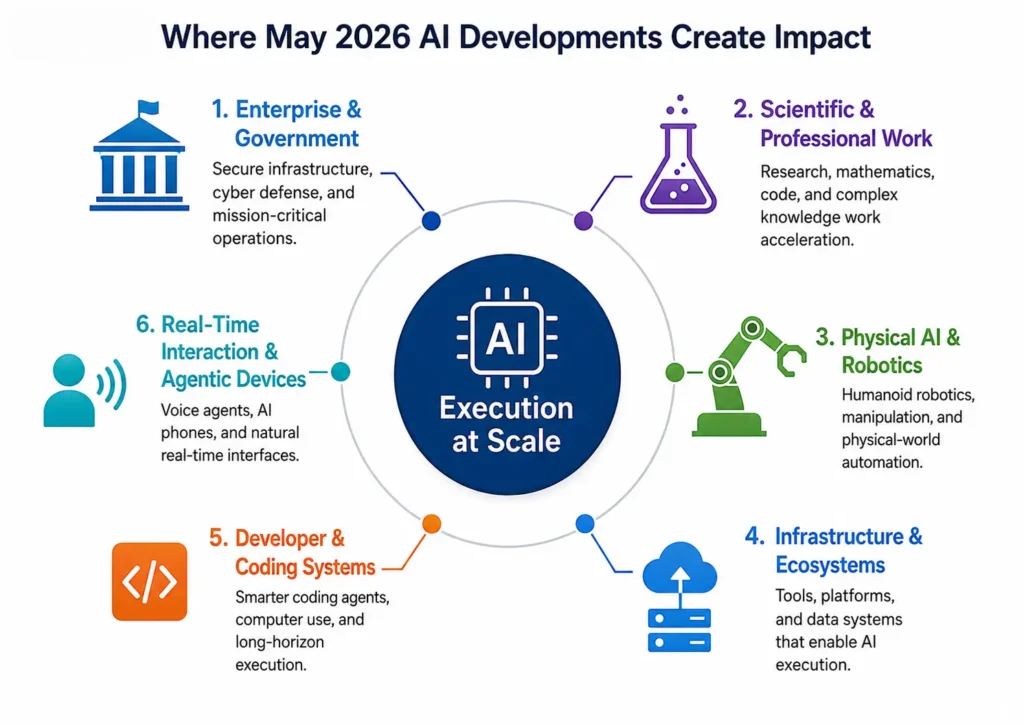
The May 2026 developments are not only product announcements. They show where AI will create practical value next: in secure infrastructure, real-time interaction, professional work, and physical execution.
3.1 Enterprise and Government AI Infrastructure
Anthropic’s Mythos case shows frontier AI moving into cyber defense, critical software, government use, and national-security workflows. In these settings, model accuracy is only one requirement. The larger requirement is operational trust. AI systems must be controlled, monitored, logged, audited, and governed.
3.2 Real-Time Voice and Agentic Devices
OpenAI’s GPT-Realtime-2 and the reported AI agent phone point toward more continuous AI interaction. Instead of typing prompts into a chatbot, users may increasingly work with AI through voice, vision, memory, and task-based interfaces. This could reshape customer service, tutoring, translation, field support, and personal task management.
3.3 Scientific, Coding, and Professional Knowledge Work
Google DeepMind’s AI co-mathematician and Claude Opus 4.8 show how AI can support deeper professional work. The key shift is from answer generation to work-process support. AI can help professionals explore ideas, test assumptions, inspect code, review evidence, and organize complex reasoning paths.
3.4 Physical AI and Humanoid Robotics
Meta’s Assured Robot Intelligence acquisition and Genesis AI’s GENE-26.5 show that robotics is becoming a major AI application frontier. Physical AI will create value in warehouse automation, manufacturing, lab work, retail logistics, service robotics, and dexterous manipulation.
Section 3 Key Insight
The application story of May 2026 is simple: AI is moving into real operating environments. The next value will come from systems that connect intelligence to useful, reliable, and governed action.
4. Conclusion: AI Is Moving Into the Execution Layer
The key AI and Physical AI developments in May 2026 show that AI strategy is moving beyond model selection.
The next advantage will come from connecting AI to real execution environments:
- Secure government and enterprise infrastructure
- Real-time voice interaction
- AI-native personal devices
- Scientific and coding workbenches
- Robotic manipulation systems
- Humanoid and embodied AI platforms
For business leaders, the lesson is practical. AI value depends on how well intelligence is connected to workflow, governance, tools, data, physical systems, and human review. This is the practical answer to the AI Value Gap: AI creates value only when capability is connected to execution, workflow, and measurable outcomes.
In May 2026, AI moved further beyond the chatbot. It moved into the execution layer, where digital systems, physical machines, and operational control begin to work together.