From Bits to Atoms: August 2026 AI and Physical AI Developments
A practical look at how frontier AI is advancing from agent platforms, scientific discovery, and specialized compute toward robot intelligence, machine control, and autonomous physical action
What happens when digital intelligence begins to understand, control, and act in the physical world?
August 2026 AI and Physical AI Developments marked a visible expansion of the AI frontier. Progress was no longer concentrated only in model capability. Scientific reasoning became more verifiable, agents became more persistent, inference moved deeper into specialized silicon, and AI systems began connecting more directly to machines operating in the physical world. At the same time, open-weight models and more efficient compute widened the range of deployment options. The important shift is not simply from Digital AI to Physical AI, but from isolated model intelligence toward integrated systems capable of reasoning, coordinating, computing, and acting.
1. Seven Key AI and Physical AI Developments in August 2026
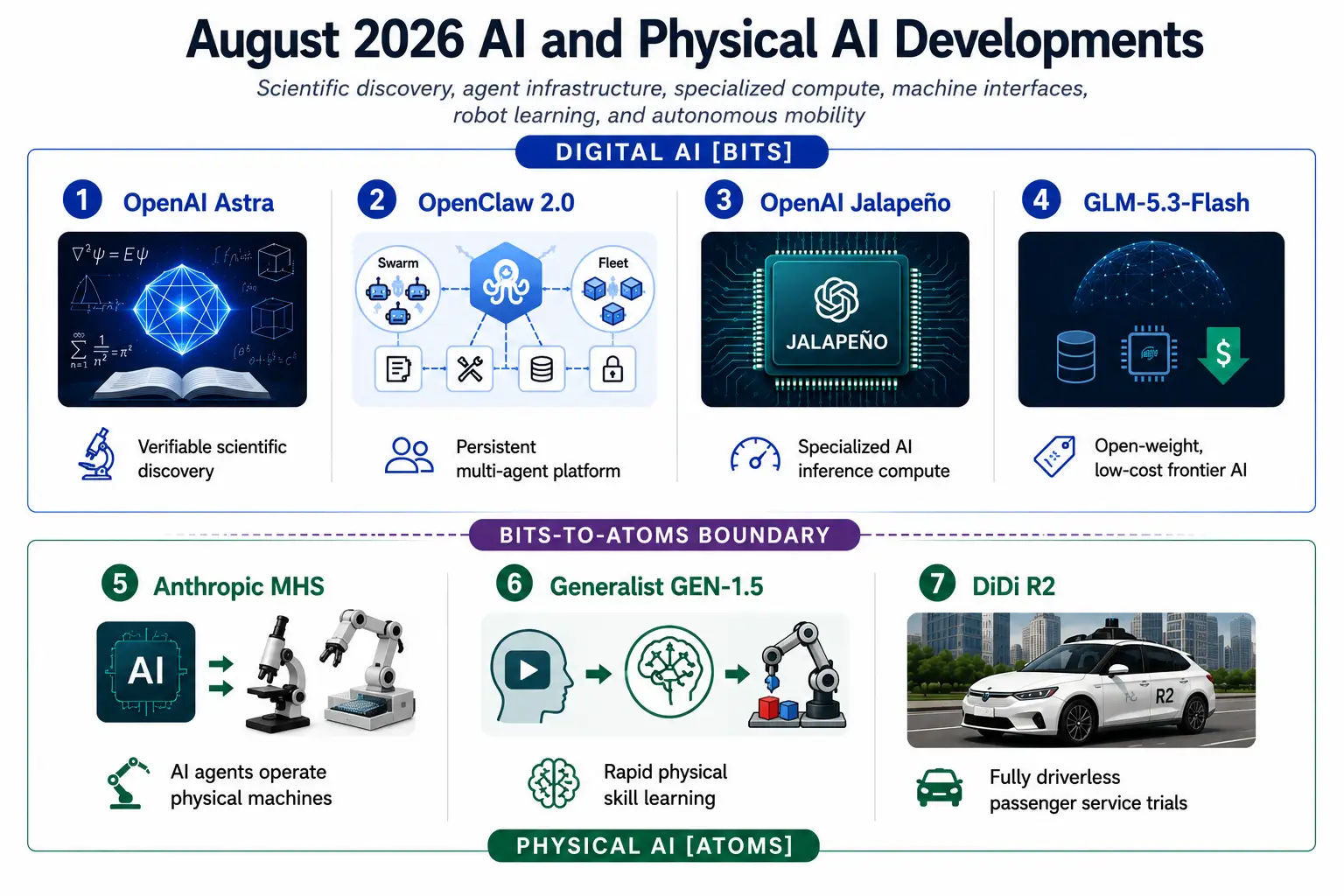
August’s seven developments span the AI stack, from verifiable reasoning and persistent agents to specialized compute, machine interfaces, robot learning, and autonomous mobility. Rather than treating them as isolated announcements, Figure 1 shows where each development sits across Digital AI and Physical AI.
1️⃣ OpenAI Astra Produces Verifiable Mathematical Advances
On August 1, 2026, OpenAI reported ten mathematical results produced with its internal Astra model across geometry, cryptography, quantum computing, and pure mathematics. Some addressed long-standing open problems or improved known bounds. Astra also converted the proofs into Lean, allowing formal software to check each logical step.
What makes this development important is verification. AI-generated research becomes more useful when outputs can be independently tested rather than accepted because a model sounds convincing. Astra therefore points toward scientific workflows in which models explore large solution spaces while formal systems provide a stronger validation layer.
2️⃣ OpenClaw 2.0 Expands Agents Into Persistent Multi-Agent Operations
On August 30, 2026, OpenClaw introduced OpenClaw 2.0 with stronger memory, shared cloud sessions, reusable skills, recurring workflows, and experimental multi-agent capabilities. Swarm can divide one task across parallel subagents, while Fleet creates separate agent cells with their own gateways, credentials, and state.
The advance is less about another chatbot interface and more about operational continuity. Agents can increasingly preserve context, distribute work, and maintain separate execution environments, capabilities required for longer-running research, development, and business workflows.
3️⃣ OpenAI Jalapeño Brings AI Optimization Into the Silicon Layer
On August 25, 2026, OpenAI published initial results for Jalapeño, its custom inference chip developed with Broadcom. The company reported improvements in throughput, latency, and computational work per watt compared with existing inference hardware.
Jalapeño reflects a broader change in frontier AI engineering. Model capability alone does not determine usable performance. Inference speed, energy consumption, hardware architecture, and deployment cost increasingly shape what systems can deliver at scale. The competitive unit is becoming the complete model-and-compute stack, not simply the model.
4️⃣ GLM-5.3-Flash Broadens the Open-Weight AI Ecosystem
On August 26, 2026, Z.ai revealed GLM-5.3-Flash after the model had circulated anonymously as Ox Alpha. It combined open weights with aggressive inference pricing, while Z.ai said the earlier testing traffic had been served on Chinese-made AI accelerators.
The development matters because frontier capability is becoming available through a more diverse ecosystem of models and hardware. Open weights, lower operating costs, and alternative compute platforms can give organizations greater flexibility in how and where advanced AI is deployed.
5️⃣ Anthropic MHS Gives AI Agents a Common Interface to Machines
On August 27, 2026, Anthropic introduced the Model Hardware Standard (MHS) in research preview to make physical equipment easier for AI agents to understand and operate. The standard targets devices such as microscopes, robotic arms, and laboratory instruments that traditionally require custom integration.
In one demonstration, Claude learned to align a laser through interaction and then converted the successful procedure into an automated routine. MHS is significant because it addresses the interface layer between AI reasoning and physical equipment, a necessary step before intelligent agents can be deployed broadly across laboratories and industrial systems.
6️⃣ Generalist GEN-1.5 Learns Physical Tasks From Minimal Demonstration
On August 19, 2026, Generalist AI introduced GEN-1.5, an embodied model designed to learn unfamiliar physical tasks from very limited demonstrations. The company showed examples in which the model learned from a single short demonstration without conventional fine-tuning.
Traditional robotics often requires task-specific programming, repeated training, or extensive data collection. GEN-1.5 instead targets faster adaptation: observe a new physical behavior, infer the task, and reproduce it. The important test now is whether this rapid learning remains reliable across longer tasks, changing environments, and different robot forms.
7️⃣ DiDi R2 Begins Fully Driverless Passenger Trials
On August 31, 2026, DiDi Autonomous Driving began fully driverless trials of its Robotaxi R2 in selected areas of Beijing and Guangzhou. Passengers can request rides through the DiDi app without a human safety driver inside the vehicle.
Unlike software-only AI, autonomous mobility must continuously combine sensing, prediction, planning, control, and feedback while operating under changing physical conditions. The R2 trials therefore provide a practical example of AI capability being evaluated not only through benchmarks, but through sustained operation in a real environment.
Key Insight
The seven developments show that AI progress is spreading across multiple system layers. August’s most important advances were not confined to better models: they also involved verification, agent persistence, specialized compute, hardware interfaces, embodied learning, and real-world autonomy.
2. The System Shift Behind These Developments
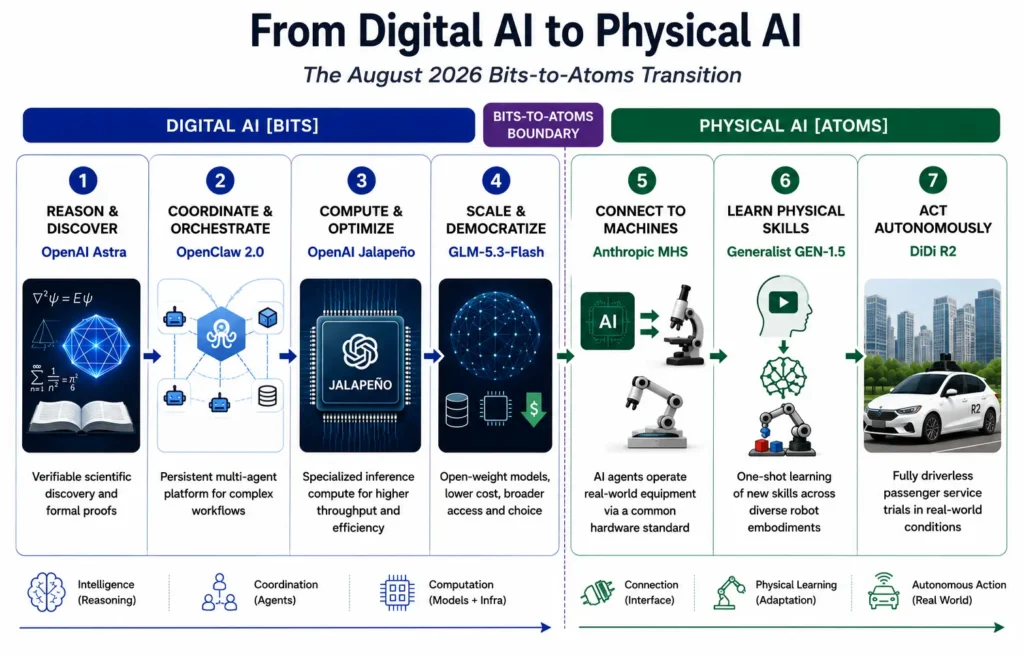
The August developments reveal an architectural shift that goes beyond individual model improvements. AI capability is increasingly distributed across three interacting layers: agentic systems that maintain state and coordinate work, compute infrastructure optimized for inference, and physical systems that must operate under real-world constraints.
2.1 Agentic Intelligence: From Model Capability to Operational Continuity
Astra and OpenClaw 2.0 illustrate different aspects of the same transition. Astra extends model reasoning into longer-horizon research, while OpenClaw emphasizes memory, persistent sessions, and multi-agent coordination.
The architectural challenge therefore shifts from producing a good response to maintaining state, context, task continuity, permissions, and coordination over time. As AI becomes persistent, Agentic AI dependability increasingly depends on the surrounding system, not only on the underlying model.
2.2 Compute Intelligence: From Model Competition to Full-Stack Optimization
Jalapeño and GLM-5.3-Flash show that AI performance is becoming inseparable from the infrastructure that delivers it.
Latency, throughput, inference cost, energy efficiency, hardware availability, and deployment flexibility now influence which models can operate economically at scale. The competitive architecture is moving from:
Model vs. Model
to:
Model + Inference + Silicon + Deployment
This matters especially for agents and real-time systems, where slow or expensive inference can directly constrain operational usefulness.
2.3 Physical Intelligence: From Decision Logic to Closed-Loop Control
MHS, GEN-1.5, and DiDi R2 extend intelligence into environments where software decisions produce physical consequences.
Physical AI must continuously operate through a feedback loop:
Sense → Interpret → Decide → Act → Observe → Adjust
That introduces engineering constraints less prominent in software-only AI: sensor uncertainty, edge latency, safety envelopes, physical limits, failure detection, and recovery. A correct decision is not sufficient if it arrives too late, violates a machine constraint, or cannot be executed safely.
Key Insight
The emerging AI architecture is becoming layered and interdependent. Reasoning, agent state, compute, interfaces, sensing, and control must work together. As intelligence moves closer to physical execution, overall system performance increasingly depends on how well these layers are engineered as a whole.
3. From Technology to Application
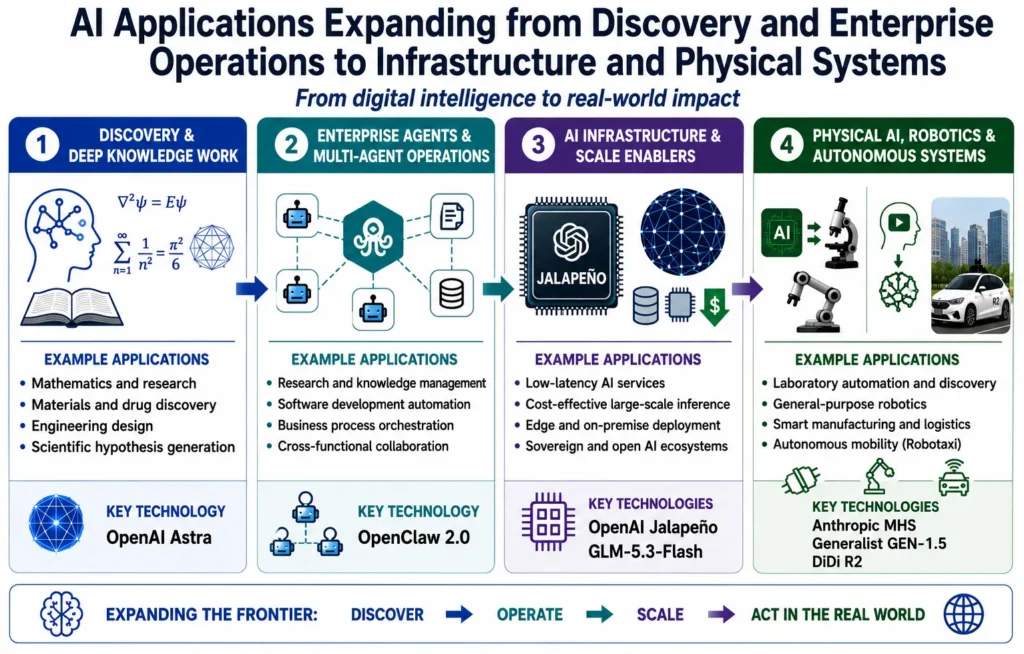
The practical value of August’s developments will depend less on whether the underlying technologies work in demonstrations and more on whether organizations can deploy them reliably, economically, and at scale. Each application domain therefore introduces a different operational bottleneck.
3.1 Scientific Discovery: Verification Becomes the Bottleneck
Astra shows how AI can accelerate mathematical and scientific exploration, but generating candidate discoveries is only part of the process. Research organizations still need rigorous verification, reproducibility, provenance, and expert review before AI-generated results can become trusted knowledge.
The emerging challenge is therefore not simply producing more ideas, but determining which results are sufficiently supported to enter the scientific record.
3.2 Enterprise Agents: Coordination and Governance Become the Bottleneck
OpenClaw 2.0 makes persistent and multi-agent workflows more practical, but persistence also increases operational complexity. Organizations must manage agent identity, permissions, memory, shared state, task ownership, and failure recovery across longer-running processes. These requirements closely connect to the runtime governance controls for enterprise AI agents needed to determine what an agent is permitted to do before execution.
As agents take on recurring work, the business challenge moves from experimenting with AI assistants to operating dependable agent systems.
3.3 AI Infrastructure: Cost, Power, and Latency Become the Bottleneck
Jalapeño and GLM-5.3-Flash highlight the growing importance of inference economics. Advanced AI becomes commercially useful only when organizations can afford to run it at the required speed and scale.
Compute availability, energy consumption, latency, hardware flexibility, and data-center capacity can therefore constrain deployment as much as model capability itself. The next competitive advantage may come from optimizing the entire inference stack rather than simply selecting the strongest model.
3.4 Physical AI: Safety and Real-World Variability Become the Bottleneck
MHS, GEN-1.5, and DiDi R2 move AI into environments where decisions can directly affect machines, equipment, vehicles, and people.
Here, deployment must account for sensor uncertainty, edge latency, physical constraints, safety limits, intervention, and recovery. A model may generate a technically reasonable action, but the system must still determine whether that action is safe and executable under current physical conditions.
Key Insight
The application frontier is shifting from demonstrating AI capability to engineering dependable deployment. Scientific AI needs verification, enterprise agents need coordination and governance, AI infrastructure needs efficient compute, and Physical AI needs safe operation under real-world uncertainty.
4. Conclusion: The Hard Part Begins at the Bits-to-Atoms Boundary
August 2026 suggests that the next phase of AI competition will not be determined by model capability alone. As intelligence moves from digital workflows into laboratories, robots, vehicles, and other physical systems, the engineering requirements become more demanding.
A software error may produce an incorrect output or failed transaction. In Physical AI, a poor decision can affect equipment, operations, or people. Latency, sensing uncertainty, power limits, safety constraints, intervention, and recovery therefore become part of the AI architecture itself.
The central challenge is shifting from demonstrating intelligence to operating it dependably in real environments. The organizations that lead the next cycle may not simply be those with the largest models, but those that can integrate reasoning, compute, interfaces, control, safety, and recovery across the boundary between digital intelligence and physical action.