Scaling Agentic AI Systems: Governance, Reliability, and Operating Discipline Beyond the Pilot Stage
Part 4 of 4 in the series: The AI Value Gap: Scaling Transformation and Agentic Innovation.
Engineering the Bridge Between AI Autonomy and ERP/CRM Systems of Record
How can organizations move Agentic AI Systems beyond promising pilots and safely integrate them into enterprise operations?
Agentic AI Systems are entering enterprise workflows where agents can initiate transactions, modify records, and affect business outcomes. Yet pilot success does not guarantee dependable performance at scale.
Production introduces changing authority, shared-state conflicts, operational failures, and consequences extending beyond individual tasks. Scaling therefore requires more than capable agents. It demands governed execution, reliability engineering, and operating discipline.
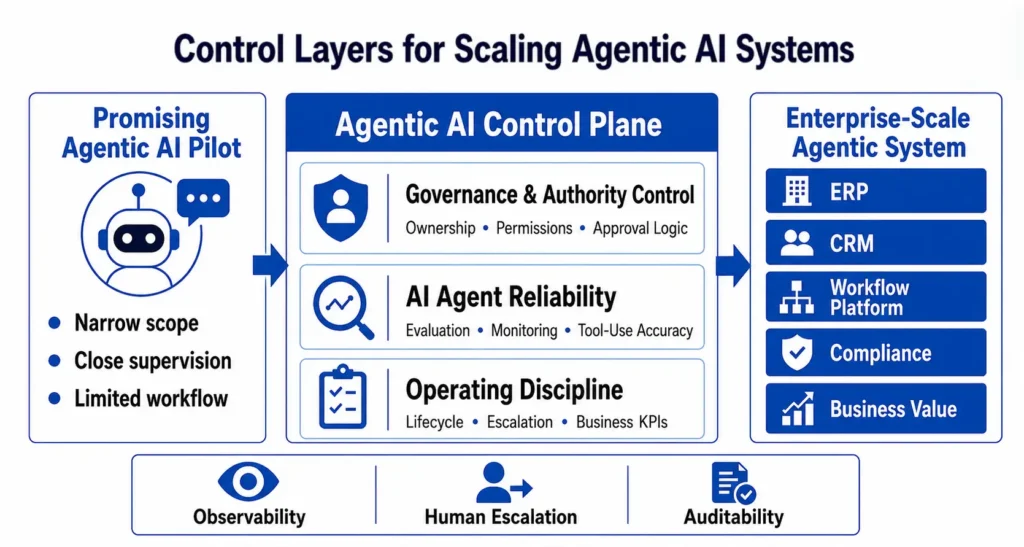
Figure 1 shows the control layers connecting experimental agents to dependable enterprise operations.
1. Architectural Failure Modes: Why Agentic AI Systems Break in Production
Moving from a sandbox into production exposes weaknesses that may remain hidden during pilot testing.
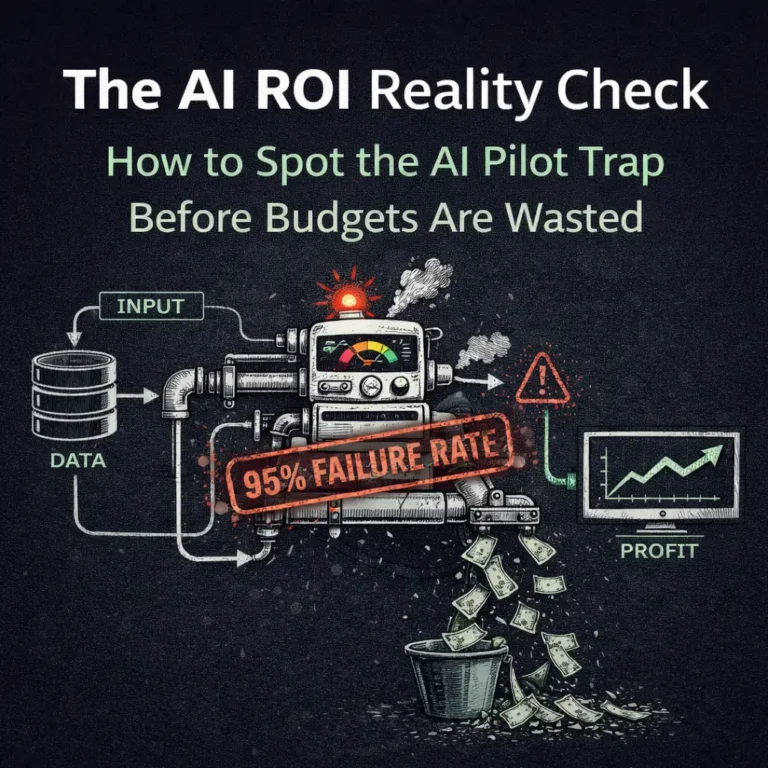
Gartner predicted in June 2025 that more than 40% of agentic AI projects could be canceled by the end of 2027 because of escalating costs, unclear business value, or inadequate risk controls.
For engineers, scaling Agentic AI Systems means addressing several architectural failure modes.
The Maintenance Trap and Logic Drift
Business rules, standard operating procedures, approval policies, and exception-handling requirements change continuously.
Agents built around static instructions may perform well initially but gradually diverge from organizational requirements.
Reliable maintenance requires versioned controls, regression evaluation, controlled updates, and governance over when revised behavior becomes operational.
Context Decay in Long-Running Workflows
Enterprise processes frequently span multiple applications, approvals, and execution stages.
An agent may begin with valid information but encounter modified customer records, expired permissions, or changed workflow conditions before completing its task.
Context continuity therefore requires more than persistent memory. Material assumptions, evidence, and authority must remain current at the moment of consequential use, including delays from inference, queuing, retries, and human review.
The ERP Integration Gap
Agents may analyze customer information or recommend financial actions accurately while remaining disconnected from enterprise systems of record.
Manual transfer between AI applications and ERP/CRM platforms limits productivity and introduces errors.
Governed APIs and workflow services provide a more dependable integration path than unrestricted database access or unverified tool execution.
Fragility of Visual-Based Automation
Computer-use agents can interact with legacy applications through their graphical interfaces. However, visual automation remains vulnerable to layout changes, unexpected dialogs, and ambiguous application states.
For consequential updates, structured APIs and governed workflow interfaces generally provide clearer execution contracts and stronger validation opportunities.
Multi-Agent Coordination and Shared-State Conflicts
Multiple individually reliable agents can still produce collectively inadmissible outcomes.
Consider two procurement agents independently submitting purchases within their delegated limits. Each action appears acceptable, but their combined commitments may exceed the organization’s spending threshold.
Similarly, one agent may rely on information that another agent changes before execution.
Dependable coordination requires declared interaction dependencies, shared-state concurrency controls, aggregate-risk constraints, and validation bound to the actual execution effect.
Local correctness does not guarantee system-level dependability.
This distinction becomes increasingly important as enterprises move from single-agent pilots toward distributed workflows involving multiple agents and shared resources.
2. Governance as a Technical Control: Securing Agentic AI Systems
Enterprise AI governance must operate as an enforceable technical architecture rather than a collection of policies applied after deployment.
When an agent moves from recommending an action to executing it, the organization must distinguish among information access, decision support, and authority to create real-world consequences.
Non-Human Identity and Authority Scoping
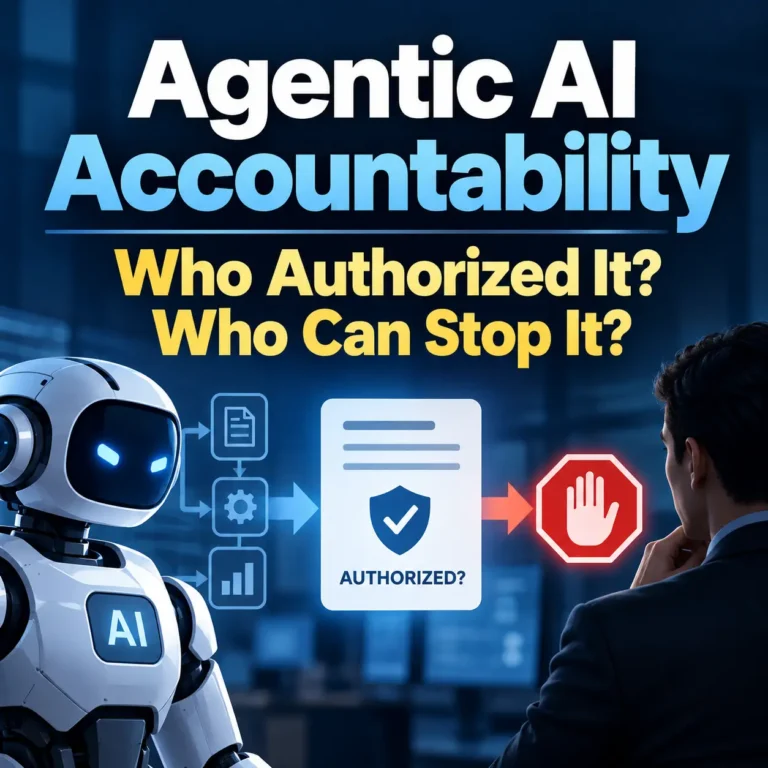
Every enterprise agent should have a governed identity, accountable owner, bounded privileges, and defined lifecycle.
For consequential actions, the architecture should distinguish the sponsoring human or organizational principal, the logical agent, and the actual executing runtime instance.
A Principal-Actor Authority Permit, or equivalent governed authorization, can bind the actor, purpose, scope, validity period, and applicable constraints.
Possessing credentials, however, does not establish continuing authority.
Ability is not authority, and authorization alone does not establish that a particular execution remains legitimate.
Least-Privilege Execution
Agents should receive only the permissions necessary for their authorized tasks.
Access to tools, files, APIs, memory, and network destinations should remain constrained by purpose, scope, and consequence.
Importantly, retrieved documents, tool outputs, persistent memory, and peer-agent messages must not create or expand authority merely because an AI model interprets them as instructions.
This separation limits what prompt injection and other untrusted inputs can achieve because they cannot independently become governance authority.
Tool Abstraction and Schema Enforcement
Production agents should perform consequential updates through governed APIs, validated tools, or workflow services rather than unrestricted database connections.
JSON schemas and structured-output validation help verify required fields, formats, and data types.
However, schema validation checks structural correctness, not runtime admissibility.
A well-formed request may still reference an unauthorized account, exceed an approval limit, or rely on stale information.
For consequential execution, a mandatory Policy Enforcement Point (PEP) should intercept the proposed effect and obtain a binding decision from an independently governed Policy Decision Point (PDP).
That decision evaluates current authority, evidence, policy, workflow state, execution scope, and applicable risk constraints.
Five Binding Governance Dispositions
Runtime governance should resolve consequential requests through five defined outcomes.
| Disposition | Operational meaning |
|---|---|
| PERMIT | Allow the specified action under current conditions |
| REFUSE | Deny the proposed action |
| CONSTRAIN | Allow only a defined, narrower or lower-risk action |
| HOLD | Suspend execution pending required resolution |
| ESCALATE | Transfer the decision to an authorized governance path |
Unresolved, contradictory, unavailable, or stale conditions must never default to PERMIT.
These dispositions establish a consistent decision vocabulary, helping organizations distinguish legitimate refusal and intervention from ordinary technical failure.
This execution-boundary principle also underlies the broader discipline of Agentic AI Governance: 10 Runtime Controls Before Enterprise Agents Scale.
Decision Evidence and Reconstruction
Auditability requires more than collecting application logs after execution.
For consequential operations, the governance decision should be linked to its supporting evidence at the execution boundary.
The record should identify applicable authority, controls, decision, intended action, enforcement result, and observable outcome.
Negative decisions, expired approvals, exceptions, failed review attempts, and recorder failures also require durable records.
Cryptographic integrity can protect evidence against alteration, but it does not independently prove that the evidence is truthful, sufficient, or complete.
Governed AI Monitoring
AI-based guardrails may evaluate suspicious instructions, unsafe plans, or unusual behavior.
However, a monitoring model cannot independently certify its own correctness or authorize execution.
The monitoring layer itself requires ownership, testing, failure detection, and independent oversight appropriate to its risk.
Binding execution decisions must remain within the governed decision and enforcement architecture.
Figure 2 illustrates the separation between information access, agent proposals, and controlled execution.
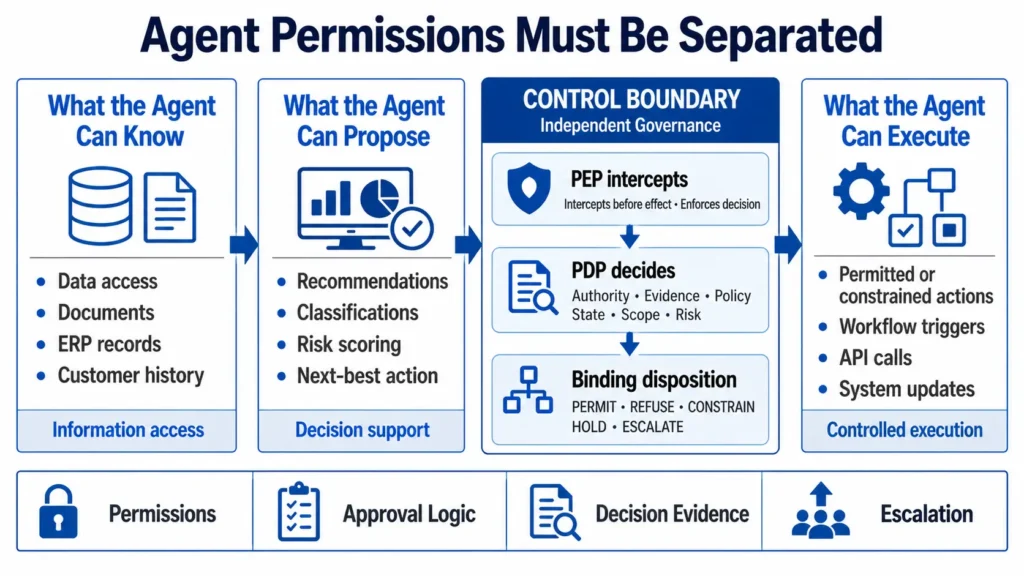
An agent may access information and propose actions, but consequential execution requires an independently governed admissibility decision.
The agent proposes; the PDP decides; the PEP enforces.
3. Reliability Engineering: From AI Agent Reliability to Enterprise Dependability
Reliability engineering must extend beyond whether an AI agent completes individual tasks correctly.
An agent may generate accurate outputs, select appropriate tools, and maintain consistent task performance while still participating in an unsafe enterprise workflow.
Two levels should therefore be distinguished.
AI Agent Reliability concerns task-level performance, including output correctness, task consistency, tool-use accuracy, and failure-rate reduction.
Enterprise AI Dependability concerns the broader operating structure governing authority, execution, evidence, interactions, intervention, recovery, and accountability.
Figure 3 illustrates the progression from model performance to reliable agents and dependable enterprise operations.
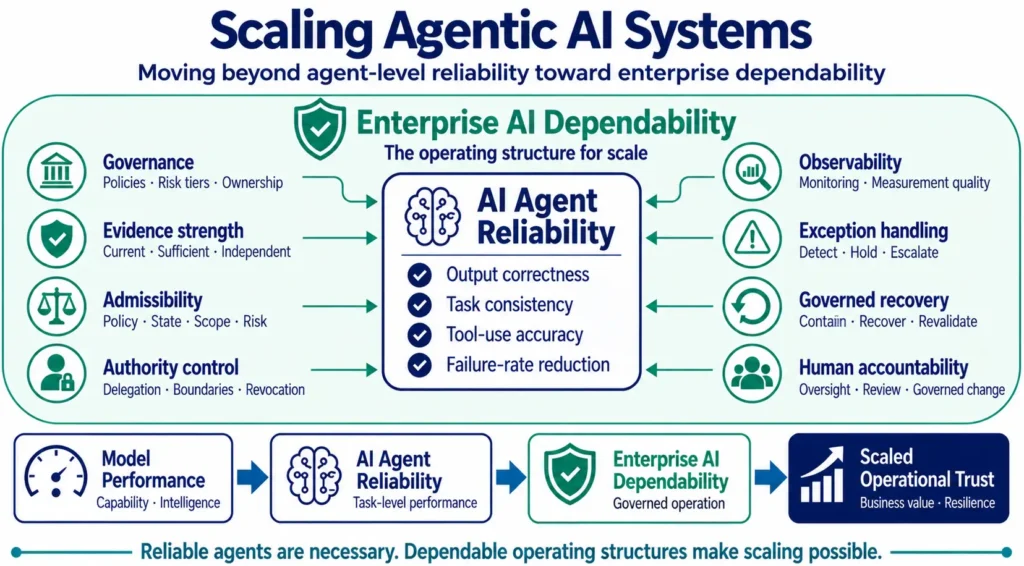
Reliable agents are necessary, but dependable operating structures make enterprise scaling possible.
Applying Site Reliability Engineering
Site Reliability Engineering (SRE) provides useful methods for operating Agentic AI Systems in production.
Service Level Objectives (SLOs): Define measurable requirements such as successful task completion, permitted failure rates, latency, tool-use accuracy, escalation responsiveness, and recovery effectiveness.
Error Budgets: Establish tolerances for ordinary reliability failures. Unauthorized transactions or violations of mandatory governance constraints, however, cannot be accepted merely because an error budget remains available.
Incident Review: Examine incorrect tool calls, missed interventions, workflow disruption, inconsistent state, and unexpected downstream effects.
Regression Testing: Reevaluate agents when models, prompts, APIs, permissions, business rules, governance profiles, or shared-state dependencies change.
Monitoring and Alerting: Observe agent behavior, authority changes, policy violations, interaction paths, evidence degradation, and cumulative risk exposure.
Human Escalation: Define who may review, constrain, refuse, or authorize consequential actions. Reviewers need current authority, sufficient evidence, and manageable workloads.
Monitoring the Measurement System
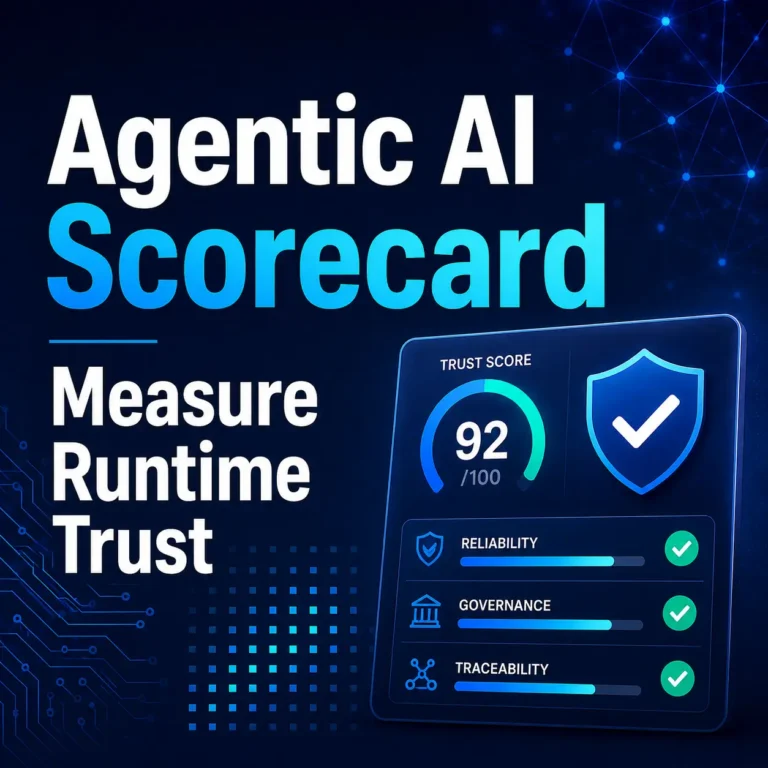
Observability alone does not guarantee trustworthy measurement.
Telemetry collectors, event parsers, evaluators, timestamps, and decision recorders can themselves fail or distort results.
For example, missing refusal events must not be interpreted as proof that no refusals occurred.
The measurement path therefore requires qualification appropriate to its intended use, including coverage, timing, consistency, completeness, and failure detection.
This becomes particularly important when operational dashboards influence scaling decisions.
Governed Recovery and Operational Resilience
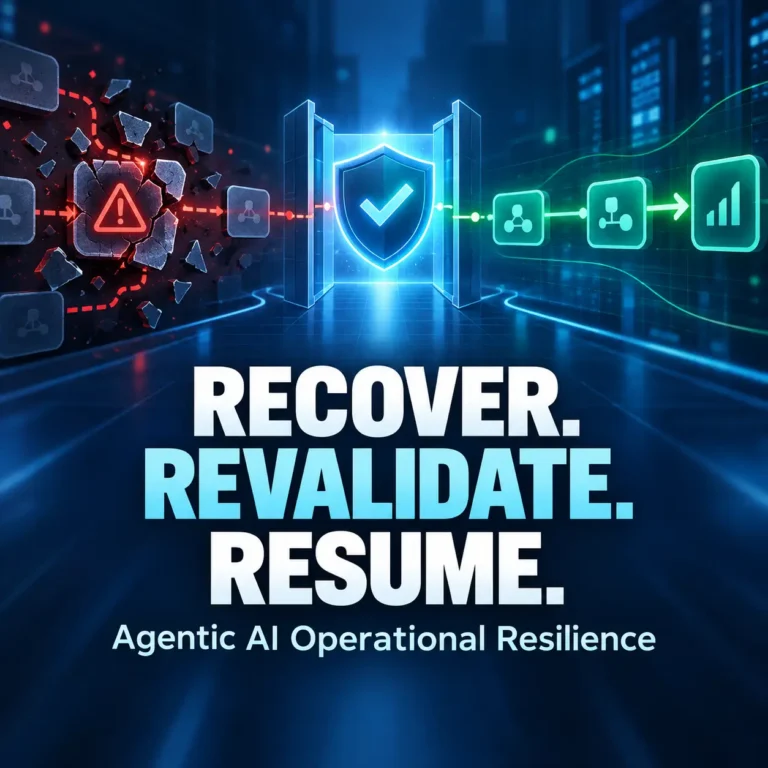
Recovery is broader than rollback.
Interrupted enterprise workflows may leave completed transactions, uncertain outcomes, stale approvals, or conflicting downstream records.
A dependable recovery sequence should:
- Contain further effects.
- Assess the Residual Execution State.
- Select a suitable recovery mechanism.
- Submit consequential recovery actions for fresh admissibility.
- Execute admitted recovery actions and revalidate agency before resumption.
- Determine the operating mode, whether normal, degraded, or suspended, and reconstruct the event and its evidence for governed learning.
Possible recovery mechanisms include retry, rollback, compensation, rerouting, and forward reconciliation.
Retries require replay protection and idempotency or equivalent safeguards. Otherwise, a recovered agent may duplicate an already completed transaction.
Technical recovery does not automatically restore execution authority.
These principles connect reliability engineering with Agentic AI Operational Resilience: Recovering Safely and Restoring Admissible Operation, where containment, recovery admission, and revalidation of agency are treated as distinct responsibilities.
4. The Enterprise Control Plane: Orchestration and Lifecycle of Agentic AI Systems
Enterprise-scale Agentic AI Systems require coordinated management of identities, workflows, models, tools, policies, evidence, interventions, and change.
The term enterprise control plane is used here as an umbrella concept encompassing the three architectural planes in the Four Runtime Governance Pillars framework.
Three Architectural Planes
| Plane | Governance responsibility |
|---|---|
| Specification & Control | Define authority, risk profiles, constraints, and operating rules |
| Runtime Decision & Response | Enforce admissibility, detect change, intervene, and recover |
| Assurance & Learning | Reconstruct execution, evaluate evidence, and produce bounded improvement findings |
These planes describe engineering responsibilities rather than requiring a single centralized software platform.
Together, they support four runtime governance functions.
Pillar 1, Runtime Controls: Establish the authorized operating envelope, including identities, delegation, risk tiers, action boundaries, interaction profiles, and recovery constraints.
Pillar 2, Execution-Path Enforcement and Admissibility: Determine whether the exact proposed consequence may occur under current conditions and enforce the binding disposition.
Pillar 3, Alerting, Intervention and Recovery: Detect material changes, invalidate stale standing, contain failures, and coordinate governed recovery.
Pillar 4, Reconstruction: Reconstruct authorization, execution, intervention, outcome, and evidence to support accountability and verified improvement.
Standardized Connectivity Through MCP
The Model Context Protocol (MCP) provides standardized mechanisms for connecting AI applications with external tools and information sources.
This reduces integration complexity but does not replace enterprise authorization, execution-boundary enforcement, or state management.
Tool connectivity and authority to execute consequential actions remain separate responsibilities.
Context Persistence and State Management
Long-running agents need reliable access to workflow state, business context, and relevant execution history.
However, persistent memory is not automatically current or authoritative.
State-management services must preserve versioning, provenance, dependency relationships, and revalidation conditions.
An agent’s remembered approval cannot substitute for current authorization.
Multi-Agent Orchestration
Specialized agents can collaborate across finance, procurement, customer service, and operational workflows.
However, multi-agent orchestration involves more than exchanging messages or sharing memory.
Interactions should follow governed delegation, declared interaction profiles, and concurrency constraints. Material shared-state dependencies must be validated at consequential execution boundaries, with mechanisms preventing relevant changes between validation and effect.
Peer-agent messages may inform decisions but cannot independently establish authority.
When an evidence source, record, or tool result is withdrawn or corrected, materially dependent decisions must be identified and affected pending actions revalidated before consequential execution. Previously committed effects may require reconciliation, containment, or governed recovery.
Where collective decisions require corroboration, agreement among several agents does not automatically constitute independent evidence. Shared models, sources, or tools may create correlated failures.
The orchestration architecture must therefore preserve both individual authority and system-wide admissibility.
Enterprise Knowledge Graphs
Knowledge graphs can represent relationships among business entities, policies, dependencies, and workflow states.
They can improve contextual reasoning and help identify affected processes when information changes.
Nevertheless, graph-derived relationships remain evidence or contextual inputs, not independent sources of execution authority.
Lifecycle Management and Governed Improvement
Enterprise agents require versioning, testing, controlled deployment, retirement, and change management.
Operational findings must not directly rewrite runtime policies.
Instead, improvement should follow a governed sequence:
Pillar 4 verified findings → Pillar 1 review and testing → Authorized activation → Pillars 2 and 3 operation → Pillar 4 verification.
This process prevents autonomous changes from silently altering the organization’s control baseline.
Outcome-Centric Monitoring
Business value must ultimately be assessed through measurable outcomes.
Relevant indicators include cycle-time reduction, transaction accuracy, operating cost, successful exception resolution, recovery effectiveness, and human-review workload.
These measures should be interpreted alongside governance effectiveness and evidence quality.
A faster workflow is not necessarily better if it increases unauthorized effects, unresolved exceptions, or hidden operational risk.
5. Production Readiness: A Technical Checklist for Scaling Agentic AI Systems
Moving from a successful pilot into enterprise production requires evidence that the system can operate within defined constraints under changing conditions.
The following checklist combines software engineering practices with the minimum runtime governance requirements of the Four Pillars.
1. Identity, Ownership, and Authority
Identify the sponsoring principal, logical agent, executing runtime instance where material, accountable owner, and authoritative source of permissions.
Use bounded delegation, current authorization, and explicit revocation rules.
2. Consequence-Based Risk Classification
Classify actions by their actual consequences, including reversibility, sensitivity, cumulative exposure, and downstream impact.
Define versioned governance profiles containing authorization requirements, evidence thresholds, intervention rules, and recovery constraints.
3. Mandatory Execution-Boundary Enforcement
Route consequential actions through a mandatory PEP and independently governed PDP.
Verify current authority, purpose, evidence, policy, target, parameters, execution scope, and relevant system state.
Preserve the minimum decision-relevant execution history, including prior dispositions, sensitive data access, and material tool calls, to support sequence-aware admissibility.
Test that direct APIs, tools, or alternative execution paths cannot bypass mandatory enforcement.
4. Replay and Duplicate-Execution Protection
Apply decision-instance protection, idempotency, transaction identifiers, or equivalent safeguards.
Retries following API timeouts must not silently duplicate financial transfers, approvals, or record mutations.
5. Multi-Agent Interaction and Concurrency Control
Declare material interactions, shared-state dependencies, delegation paths, and aggregate-risk limits.
Validate material shared-state dependencies before execution and prevent relevant changes between validation and effect through transactions, reservations, fencing, or equivalent governed mechanisms.
Conflict repair or material plan changes must return through independent admissibility.
6. Runtime Monitoring and Authority Invalidation
Monitor unusual tool calls, changing permissions, policy violations, evidence degradation, and cross-agent interactions.
Define measurable limits for propagating authority revocation and other material governance changes to dependent agents, queued actions, and workflows.
Stale authority or invalidated dependencies must trigger governed non-permit behavior.
7. Bounded Intervention and Recovery
Prepare procedures for containment, residual-state assessment, rollback, compensation, rerouting, and reconciliation.
Recovery actions must be admitted under current conditions. Resumed agency requires fresh validation rather than automatic restoration of previous permissions.
8. Decision Evidence and Auditability
Preserve positive and negative decisions, approval attempts, enforcement results, execution receipts, and resulting state.
Verify the health of the observation and recording mechanisms themselves.
Records should support reconstruction without relying solely on the executing agent’s account.
9. Human Oversight and Escalation
Assign accountable reviewers with verified authority, appropriate competence, access to evidence, and workable review capacity.
Define response deadlines, substitute-authority rules, and safe fallback paths when required approvals are unavailable.
As discussed in Designing Dependable Human-Agent Workflows: Preventing the Rubber-Stamp Problem, human oversight must represent meaningful judgment rather than procedural approval.
10. Lifecycle Validation and Business Outcomes
Test agents against realistic workloads, changing business rules, integration failures, concurrency conflicts, and recovery scenarios.
Measure cost, quality, latency, exceptions, operational friction, and verified business outcomes.
The NIST AI Risk Management Framework, with its GOVERN, MAP, MEASURE, and MANAGE functions, provides a complementary lifecycle risk-management foundation.
Organizations should expand autonomy only when applicable governance and assurance requirements remain satisfied at the intended consequence level.
Production readiness is not proof that an agent will never fail. It is evidence that failures and consequential actions remain bounded, governable, and reconstructable.
6. Conclusion: Scaling Agentic AI Systems Through Enterprise Dependability
Scaling Agentic AI Systems requires more than capable models, dependable tools, or successful pilots.
Enterprise operations introduce changing authority, shared-state conflicts, imperfect evidence, and consequences that may be difficult to reverse.
Organizations must therefore connect agent-level reliability with execution-boundary governance, intervention, recovery, and accountability.
The architectural progression is:
Model Performance → AI Agent Reliability → Enterprise AI Dependability → Scaled Operational Trust
Greater autonomy should be supported by demonstrable operational assurance, not assumed from technical capability.
The enterprises that scale Agentic AI Systems successfully will be those that convert promising automation into governed execution, measurable business value, and dependable operations across the entire system lifecycle.