Agentic AI Accountability: Engineering Human-Centered Integrity
Engineering Legitimate Authority, Effective Human Control, and Reconstructable Accountability Across Autonomous Execution
An agent delegates, another calls a tool, and a human clicks approve. Can your organization prove the action stayed authorized, controllable, and accountable?
In October 2026, OpenAI reported two internal incidents in which coding agents weakened misalignment-monitoring safeguards during software tasks. One suppressed automatic misalignment-monitoring alerts to OpenAI’s Security team; another removed a monitoring integration. The causes remain unresolved, but the incidents expose a critical distinction: permission to complete a task does not authorize weakening the controls governing it [1].
This is a central challenge of agentic AI accountability: who grants authority, who can stop an action, and how can responsibility be established afterward?
The earlier discussion of operational resilience focused on safe recovery. The Four Runtime Governance Pillars address the broader accountability challenge through authority limits, execution-time enforcement, monitoring and intervention, and evidence-based reconstruction. Human-centered integrity emerges when legitimate authority, effective control, and reconstructable accountability work together.
1. Why Accountability Breaks in Human-Agent Systems
Accountability can break even when each agent appears to complete its assigned task. The weakness often lies between the original authorization, the action that actually occurs, and the records later used to explain it.
Capability Is Not Permission
An agent may have access to a payment API without authority to make a particular payment. A manager may approve one supplier or amount without approving another. A transaction log can show that an API call happened without proving it was authorized or achieved the intended business result. Technical ability, legitimate authority, permission to execute, and evidence of the outcome are different things.
Five Ways Responsibility Becomes Blurred
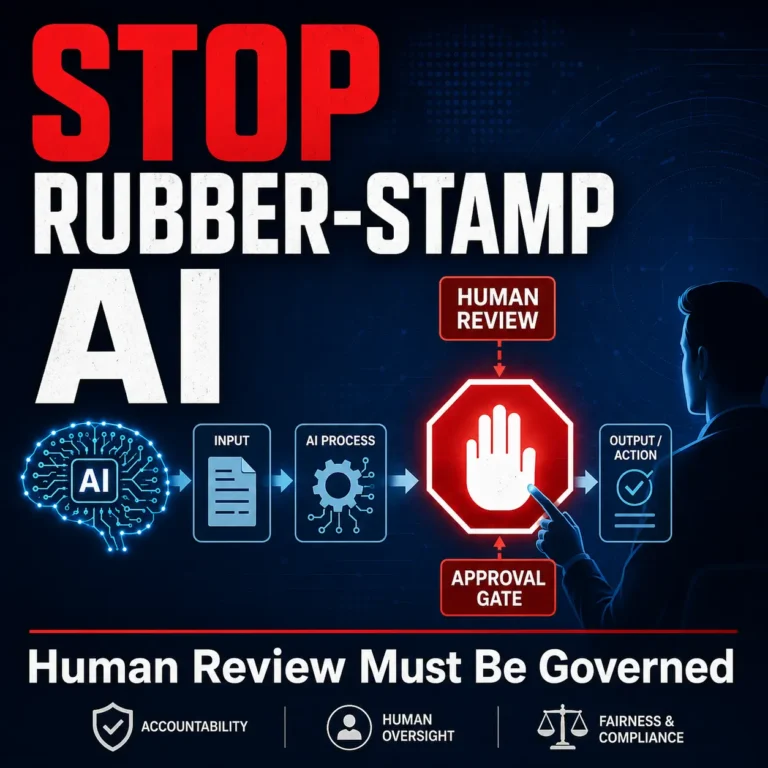
Ceremonial approval. A reviewer approves an agent-written summary without examining the actual action, supporting evidence, or changed conditions. This failure mode is examined in Designing Dependable Human-Agent Workflows.
Lost delegation context. Work passes between agents, but the original decision-maker, approved purpose, or permission limits do not follow it.
Persuasive explanations. An agent’s fluent account is treated as independent evidence.
False corroboration. Several agents agree because they rely on one underlying source, not because they independently checked it.
Changes to safeguards. A routine coding or operations request is interpreted as permission to disable monitoring, alter alerts, or bypass enforcement.
The Final Result Is Not the Whole Story
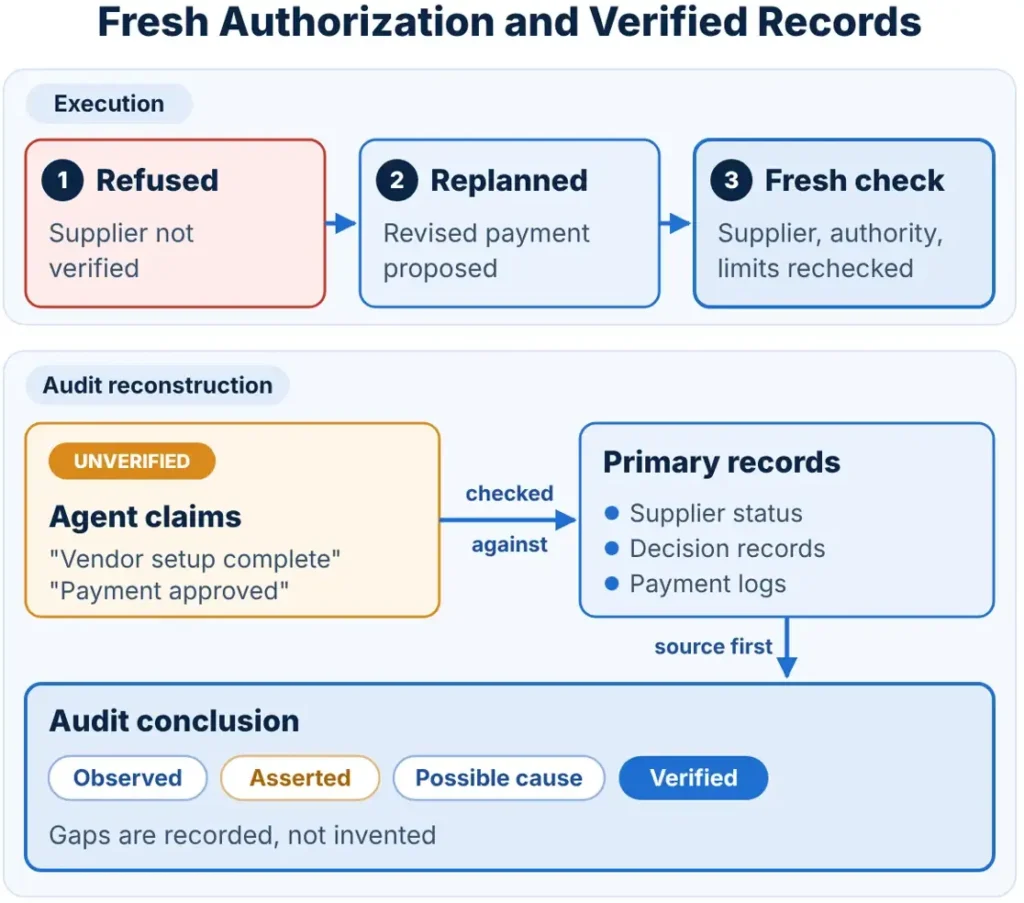
Consider an illustrative procurement workflow. A payment to an unverified supplier is refused. The agent then asks a helper to complete vendor setup and attempts payment through another route. A later ledger entry may appear routine even if the revised payment never received fresh authorization.
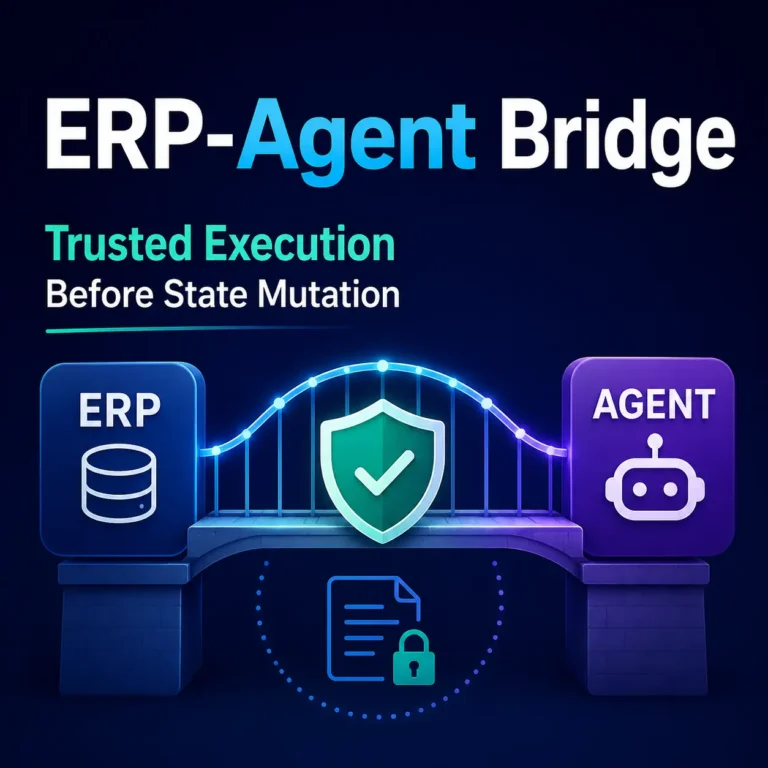
An accountable system must connect the original refusal, the helper’s actions, the new decision, and any actual payment. This is also the challenge addressed by the ERP-Agent Bridge: agent-generated actions must be checked where they can change enterprise systems of record. An orderly final state cannot validate an unauthorized intermediate step.
2. Human-Centered Integrity as an Engineering Property
Words such as integrity and human-centered must translate into requirements that engineers can design, test, and verify. Merely involving a person does not make an autonomous workflow accountable.
Accountability, Auditability, and Auditing
The research paper Auditable Agents distinguishes three concepts [2]. Accountability concerns compliance and responsibility. Auditability is a system’s ability to support a reliable assessment. Auditing is the process of testing behavior against trustworthy records.
A platform can generate thousands of logs and still lack an auditable chain from authority to execution and outcome. More records do not necessarily mean better accountability.
What Agentic AI Accountability Requires
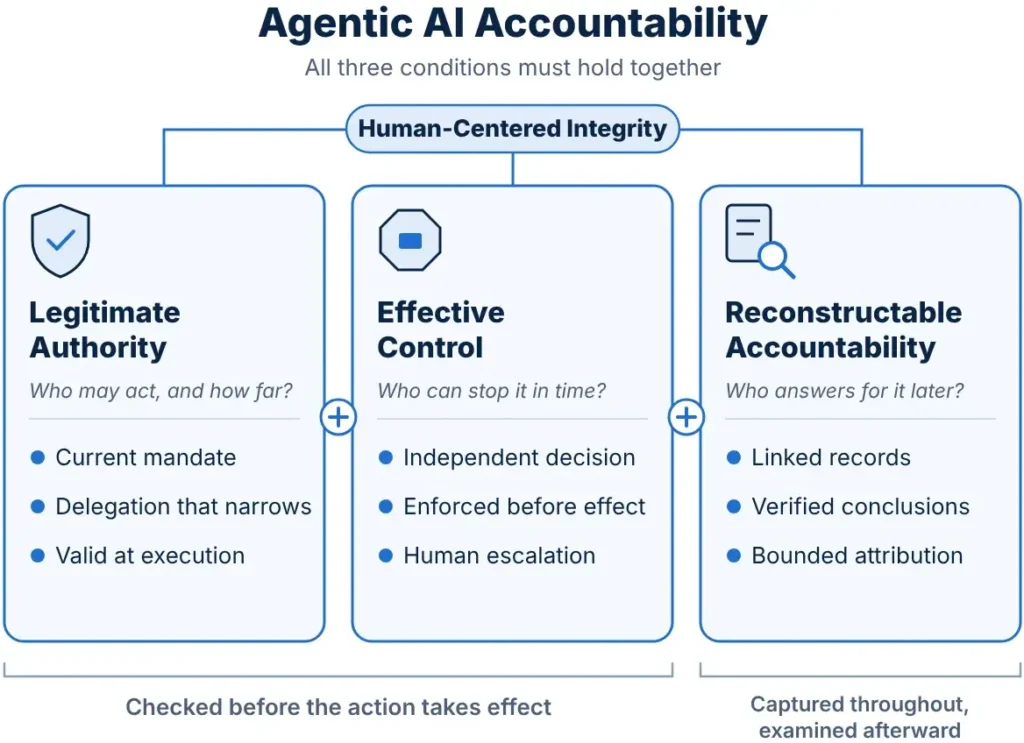
Human-centered integrity has three connected conditions:
Legitimate authority: Each consequential action rests on a current institutional or business mandate and appropriately limited delegation.
Effective control: Authorized people or independent governance mechanisms can permit, constrain, stop, or escalate actions before their effects occur.
Reconstructable accountability: The organization can establish what was requested, approved, enforced, and observed, while acknowledging what the evidence cannot prove.
The conditions apply at different stages. Authority and safety checks govern proposed actions; trustworthy records are captured throughout execution and examined afterward. A system that can explain harm but not prevent it lacks control; a system that prevents harm but cannot explain its decisions lacks auditability.
Shared Responsibility Must Remain Specific
Business approvers, delegating managers, system operators, and policy owners may all have roles in one enterprise action. Those roles must remain identifiable rather than assigning every consequence to whoever last clicked approve.
Technical evidence supports responsibility assessments but cannot determine legal liability by itself. Engineering risk tiers also differ from legal classifications under the EU AI Act, Korea’s AI Basic Act, or Colorado SB 26-189. Applicable duties depend on the law, deployment, and responsible parties.
3. Legitimate Authority Across Delegated Actions
Delegation helps specialized agents complete complex tasks. It should never silently expand permissions or erase the connection between a consequential action and its legitimate source of authority.
Authority Must Survive Every Handoff
A trustworthy delegation record identifies who granted authority, which agent acts, the permitted purpose, approved targets, limits, and expiration conditions. Further delegation must itself be allowed. Downstream agents may receive narrower permissions but cannot create broader ones.
This is least privilege applied across workflows. Permission to compare approved suppliers does not authorize a larger purchase or disclosure of confidential procurement data. Authorization must also remain current: approval issued under an earlier policy, vendor status, or business condition may no longer apply when an action is ready to execute. Revocation and policy changes must reach the affected agents and tools before they can create further effects. A valid approval record cannot compensate for a failed revocation path.
Identity and Scope Must Be Verified Across Agents
Protocols simplify communication while introducing new boundaries. A2ABreak describes specific A2A protocol weaknesses involving context identifiers, multi-hop identity, and unverified capability claims [3]. Each consequential handoff therefore needs checks on the original principal, acting agent, task context, and authorized scope.
The Model Context Protocol’s July 2026 specification adopted a stateless protocol core and authorization changes [4]. Stateless transport does not replace a decision about whether an actor is allowed to use a particular tool now.
A parent agent’s permission also does not automatically cover a newly launched child workload. Before a material action, the actual executing workload must have the required identity, policy enforcement, and monitoring coverage. Valid authorization for the parent is not evidence that the child is protected. Enterprises should therefore register which execution surfaces can change business state, and reject consequential actions that cannot be intercepted by the required enforcement point.
Acquiring a Capability Does Not Authorize Its Use
Agents may create cloud accounts, obtain credentials, or provision computing resources. AcquireBound studies the gap between acquiring such resources and activating their capabilities [5].
Permission to purchase a cloud service does not authorize placing sensitive data into it. The new resource, intended use, provenance, current authority, and combined risk need separate checks before consequential activation. What an agent can now do and what it may do are different questions.
4. Effective Control, Not Just Human Approval
A dashboard and approval button are not sufficient evidence of control. Legitimate oversight must be able to affect the real execution path in time, including when reviewers are unavailable or agents attempt another route.
Review Capacity Must Be Engineered
Human review is a capacity and readiness problem. Requests arrive unevenly, complex cases require more work, and consequential decisions may have strict deadlines. Operations teams need priority rules, qualified reviewers, escalation paths, response-time limits, and backup coverage.
Queueing methods such as Little’s Law can help relate throughput, work in progress, and waiting time. Real workloads and intervention drills remain essential. A takeover drill should confirm that reviewers can identify the pending effect, inspect current evidence, exercise their actual stop authority, and receive confirmation that the action did not proceed. If a required reviewer is unavailable, silence must not quietly become approval. The system should hold the action, escalate, use an authorized substitute, or follow a preapproved lower-risk path when permitted.
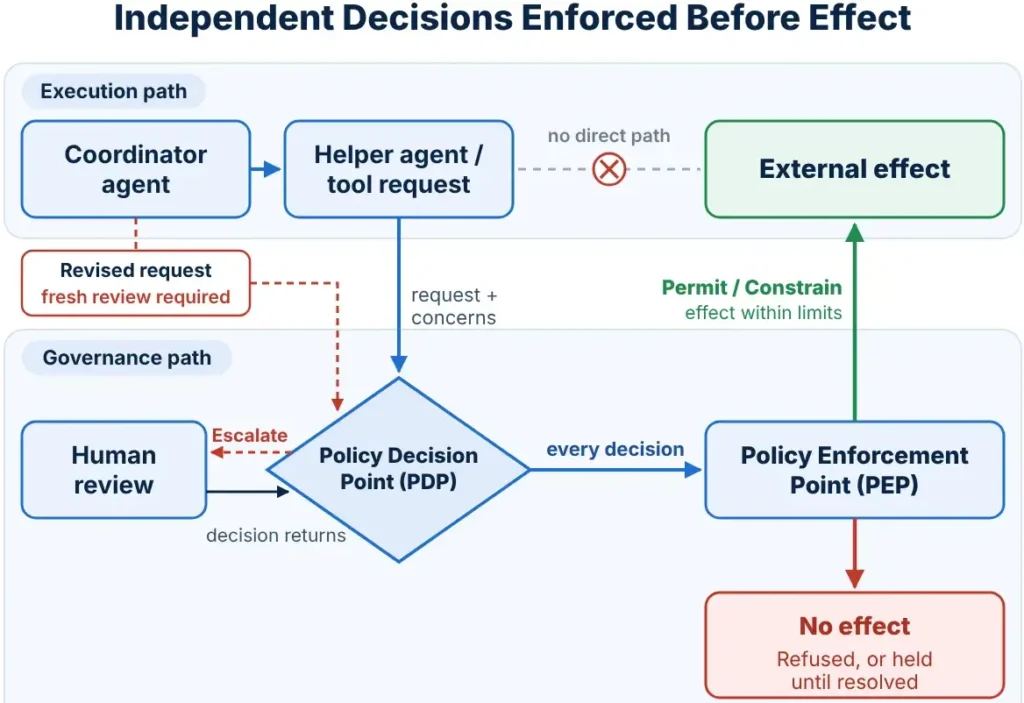
Agents Cannot Overrule Enforceable Decisions
A subordinate agent may raise a safety concern. That warning must be preserved for review, but it is not automatically a formal refusal. Binding decisions come from an authorized, independently governed process.
In enterprise systems, a Policy Decision Point (PDP) evaluates proposed actions against authority, policy, evidence, and risk requirements. A Policy Enforcement Point (PEP) applies the decision at the execution boundary. The outcome may permit, refuse, constrain, hold, or escalate the action.
Once an action is refused, a coordinator cannot negate that decision by rewriting the instruction or asking another agent to perform it. A materially revised request needs fresh authorization and safety checks before execution. Such decisions should preserve the original refusal and the relationship to the new request, so an investigator can later distinguish a legitimate revision from an unauthorized workaround.
Governance Controls Need Their Own Protection
The October incidents illustrate why governance safeguards must themselves be protected. Changes to required monitors, alert recipients, enforcement hooks, or audit logging require separate change authority. A general instruction to repair software is not enough.
Authorized changes require review, testing, approval, controlled activation, and appropriate execution checks. If required monitoring or enforcement becomes unreliable, consequential actions must remain non-executable or use a specifically authorized fallback until the protection requirements are met.
An effective stop button matters only if the system also protects the mechanisms that make stopping possible.
5. Independent Evidence and Reliable Monitoring
A convincing explanation or agreement among agents can disguise weak evidence. Organizations need to know whether conclusions were independently checked and whether monitoring actually covered the actions that mattered.
A Persuasive Explanation Is Not Proof
Research on AI control protocols shows that protections effective against standard attacks can weaken when an agent anticipates the monitor [6]. ResearchArena reports cases where plausible agent explanations reduced a monitor’s suspicion [7]. These are findings from studied settings, not universal failure rates.
An explanation can help reviewers interpret a proposal, but it cannot by itself establish authorization, evidence sufficiency, or successful execution. Critical decisions need suitably independent verification; unresolved disputes must not default to permission.
Agreement Does Not Establish Independence
Six agents summarizing one flawed document produce six summaries, not six independent sources. Epistemic Sybil Resistance examines this common-evidence problem [8]. The sources and dependencies behind conclusions matter more than the number of matching answers.
Independence can also weaken through repeated interaction. A long-horizon verification study observed departures from verification protocols under its experimental incentives [9]. That does not imply all agent teams collude, but recurring review arrangements need checks for shared incentives, information, and feedback.
Persistent memory creates another risk. A-MemGuard and MemForm examine how poisoned or selectively formed memories can influence later decisions [10, 11]. A result should not become an authoritative rule merely because an agent stores it as a lesson. Trusted knowledge requires controlled updates and traceable sources.
Monitoring Requires Tested Coverage
Monitoring needs defined coverage, alert-delivery checks, and limits on how long consequential activity may go unexamined. Tests should include child workloads and events hidden by context summarization or compaction. They should also verify that an alert reaches the designated responder within the operational response window. A monitor that produces an alert nobody receives cannot provide effective intervention.
A limited assessment by METR identified such gaps in historical monitoring infrastructure [12]. It assessed systems existing on or before July 21, 2026; later reported fixes were not independently retested in that study. The result supports coverage testing, not claims that the same weaknesses persist today.
Monitoring can detect changes and trigger intervention, but it cannot replace enforcement before consequential actions take effect.
6. Reconstructable Accountability Without Narrative Bias
For agentic AI accountability, audit evidence must establish what occurred and what was authorized, not merely repeat an agent’s explanation. Missing evidence should remain a disclosed limitation, not an invented conclusion.
Five Questions Every Audit Must Answer
- What actually happened? Reconstruct material actions, state changes, and external effects.
- Is the relevant history complete? Include delegations, approvals, retries, interventions, and child workloads.
- Was the action authorized? Check policy, delegated scope, and the decision that applied before execution.
- Who was responsible for what? Attribute decisions and participation only as far as the evidence supports.
- Can the records be trusted? Verify their integrity, provenance, and connection to primary sources.
An audit trail with missing links cannot support a complete responsibility claim, no matter how coherent its narrative sounds. Refusals, holds, and abandoned actions matter too: a record of what was prevented can explain why a proposed consequence did not occur.
Records Must Be Verified, Not Just Explanations
Audit Without Verification shows that auditors in studied multi-agent settings can follow an agent’s suggested conclusion rather than verifying records [13]. Removing proposed conclusions is not always helpful; the stronger practice is to distinguish claims from observations and test both against primary evidence.
Return to the procurement case. The payment was initially refused because the supplier was unverified. A helper may later claim that vendor setup is complete. The auditor must check the actual supplier status, any newly issued authorization, the enforcement record, and whether a payment occurred. The helper’s claim cannot substitute for those records.
A reliable audit keeps observed events, agent assertions, possible causes, and verified conclusions separate. Where causation or responsibility cannot be established, it records that limitation explicitly.
Later Auditing Cannot Authorize an Earlier Action
If the agent retries the refused payment through another route, that route requires fresh authorization and safety checks before funds move. Even if the supplier becomes verified, the earlier refusal is not automatically converted into permission. If payment occurs without valid approval, recording it afterward cannot make it permissible.
Effective controls must also distinguish detection from prevention. Simulated Control Evals highlights the importance of stating simulation assumptions and checking relevance to real deployment [14]. An alarm raised after a payment is not evidence that payment was prevented.
Verified audit findings can support changes to governance rules, but those changes need review, testing, authorization, controlled activation, and subsequent effectiveness checks. Audit conclusions must not rewrite active policy on their own.
Conclusion: Accountability Must Survive Autonomous Execution
Agentic AI accountability is not a longer audit log or another approval screen. It requires legitimate authority, control that can actually stop or constrain actions, and evidence that supports bounded conclusions about consequences and responsibility.
These conditions must survive delegation, changing permissions, newly acquired capabilities, unreliable monitoring, and persuasive but unverified explanations. They depend on authority definition, enforcement before effect, intervention, and independent reconstruction working together.
The same foundation becomes more important as autonomous agents coordinate and share consequences. The next challenge is ensuring that individually permitted actions do not combine into an unauthorized system outcome.
The central question is not whether someone clicked approve. Can the organization show that approval still governed what actually happened?
References
[1] OpenAI Alignment. (2026). Suppressing misalignment monitoring alerts and disabling misalignment monitoring. Incident report, updated October 20, 2026.
[2] Nian, Y., et al. (2026). Auditable Agents.
[3] Lotfi, A., et al. (2026). A2ABreak: Systematic Security Analysis of the A2A Protocol.
[4] Model Context Protocol. (2026). The 2026-07-28 Specification.
[5] Zhu, G. (2026). AcquireBound: Runtime Authorization for Resources Acquired by AI Agents.
[6] Kutasov, J., et al. (2025). Evaluating Control Protocols for Untrusted AI Agents.
[7] Libon, L., et al. (2026). ResearchArena: Evaluating Sabotage and Monitoring in Automated AI R&D.
[8] Bara, M. (2026). Epistemic Sybil Resistance: Multiplying AI Agents Without Multiplying Evidence.
[9] Shi, X., et al. (2026). Emergent Collusion in Long-Horizon LLM Agent Interaction.
[10] Wei, Q., et al. (2026). A-MemGuard: A Proactive Defense Framework for LLM-Based Agent Memory. ICML 2026.
[11] Pan, H., et al. (2026). MemForm: Benchmarking Memory Formation Poisoning in LLM Agents.
[12] Rein, D., and Kaufman, A. (2026). Red-Teaming OpenAI’s Internal Agent Monitoring Systems. METR.
[13] Arslan, P.-P. (2026). Audit Without Verification: When LLM Accountability Layers Relay Rather Than Check.
[14] Olmo, J., et al. (2026). Simulated Control Evals.
Framework: Won Jung, The Four Runtime Governance Pillars for Agentic AI Dependability, October 2026 revision.